
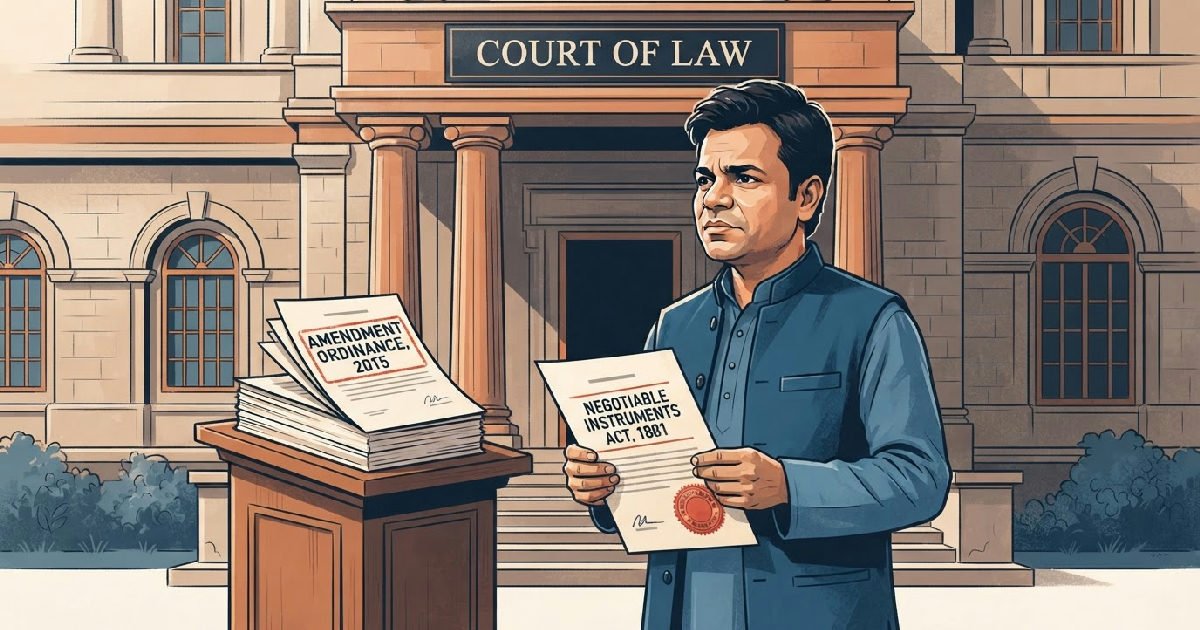
India’s legal landscape for the cheque bounce case underwent a significant transformation on 2015-06-15 with the promulgation of the Negotiable Instruments (Amendment) Ordinance. This pivotal change directly reshaped how and where complaints under Section 138 of the Negotiable Instruments Act, 1881, can be filed, impacting courts across the entire nation.
The amendment clarified that the territorial jurisdiction for such complaints now largely rests with the court overseeing the payee’s bank branch. This legislative intervention aimed to simplify proceedings and reduce complexities arising from multiple potential filing locations, a common issue in these financial disputes.
Cheque bounce complaint jurisdiction shifts
The Negotiable Instruments (Amendment) Ordinance, 2015, which took effect on June 15, 2015, marked a critical juncture for cheque dishonour cases. It introduced a clearer framework for determining the appropriate court for filing a complaint nationwide.
This ordinance was later solidified into law as the Negotiable Instruments (Amendment) Act, 2015, receiving presidential assent on December 26, 2015. Crucially, the Act was deemed to have come into force retrospectively from June 15, 2015, ensuring continuity and seamless transition in legal practice.
Overruling the Dashrath Rupsingh Rathod Precedent
Prior to this amendment, the Supreme Court’s 2014 ruling in Dashrath Rupsingh Rathod v. State of Maharashtra had declared that only the court where the cheque was dishonoured (i.e., the drawee bank’s location) held jurisdiction. This ruling created substantial difficulties for payees across India.
Many complainants found themselves having to travel to distant locations to pursue their cases, often far from where they had originally presented the cheque for payment. This practical challenge underscored the need for legislative action to rebalance the jurisdictional framework and ensure easier access to justice.
The previous interpretation often led to prolonged litigation and logistical nightmares for individuals and businesses trying to recover their dues. It made the legal process less accessible and more burdensome, particularly for those in remote areas or dealing with cheques drawn on banks far from their residence or business.
Section 142(2): The Core of the Jurisdictional Change
The 2015 amendment specifically inserted Section 142(2) into the Negotiable Instruments Act, 1881. This new section became the cornerstone of the updated jurisdictional rules, providing much-needed clarity for both complainants and defendants and streamlining the process.
Under this provision, if a payee presents a cheque through their own bank account, the complaint must be filed in the court where that bank branch is situated. This effectively shifts the primary locus of jurisdiction to the payee’s convenience, addressing previous grievances.
However, if the cheque is presented for payment otherwise than through an account, jurisdiction lies with the court where the drawee bank (the bank on which the cheque is drawn) is located. For cases involving multiple payees, the complaint can be filed in any court with jurisdiction over one of their respective bank branches.
Clarifying the Payee’s Bank Location
The insertion of Section 142(2) decisively established the payee’s bank branch as the primary determinant for territorial jurisdiction. This was a direct response to the complexities that arose under previous interpretations of the law and the Dashrath Rupsingh Rathod judgment.
This specific clarification streamlines the process for victims of cheque dishonour. It ensures they can pursue legal remedies closer to their own operations, rather than being forced to litigate in potentially distant jurisdictions across the country. It also curtails forum shopping by providing a clear, unambiguous rule.
Why the Jurisdictional Shift Became Imperative
The pre-2015 legal landscape was fraught with inconsistencies and practical difficulties for those seeking redress for cheque dishonour. Different High Courts had offered varied interpretations of where a complaint should be filed, leading to significant confusion and an increased judicial burden.
This ambiguity often resulted in preliminary legal battles over jurisdiction itself, delaying the substantive resolution of disputes. Litigants frequently spent considerable time and resources simply determining the correct forum, rather than focusing on the merits of their case.
The amendment sought to overcome these challenges by providing a uniform and predictable rule. It aimed to reduce the backlog in courts, minimise procedural complexities, and enhance the efficiency of the justice delivery system for cheque bounce cases nationwide.
Impact on Litigation Strategy
The legislative change fundamentally altered how legal practitioners approach filing a cheque bounce case. Lawyers must now meticulously verify the payee’s bank branch location to ensure correct jurisdiction, avoiding procedural setbacks.
For defendants, understanding this new framework became crucial for mounting an effective defense based on jurisdictional challenges. Early identification of an incorrectly filed complaint can save significant time and legal costs, shifting the burden back to the complainant.
Navigating Cheque Bounce Complaint Filed in the Wrong Court
The change in jurisdiction naturally raised questions about complaints already filed or those mistakenly lodged in the wrong court after the new law. The Supreme Court addressed some of these concerns in Bridge Stone India Pvt. Ltd. vs. Inderpal Singh (2015).
That ruling clarified that complaints filed prior to the 2015 ordinance would continue in their original courts. However, any complaints initiated after June 15, 2015, must strictly adhere to the new jurisdictional requirements set out in the amendment, preventing a retrospective application of the new rule to older cases.
| Jurisdiction Aspect | Pre-June 15, 2015 Rule | Post-June 15, 2015 Rule |
|---|---|---|
| Governing Authority | Dashrath Rupsingh Rathod (SC, 2014) | Negotiable Instruments (Amendment) Act, 2015 |
| Primary Jurisdiction (Account Presentment) | Drawee Bank Location | Payee’s Bank Branch Location |
| Complaints Filed Before Jun 15, 2015 | Continue in Original Court | Continue in Original Court |
| Complaints Filed After Jun 15, 2015 | Risk of Dismissal/Return | Must be in Payee’s Bank Branch Location |
Distinguishing Between Old and New Filings
The distinction between pre- and post-ordinance filings is crucial for legal practitioners. While older cases were grandfathered in, new cases had an immediate obligation to comply with the cheque bounce jurisdiction rules.
This cut-off date of June 15, 2015, acts as a clear dividing line for the applicability of the updated jurisdictional principles. Courts will consistently examine the filing date when assessing territorial jurisdiction, ensuring adherence to the legislative intent.
Should a complaint be filed in a court lacking territorial jurisdiction, that court typically returns the complaint to the complainant. This action, often taken under Order VII Rule 10 of the Civil Procedure Code, directs the complainant to present it to the proper court, rather than dismissing it outright.
This procedural safeguard allows for corrections without penalising complainants excessively, provided the limitation period for refiling has not expired. It maintains the right to legal recourse while enforcing proper jurisdictional adherence.
Strategic Defense: Challenging Jurisdiction Effectively
For an accused facing a cheque bounce complaint, challenging incorrect jurisdiction can be a powerful defense. However, timing is paramount for this strategy to be effective across the judicial system, as delays can waive crucial rights.
The accused should raise any objection regarding territorial jurisdiction at the earliest possible opportunity. This typically means bringing it up during the very first hearing of the case, rather than waiting for later stages when the court might deem the objection as an afterthought or dilatory tactic.
To substantiate such a claim, the accused must present compelling evidence. This includes documentation like the bank branch where the cheque was deposited and the dishonour memo, which clearly indicates the location of the transaction’s failure. Such evidence provides a factual basis for the jurisdictional challenge.
The Importance of Timely Objection
Delaying a jurisdictional objection can be detrimental to the accused, as courts might assume acceptance of jurisdiction if not challenged promptly. This principle aligns with broader legal doctrines preventing parties from raising objections at advanced stages of litigation.
The Supreme Court, in Yogesh Upadhyay & Anr. vs. Atlanta Ltd. (2019), discussed the complexities surrounding case transfers when multiple complaints are filed in different jurisdictions. This highlights the ongoing judicial effort to ensure cases are heard in the correct forum.
While the option to transfer a case exists under Section 406 of the CrPC, it often involves a more intricate legal battle than simply challenging jurisdiction at the outset. Therefore, prompt action remains the most prudent course for the defense, particularly for those considering quashing a complaint.
Broader Implications and Future Outlook
The 2015 amendment has brought a significant degree of predictability and clarity to cheque bounce litigation across India. By establishing a clear jurisdictional rule, it has reduced the scope for legal disputes over procedural matters, allowing courts to focus on the substantive issues.
This legislative move reflects a broader trend towards making legal processes more efficient and accessible for ordinary citizens and businesses. It’s a recognition that procedural hurdles can often undermine the pursuit of justice, particularly in high-volume areas like cheque dishonour cases.
While the law has largely settled the jurisdictional debate, legal interpretations will continue to evolve, especially concerning nuanced scenarios. Nevertheless, the foundation laid by the 2015 Act remains a critical benchmark for handling these financial disputes across India.
What was the main change introduced by the 2015 amendment regarding cheque bounce cases?
The 2015 amendment, through Section 142(2) of the Negotiable Instruments Act, 1881, primarily shifted the territorial jurisdiction for cheque bounce complaints. Instead of the location where the cheque was dishonoured, jurisdiction largely moved to the court overseeing the payee’s bank branch where the cheque was presented for payment.
How did the 2015 amendment overrule the Dashrath Rupsingh Rathod precedent?
Before the 2015 amendment, the Supreme Court’s ruling in Dashrath Rupsingh Rathod v. State of Maharashtra mandated that only the court where the cheque was dishonoured (drawee bank’s location) had jurisdiction. This caused significant inconvenience for payees. The amendment directly countered this by placing jurisdiction with the payee’s bank branch, making it easier for complainants.
What happens if a cheque bounce complaint is filed in the wrong court after June 15, 2015?
If a complaint was filed after June 15, 2015, in a court without proper territorial jurisdiction as per the new law, that court typically returns the complaint to the complainant. The complainant is then required to present it to the correct court, usually the one overseeing their bank branch where the cheque was presented.
Unsure which Delhi magistrate should have the 138 file? Call or Whatsapp for consultation.
Related: https://arpitmarwah.com/cheque-bounce-lawyers-in-delhi/