
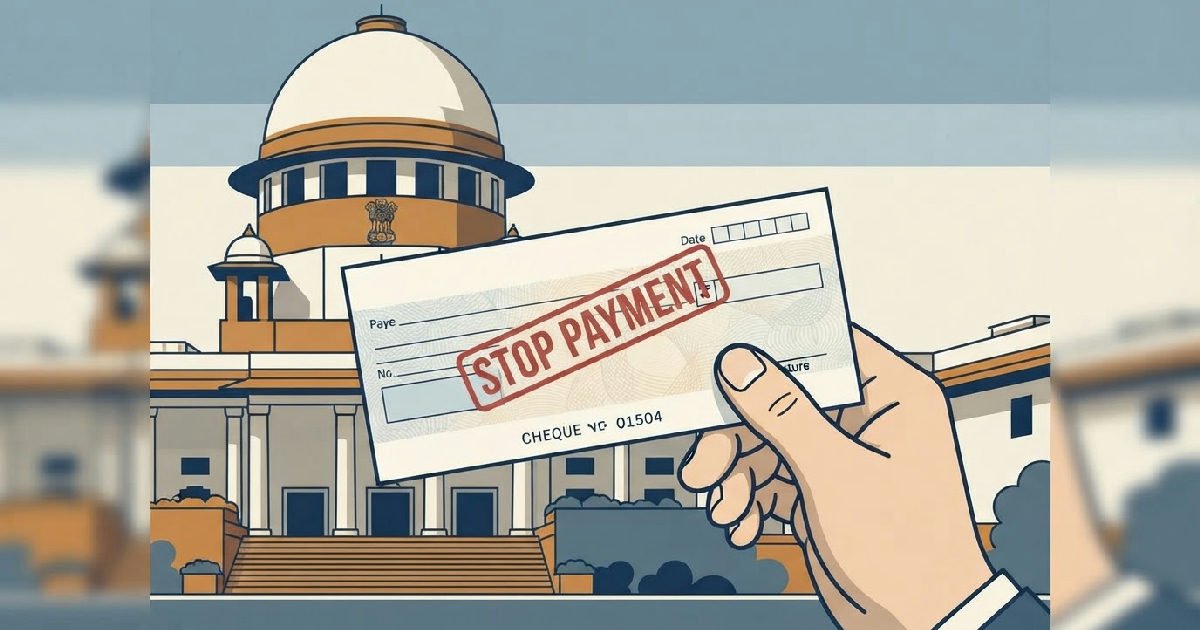
Supreme Court Affirms Liability for Stop Payment on a Cheque
Stopping payment on a cheque does not automatically negate the offense under Section 138 of the Negotiable Instruments Act, 1881, India’s Supreme Court has clarified.
This crucial stance means that simply stopping a cheque doesn’t absolve liability if the instrument was issued for a legally enforceable debt or obligation.
The judiciary’s position underlines a commitment to protecting creditors and maintaining trust in the cheque system. Crucially, the burden shifts to the drawer to prove a valid and justifiable reason for the stop payment. Without such proof, the legal implications of a dishonoured cheque can still apply, regardless of the stop payment instruction.
Upholding Cheque Credibility Through Judicial Precedent
The Supreme Court has long emphasized the need to preserve the credibility of cheques as a reliable mode of payment. Allowing drawers to escape liability simply by issuing a stop payment instruction would undermine this trust, potentially enabling individuals to defraud creditors with impunity.
A landmark ruling in this regard came in 1998 with Modi Cements Ltd. v. Kuchil Kumar Nandi. The Supreme Court overturned a High Court decision that had previously considered a stop payment instruction sufficient to negate the Section 138 offense.
This judgment firmly established that the reason for dishonour, even if stated as “payment stopped by drawer,” can still trigger legal action under Section 138 if the underlying debt is valid.
The Court reiterated this principle on March 21, 2002, in MMTC Ltd. v. Medchl Chemicals and Pharma (P) Ltd.. This ruling further solidified the view that a complaint under Section 138 is viable not only for insufficient funds but also when a drawer deliberately instructs to stop payment. These decisions collectively reinforce the legal framework designed to prevent the misuse of cheques.
Defining Conditions for Section 138 Applicability
For an offense under Section 138 of the Negotiable Instruments Act, 1881, to be established, several specific conditions must be met. These conditions ensure that legal proceedings are initiated only when the statutory requirements are strictly adhered to by the payee.
First, the cheque must originate from an account maintained by the drawer. Second, it must be for a legally enforceable debt or liability, whether in full or in part. Third, the cheque needs to be presented to the bank within three months of its issuance or within its period of validity, whichever comes first.
The bank must then return the cheque unpaid, citing reasons such as “insufficient funds,” “exceeds arrangements,” “payment stopped by drawer,” “account closed,” or “signature mismatch.” Subsequently, the payee or holder in due course must dispatch a written demand notice to the drawer. This notice must be sent within 30 days of receiving the bank’s information about the dishonour.
Finally, the drawer must fail to make the demanded payment within 15 days of receiving this notice. If payment isn’t made within this stipulated period, the offense is considered complete, paving the way for a criminal complaint.
Navigating Defenses: When Stop Payment is Justified
While a stop payment instruction doesn’t automatically shield a drawer from Section 138 liability, legitimate defenses do exist. The onus is on the drawer to rebut the presumption that the cheque was issued for a legally enforceable debt.
A drawer can escape liability by demonstrating that the stop payment was for valid reasons. These include situations where the cheque was lost or stolen, the liability it represented was already discharged, or a genuine dispute existed regarding goods or services. For instance, if a cheque was given as security and the underlying transaction never materialized, this could serve as a defense.
Proving that sufficient funds were available in the account at the time of presentation, and the stop payment was issued for a genuine reason, can also be a strong defense.
The Karnataka High Court notably ruled in March 2026 that Section 138 proceedings cannot continue if the dishonour resulted from a “blocked” or “debit-frozen” account due to external criminal investigations. This particular scenario meant the dishonour wasn’t due to the drawer’s intent or insufficient funds, but an external, involuntary block.
Other viable defenses include challenging the legal notice itself. For example, if the notice was sent late, to an incorrect address, or demanded an inaccurate amount, it could invalidate the proceedings. Moreover, proving that no legally enforceable debt existed at the time of the cheque’s presentation is a fundamental defense against a Section 138 charge.
Procedural Milestones for Payees and Associated Penalties
For a payee, the process following a cheque dishonour, even due to a stop payment, is clearly delineated. The bank’s return memo serves as the trigger, starting the 30-day clock for the payee to issue a statutory demand notice to the drawer.
This legal notice is critically important; it must precisely demand the exact cheque amount. Even minor discrepancies in the demanded sum can invalidate the notice, potentially derailing the entire legal process. Once the drawer receives this notice, they have a 15-day window to make the payment. If the payment isn’t made within this timeframe, the Section 138 offense is deemed to have occurred.
Following the expiry of this 15-day period, the payee then has another 30 days to file a criminal complaint before a Magistrate. Swift action is often key, as delays can impact the case’s viability.
If found guilty under Section 138, a person faces severe penalties, including imprisonment for up to two years, a fine that can be twice the cheque amount, or both. These offenses are, however, compoundable, meaning there’s scope for settlement between parties even after legal proceedings have begun.
Landmark Judgments Shaping Cheque Dishonour Law
The interpretation and application of Section 138 of the Negotiable Instruments Act have been refined over decades by numerous significant rulings from the Supreme Court of India. These judgments have provided critical clarity on various facets of cheque dishonour cases.
| Case Name | Date of Ruling | Key Clarification |
|---|---|---|
| Modi Cements Ltd. v. Kuchil Kumar Nandi | March 2, 1998 | Stop payment doesn’t negate Section 138 offense if debt exists. |
| MMTC Ltd. v. Medchl Chemicals and Pharma (P) Ltd. | March 21, 2002 | Section 138 applies to “stop payment” instructions. |
| P. Mohanraj v. M/s. Shah Brothers Ispat Pvt. Ltd. | March 1, 2021 | Section 138 proceedings against corporate debtors under IBC moratorium. |
| Messrs. Gimpex Private Limited v. Manoj Goel | October 8, 2021 | No two simultaneous Section 138 proceedings for same transaction. |
| Dashrathbhai Trikambhai Patel v. Hitesh Mahenrabhai Patel | January 5, 2023 | Dishonoured cheque must represent a “legally enforceable debt.” |
These rulings collectively underscore the judiciary’s consistent effort to strengthen the enforceability of cheques and penalize dishonest intent. The Modi Cements and MMTC Ltd. cases, in particular, were instrumental in establishing that stop payment alone is not a valid defense where a genuine debt exists.
More recent judgments have addressed nuanced situations. For instance, in P. Mohanraj v. M/s. Shah Brothers Ispat Pvt. Ltd., the Supreme Court clarified the interplay between Section 138 and the Insolvency and Bankruptcy Code (IBC). While proceedings against a corporate debtor might be subject to a moratorium, directors and officers retain personal liability, ensuring accountability isn’t entirely sidestepped.
Similarly, the ruling in Messrs. Gimpex Private Limited v. Manoj Goel prevented the harassment of drawers through multiple, simultaneous complaints for the same underlying transaction. The Dashrathbhai Trikambhai Patel case reaffirmed a fundamental principle: the debt must be legally enforceable at the time of presentation, not merely an outstanding amount. These decisions collectively paint a comprehensive picture of the legal landscape surrounding cheque dishonour.
Broader Implications for Commercial Transactions
The consistent judicial interpretation of Section 138, particularly concerning stop payment instructions, has significant implications across the commercial landscape. It reinforces the notion that cheques are more than just pieces of paper; they are promises to pay, backed by legal recourse. This steadfastness helps maintain confidence in the financial system.
For businesses, this means greater assurance when accepting cheques as payment. It discourages unscrupulous practices where drawers might issue cheques without genuine intent to honor them, only to later instruct a stop payment. Creditors, therefore, have a clearer path to justice and compensation when faced with such situations.
Conversely, drawers must exercise extreme caution and diligence when issuing cheques. The “stop payment” option, while a legitimate banking service, is not a get-out-of-jail-free card for avoiding valid debts. Any instruction to stop payment must be backed by concrete and legally defensible reasons.
This judicial clarity aims to balance the protection of payees with the rights of drawers, ensuring fairness while upholding the sanctity of commercial contracts.
The stringent conditions and potential penalties under Section 138 serve as a powerful deterrent. They encourage parties to honour their financial commitments, fostering a more reliable environment for transactions. The legal framework ensures that victims of cheque dishonour receive adequate compensation, rather than solely focusing on punishing the offender, which underpins the corrective nature of the Act.
Due Diligence and Legal Recourse: A Prudent Approach
Given the complexities of Section 138 and the nuances surrounding stop payment instructions, both payees and drawers must exercise considerable due diligence. Payees, upon receiving a dishonoured cheque, must ensure their demand notice is precise and delivered within the stipulated timeframe. This legal step is a critical prerequisite for any subsequent action.
Drawers, on the other hand, should never use a stop payment instruction lightly. If a dispute arises or a cheque needs to be stopped, it’s crucial to document the valid reasons meticulously. These reasons could range from a lost cheque to a fundamental breach of contract that negates the underlying debt.
Without verifiable justification, a stop payment can inadvertently strengthen the payee’s case under Section 138.
Seeking legal counsel early can often prevent costly and time-consuming litigation. A lawyer can advise on the validity of a defense, the correctness of a demand notice, or the best course of action when faced with a cheque dishonour situation. Understanding the legal framework, as clarified by the Supreme Court, is paramount for anyone involved in cheque-based transactions.
The overarching objective of the Negotiable Instruments Act is to foster trust in financial instruments. These judicial pronouncements serve as constant reminders that while cheques offer convenience, they carry significant legal weight. Adherence to legal and ethical practices benefits all parties involved in commercial dealings.
Can I stop payment on a cheque and avoid Section 138 charges?
No, simply stopping payment on a cheque does not automatically exempt you from charges under Section 138 of the Negotiable Instruments Act, 1881. If the cheque was issued to discharge a legally enforceable debt, the Supreme Court has consistently held that you can still be liable. The burden will be on you to prove a valid reason for the stop payment.
What are some valid defenses if I stop payment on a cheque?
Valid defenses against Section 138 charges after a stop payment include proving the cheque was lost or stolen, the debt was already paid, or there was a genuine dispute over goods or services that negates the underlying liability. You might also argue that there were sufficient funds, and the stop payment was for a legitimate reason, or that the account was blocked by external investigations.
What is the timeline for legal action after a cheque stop payment?
After a cheque is returned with a “payment stopped by drawer” memo, the payee has 30 days to send a demand notice. If the drawer fails to pay within 15 days of receiving this notice, the payee then has another 30 days to file a criminal complaint before a Magistrate. Adhering to these timelines is crucial for the legal process.
Memo says stop payment? Call or Whatsapp for free consultation.
Related: https://arpitmarwah.com/cheque-bounce-lawyers-in-delhi/