
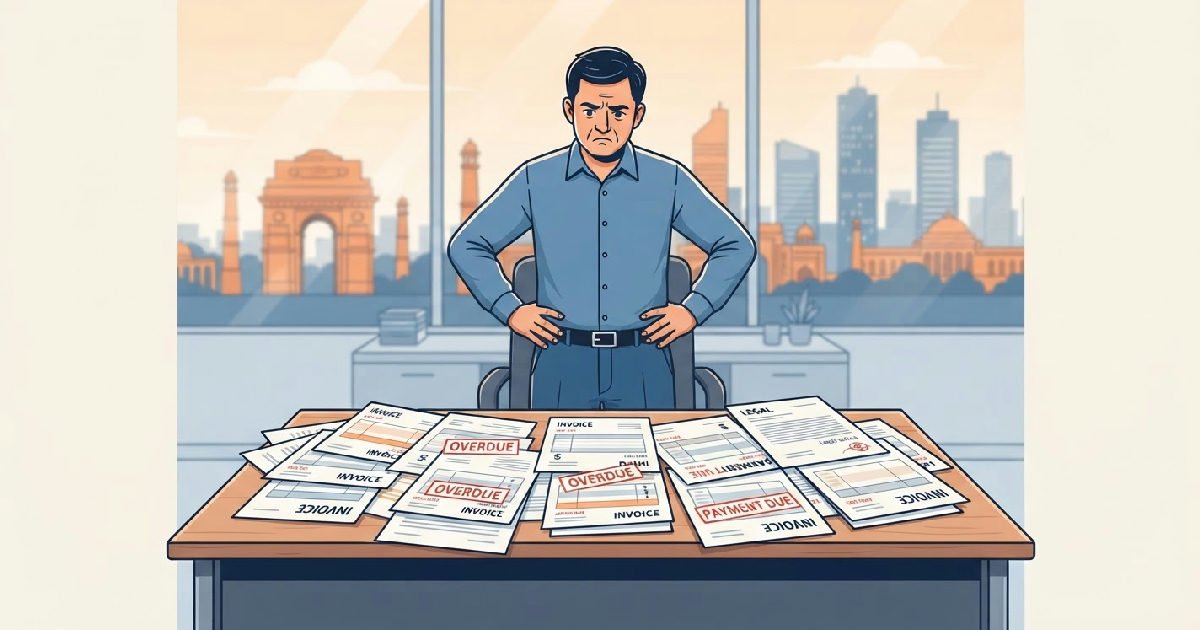
Companies in Delhi are increasingly facing the arduous task of recovering unpaid invoices, a persistent issue where services are rendered or goods supplied, but payment remains elusive. Delaying decisive action, often by relying on polite reminders for months, can significantly weaken a company’s legal position and complicate the recovery process, and this delay is a significant Delhi firms risk.
Understanding how to recover unpaid invoices can greatly enhance your business’s cash flow and overall stability.
It is crucial to learn how to recover unpaid invoices effectively, especially in a competitive environment.
The key to successfully reclaiming these commercial dues lies in strategically choosing the correct legal approach and acting promptly. This approach is vital for businesses looking to recover money from another company in the capital.
Businesses must strategize on how to recover unpaid invoices to maintain their financial health.
How to recover unpaid invoices for Delhi firms
Effective methods on how to recover unpaid invoices can significantly reduce financial strain.
The landscape of commercial transactions in Delhi frequently presents the challenge of outstanding payments, forcing businesses to consider legal avenues. Addressing these financial impasses requires a methodical approach, starting long before formal litigation commences.
Companies often underestimate the power of thorough preparation in these scenarios. Such a systematic approach is crucial to avoid avoidable legal errors that can undermine recovery efforts.
Knowing how to recover unpaid invoices is essential for any business facing cash flow issues.
This methodical approach involves a clear understanding of the debtor’s payment history, the contractual obligations, and the specific circumstances surrounding the non-payment. Such preliminary analysis allows businesses to tailor their recovery strategy.
Companies that understand how to recover unpaid invoices can avoid lengthy litigation processes.
Failing to act on how to recover unpaid invoices can lead to missed opportunities for recovery.
Understanding the nuances of how to recover unpaid invoices is vital for any firm.
This ensures resources are allocated effectively and actions are taken with maximum impact. It also helps in identifying potential weaknesses within a company’s own documentation processes.
Learning how to recover unpaid invoices can empower businesses to take necessary legal actions.
Mastering how to recover unpaid invoices is a key skill for financial managers.
Effective strategies on how to recover unpaid invoices can simplify the debt collection process.
Incorporating tactics on how to recover unpaid invoices can enhance your negotiation stance.
Documentation is key when discussing how to recover unpaid invoices effectively.
Understanding your rights on how to recover unpaid invoices can protect your business interests.
Properly executed methods on how to recover unpaid invoices can lead to timely payments.
Knowing how to recover unpaid invoices should be part of every business’s strategy.
Being proactive about how to recover unpaid invoices can prevent future issues.
Implementing a structured approach on how to recover unpaid invoices improves recovery rates.
Learning about how to recover unpaid invoices can save time and resources.
Training staff on how to recover unpaid invoices can enhance the overall effectiveness of recovery efforts.
Every business should have a clear plan on how to recover unpaid invoices.
By adopting a structured process for invoice follow-up and debt collection, businesses can significantly improve their recovery rates. This process typically includes staged communications, from friendly reminders to formal legal notices.
Understanding how to recover unpaid invoices effectively is crucial for the financial health of any business.
Each communication is designed to elicit a response while simultaneously building a robust legal case. Early intervention and consistency prove key to preventing minor delays from escalating into major commercial disputes.
The Cost of Delaying Legal Action
Many firms find themselves in a weaker position because they postpone legal action, hoping for an amicable resolution. This delay can provide the non-paying entity ample time to alter its narrative or financial situation, complicating eventual recovery efforts.
It’s a strategic misstep that can prove costly for businesses. Prompt engagement is therefore essential to preserve the strength of any potential claim.
Utilizing technology can assist in how to recover unpaid invoices more efficiently.
Consideration of external help on how to recover unpaid invoices could be beneficial.
Reviewing previous cases of how to recover unpaid invoices can provide valuable insights.
Networking with other businesses may offer tips on how to recover unpaid invoices effectively.
The longer a company waits, the more difficult it becomes to enforce its rights, potentially pushing claims beyond crucial limitation periods. This emphasizes why prompt and informed action is not merely beneficial, but often essential for securing due payments.
Consulting with industry experts on how to recover unpaid invoices can be invaluable.
Each step in the process of how to recover unpaid invoices should be documented.
Businesses shouldn’t rely solely on goodwill when facing unpaid commercial dues. Doing so frequently leads to situations where legal recourse becomes significantly harder.
Understanding local laws can affect how to recover unpaid invoices successfully.
Maintaining a professional demeanor is essential when discussing how to recover unpaid invoices.
Regular checks on payment status can improve how to recover unpaid invoices.
Assessing potential risks in how to recover unpaid invoices can save time.
Efficient communication is vital for understanding how to recover unpaid invoices.
Foundational Document Preparation
Successful recovery cases hinge almost entirely on robust documentation, not verbal assurances or prolonged informal follow-ups. Before contemplating any legal notice, businesses must meticulously compile a comprehensive set of records.
These documents form the bedrock of any future claim. Without them, even a strong case for payment can be difficult to prove in court.
Key records include the original contract, purchase order, or work order, alongside all relevant invoices and proof of delivery or service completion. Any written communication, such as emails or letters acknowledging the work or outstanding debts, also holds significant evidential weight.
Maintaining precise account statements and retaining copies of any payment advice or dishonoured cheques are equally vital for a strong case. Recovery proceedings rely heavily on a verifiable paper trail.
Essential Steps for Effective Debt Collection
Once essential documentation is in order, the path to recovering unpaid commercial dues in Delhi follows a series of structured and increasingly formal steps. These stages are designed to escalate the demand for payment while preserving a clear legal trail.
Each deliberate step serves to formalize the outstanding debt. This methodical escalation is critical for building a strong legal position.
The progressive nature of these steps ensures that the debtor is given ample opportunity to rectify the situation before more drastic measures are taken. This structured escalation also helps businesses demonstrate their good faith.
Adherence to proper procedures can be advantageous should the matter proceed to court. Every communication and action taken during these stages becomes a vital part of the overall evidence.
Moreover, this systematic approach allows businesses to track the debtor’s responses and adjust their strategy accordingly. It moves beyond informal requests, establishing a formal record of attempts to recover the debt.
This formalization not only increases the pressure on the debtor but also strengthens the creditor’s position. Meticulously documenting non-payment and resolution efforts is key.
Crafting a Firm Written Demand
After a brief period of polite reminders, a business must transition to a firm, written demand for payment. This communication should be professional in tone, avoiding any emotional language or threats.
It must explicitly detail the exact amount owed. Clarity here is paramount to establishing the demand’s legal standing and intent.
The demand letter must specify the exact unpaid amount, precisely identify the invoices against which the sum is due, and state the original payment deadline. Crucially, it must clearly articulate that legal action will ensue if payment is not received by a stated date.
This written communication serves as a formal warning. It clearly outlines the consequences of continued non-payment.
Issuing a Formal Legal Notice
Should the debtor company fail to respond satisfactorily to the written demand, the next critical step involves issuing a formal legal notice. In many commercial disputes, a well-structured legal notice itself can often prompt a settlement, avoiding protracted court battles.
It signals a serious intent to pursue the matter legally. This formal communication often proves a pivotal moment in the recovery process.
The legal notice should not only demand the principal outstanding amount but also, where legally justifiable, include claims for accrued interest and the costs incurred in pursuing the debt. This adds further pressure on the defaulting party to resolve the issue swiftly.
A qualified solicitor typically drafts this critical document. Its professional presentation reinforces the seriousness of the creditor’s intent.
Choosing the Right Legal Recourse in Delhi
Identifying the most appropriate legal route is paramount for successful recovery, as the specific facts of each case dictate the optimal strategy. Opting for the wrong legal channel can lead to significant delays and wasted resources for the claimant company.
This initial decision heavily influences the eventual outcome of any recovery effort. It’s a critical juncture in the debt collection process.
A thorough assessment involves considering the nature of the debt, the existence of any formal agreements, and the debtor’s financial standing. For instance, a simple contractual dispute might warrant a civil recovery suit.
Conversely, the presence of a dishonoured cheque introduces the possibility of more stringent action. Each legal path has distinct requirements and potential outcomes that must be carefully evaluated.
Incorrectly choosing the legal pathway can result in the rejection of a case on technical grounds or its transfer between different courts, consuming valuable time and increasing legal costs. This can severely impact a company’s cash flow.
Exploring various options on how to recover unpaid invoices can yield better results.
Therefore, seeking expert legal advice at this juncture is not just beneficial but often essential. This ensures the chosen strategy aligns perfectly with the case specifics, maximizing chances for a swift and favourable resolution.
Understanding the available legal options is paramount for businesses across India seeking to recover outstanding funds.
Commercial and Civil Recovery Suits
When an outstanding debt arises primarily from invoices and a contractual agreement, and no cheque is involved, a commercial or civil recovery suit is the standard course of action. These cases are fundamental for asserting a company’s right to payment based on fulfilled obligations.
They form the backbone of many debt recovery efforts. Such suits are initiated when all other avenues have been exhausted.
Understanding the market can help in addressing how to recover unpaid invoices.
For disputes classified as commercial, these suits can be filed specifically before a Commercial Court. Understanding this distinction is vital for businesses in Delhi.
The Commercial Court provides a dedicated forum for resolving business-related financial disagreements efficiently. This streamlines the legal process for companies.
Navigating Cheque Bounce Cases (Section 138)
Being aware of the limitations in how to recover unpaid invoices is crucial for success.
If the debtor company has issued a cheque that subsequently bounced or was dishonoured, Section 138 provides a specific and often potent legal recourse. This avenue is available when a financial instrument intended for payment fails.
It offers a strong mechanism for creditors to pursue payment. The dishonour of a cheque initiates a distinct legal pathway.
A cheque bounce case can be pursued concurrently with a civil recovery suit, allowing companies to exert significant pressure for payment. This dual-pronged approach can significantly accelerate the recovery process.
Strategic planning can enhance your approach on how to recover unpaid invoices.
It’s a powerful tool in a company’s arsenal when dealing with outstanding commercial dues. This strategy maximizes the chances of securing a favourable outcome.
Arbitration as a Contractual Solution
Arbitration presents an alternative dispute resolution mechanism, but its applicability is strictly limited. It applies only where the contract between the parties explicitly contains a valid arbitration clause.
This clause mandates that disputes be settled outside conventional court proceedings. It offers a private, often faster, resolution process compared to traditional litigation.
Engaging in arbitration can be advantageous for businesses seeking a more confidential and potentially quicker resolution compared to court litigation. However, if no such clause exists in the underlying agreement, this route is simply unavailable.
Therefore, reviewing contractual terms is a critical preliminary step for selecting the correct legal path. This initial check prevents wasted effort and ensures the chosen method is viable.
| Legal Route | Primary Condition for Use | Key Documents for Applicability |
|---|---|---|
| Commercial/Civil Recovery Suit | Primary claim based on invoices and a contract; no cheque involved | Contract, purchase order, invoices, delivery/completion proof, account statements, written communications |
| Cheque Bounce Case (Section 138) | Cheque issued by debtor and subsequently dishonoured | Dishonoured cheque |
| Arbitration | Contract between parties contains a valid arbitration clause | Contract with valid arbitration clause |
Critical Jurisdictional Considerations
A common and costly error for businesses pursuing debt recovery in Delhi is filing their case in the wrong court. Incorrect jurisdiction can lead to months, if not years, of procedural delays and the eventual dismissal of the suit.
This highlights the critical importance of precise legal due diligence. Such oversights can severely hinder the debt recovery process.
Such delays not only prolong the recovery process but also incur additional legal fees and administrative burdens for the claimant company. A case dismissed due to jurisdictional issues requires refiling in the correct forum.
This effectively restarts the entire process, further deferring any potential settlement or judgment. Such setbacks can severely impact a company’s financial liquidity and planning.
Ensuring proper jurisdiction from the outset involves careful analysis of the contract’s terms and the geographical touchpoints of the transaction. This meticulous verification helps prevent procedural setbacks.
It ensures the legal process proceeds without unnecessary interruptions. Foundational legal knowledge is as crucial as the substance of the claim itself for a successful outcome.
Defining Proper Court Venue
The appropriate court, or jurisdiction, depends on several factors that must be thoroughly evaluated before filing any legal action. These include the specific terms outlined in the contract between the parties, particularly any clauses designating a forum for dispute resolution.
Contractual stipulations regarding jurisdiction often override general principles. This makes precise review of agreements indispensable.
Further factors determining jurisdiction are the physical location where the work was performed, the designated place of payment for the services or goods, and sometimes even the location of the bank involved in the transaction.
Meticulous verification of these points can prevent significant procedural setbacks. Consulting legal counsel is often essential to navigate these complexities effectively.
Proactive Measures for Businesses
Beyond the formal legal steps, companies in Delhi can adopt several proactive strategies to mitigate risks associated with unpaid invoices. These measures also strengthen their position should disputes arise.
Such foresight emphasizes prevention and a pragmatic business approach. Implementing these strategies early can save substantial future costs.
Implementing robust credit management policies, including thorough background checks on new clients and clearly defined payment terms in all contracts, forms the bedrock of a preventative strategy. These steps help to identify potential high-risk clients early on.
They also establish unambiguous expectations regarding financial obligations. This proactive approach significantly reduces the likelihood of future payment defaults for companies.
Regularly reviewing and updating these policies ensures they remain effective in a dynamic business environment. Maintaining open communication with clients regarding their payment status, even before invoices become overdue, can also preemptively address issues.
This approach fosters a healthier financial relationship. It effectively minimizes the need for escalating situations to formal recovery actions.
Pausing Further Supply to Non-Payers
A critical practical consideration is whether to continue supplying goods or services to a company that has already defaulted on payments. Continuing work without securing new terms or guarantees often exacerbates the financial loss incurred.
Businesses must carefully review their contracts and decide whether to halt further provisions immediately. This decision protects against accumulating additional unrecoverable debt.
Understanding Limitation Periods
All commercial recovery claims are subject to strict limitation periods, which define the maximum time frame within which legal action can be initiated. Waiting too long to act can invalidate an otherwise strong case, irrespective of the claim’s merit.
This makes timely intervention crucial for businesses. Failing to observe these deadlines can lead to the loss of an otherwise valid claim.
Delaying action significantly reduces the probability of actual money recovery, even if a legal judgment is eventually secured. Therefore, companies must be acutely aware of these statutory deadlines to avoid forfeiting their right to seek redress.
The need for prompt action is crucial for claimants, highlighting the importance of understanding limitation period exclusion in recovery suits.
Strategic Advice for Successful Recoveries
Navigating the complexities of unpaid invoices requires more than just legal knowledge; it demands strategic business acumen and a disciplined approach to documentation. Companies that master these elements significantly enhance their chances of recovering outstanding commercial dues.
These insights move beyond mere procedural compliance. They form a comprehensive strategy for financial protection.
Strategic business acumen involves understanding the commercial implications of various recovery options. It means weighing the costs of litigation against the potential for settlement, and preserving client relationships where possible.
Approaching debt recovery not just as a legal problem but as a business challenge requires calculated decisions. These decisions protect both financial assets and long-term interests.
A disciplined approach to documentation, on the other hand, ensures that every aspect of the transaction and subsequent communication is recorded and easily accessible. This thoroughness is invaluable when presenting a case.
It demonstrates consistency and helps counter any claims made by the debtor. This process underpins the entire recovery, turning informal agreements into legally defensible positions.
Beyond Verbal Agreements
Relying solely on informal relationships or verbal assurances for payment follow-ups is a common pitfall. It undermines a company’s ability to recover debts effectively.
Every significant communication, particularly concerning payment terms, acknowledgements of debt, or dispute resolution, should be meticulously documented in writing. These written records provide undeniable proof.
Avoiding Weak Settlements
In the rush to “close the file” on an outstanding invoice, some companies may be tempted to accept weak settlement offers that do not adequately cover their losses. It is crucial to seek professional legal advice before agreeing to any settlement that feels insufficient.
A quick resolution might not be the best one for a company’s long-term financial health. Strategic negotiation is often more beneficial.
A thorough assessment of the claim’s strength and the potential for full recovery should guide settlement negotiations. This process requires persistence, backed by sound legal counsel.
Companies should not undervalue their claims or settle for less than what’s just, especially given how contract drafting errors can already incur significant costs.
What is the most crucial first step when an invoice remains unpaid?
The most crucial first step is to gather and organize all relevant documentation immediately. This includes contracts, purchase orders, invoices, and any communication regarding the debt. A strong paper trail is fundamental before escalating the issue.
Can I pursue both a cheque bounce case and a recovery suit simultaneously?
Yes, if a cheque issued by the debtor was dishonoured, you can pursue a cheque bounce case under Section 138 concurrently with a commercial or civil recovery suit. This dual approach can exert significant pressure for payment.
How long do I have to initiate legal action for an unpaid invoice?
Most commercial recovery claims are subject to a limitation period. Acting promptly before this period expires is critical to prevent your claim from becoming legally unenforceable. The research does not specify a duration for this period.
Learn how to recover unpaid invoices from another company. WhatsApp or call for a free consultation.
Related Service: Commercial Law