
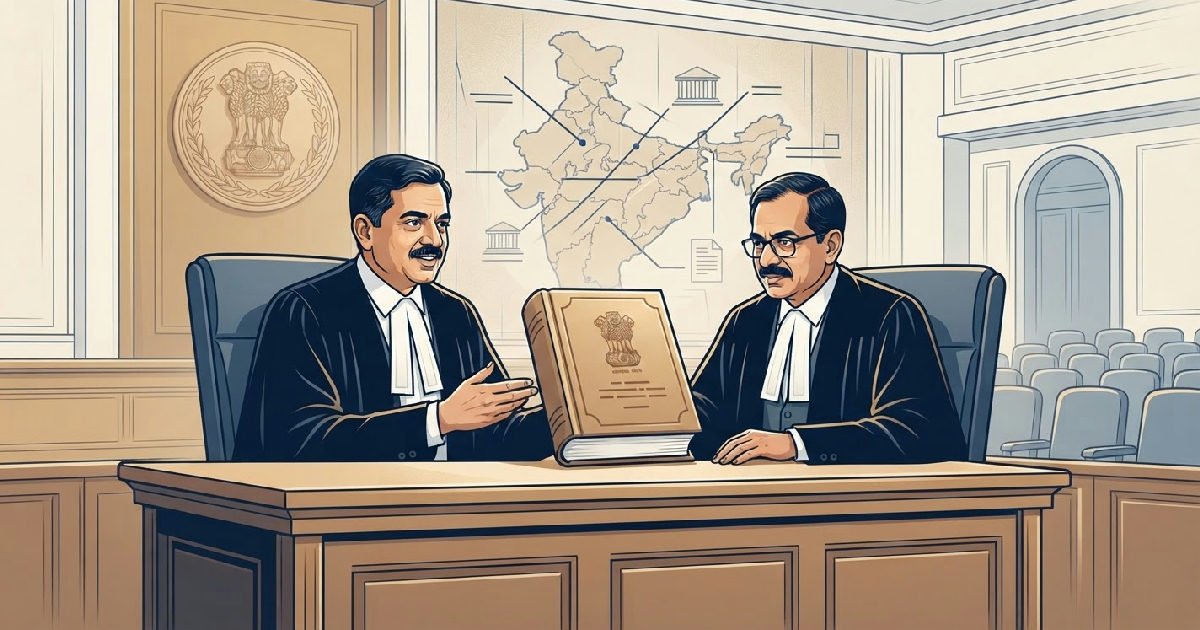
In a significant ruling on February 6, 2019, the Supreme Court of India clarified the interpretation of Section 17 CPC (Code of Civil Procedure), 1908. A Division Bench, comprising Justices Ashok Bhushan and K.M. Joseph, determined that the term “property” within this section can encompass more than a single piece of real estate.
This decision allows lawsuits involving multiple properties situated in different judicial areas to be initiated in any court possessing jurisdiction over at least one of those properties.
Defining territorial jurisdiction for immovable property
The landmark judgment, delivered in the case of Shivnarayan (Dead) By Legal Representatives v. Maniklal (Dead) Through Legal Representatives And Others, effectively broadened the application of Section 17. Critically, this expanded scope is contingent on one essential condition: the suit must arise from the same cause of action for all the properties involved.
This nuanced interpretation continues to shape civil litigation concerning immovable assets across India.
Section 16 of the CPC generally dictates that legal actions concerning immovable property, such as those for recovery or partition, must be filed in the court where the property is located. This principle establishes the physical location, or situs, of the property as the primary determinant for jurisdiction in property disputes.
However, Section 17 of the CPC has always provided an exception to this general rule. It allows a suit to be filed in any court having jurisdiction over a portion of a property if that single property is spread across different judicial territories. The Supreme Court’s ruling clarified this exception applies more broadly than previously understood.
The Court observed that the singular word “property” in Section 17 can also be read in the plural as “properties.” This interpretation was bolstered by referencing Section 13 of the General Clauses Act, 1897, which allows for such linguistic flexibility in legal texts.
The Shivnarayan v. Maniklal legal journey
The case that led to this pivotal Supreme Court decision originated from a civil suit. The appellant sought the partition of joint family properties and the annulment of specific conveyance documents. The plaintiff had initially filed the suit in a civil court in Indore, Madhya Pradesh.
However, the plaint included properties not only in Indore but also in Mumbai, Maharashtra. The trial court in Indore struck down the Mumbai properties from the suit. It cited a lack of territorial jurisdiction, maintaining that the Indore court couldn’t preside over assets outside its geographical remit.
This decision was subsequently challenged in the Madhya Pradesh High Court, which upheld the trial court’s finding. The High Court specifically ruled that Section 17 of the CPC could not be applied to scenarios involving multiple distinct properties located in different jurisdictions. It confined its scope to portions of a single, indivisible property.
This earlier ruling reflected a more conservative interpretation of the law, highlighting the complexities inherent in jurisdictional matters.
Supreme Court’s expanded interpretation of Section 17 CPC
The Supreme Court, in overturning the High Court’s decision on the interpretation of Section 17, provided a more expansive view. The bench explicitly stated: “The word “property” under Section 17 of the Civil Procedure code may also be properties, hence, in a schedule of plaint, more than one property…” This statement underscores the intention to broaden the section’s applicability.
The Court further elaborated that “Section 17 can be applied in event there are several properties, one or more of which may be located in different jurisdiction of courts.” This means that even when dealing with entirely separate properties, a plaintiff can choose a single forum if the overarching legal grievance remains the same.
They noted, “We are also of the same view that the word “property” used in Section 17 can be more than one property or properties,” reinforcing their stance.
This ruling effectively harmonizes the jurisdictional complexities that arise when family assets or business holdings span across state lines or multiple judicial districts. It aims to prevent the necessity of filing multiple, potentially conflicting, lawsuits in various courts for a unified dispute. The Court’s reasoning was also fortified by Section 39(1)(c) of the CPC.
This section indicates that a decree passed by a court can indeed deal with immovable properties situated outside its immediate jurisdiction.
The crucial ‘same cause of action’ rider
Despite the broader interpretation of “property,” the Supreme Court introduced a critical caveat. The suit must be based on the same cause of action for all the properties involved. This condition acts as a safeguard against forum shopping, ensuring that the consolidation of suits is genuinely warranted by the nature of the dispute.
In the original Shivnarayan v. Maniklal case, this rider proved decisive. The Supreme Court ultimately dismissed the plaintiff’s appeal. This was because it found that the causes of action relating to the Indore property and the Mumbai property were “entirely different with different set of defendants.”
This meant the specific facts of the case didn’t meet the newly clarified condition for applying Section 17 CPC. The bench concluded that “The suit as framed with regard to Bombay property was clearly not maintainable in the Indore Courts,” thus affirming the High Court and trial court’s outcome, albeit for different legal reasons.
Litigants often grapple with these nuances, making clear rules for jurisdictional applicability crucial for fair and efficient justice.
Impact and implications for property litigation
This judgment has far-reaching implications for individuals and entities involved in property disputes across India. It offers a streamlined approach for litigants who might otherwise face the daunting prospect of initiating separate legal proceedings in different jurisdictions for related properties. This can lead to significant savings in time, legal costs, and effort.
The ruling encourages a more holistic view of property disputes, especially in cases involving ancestral properties, business assets, or complex contractual agreements that span multiple regions. Lawyers now need to carefully assess whether the “same cause of action” criterion is met before advising clients on the appropriate forum for their suits.
For courts, it means potentially handling more complex cases involving properties in various locations, requiring robust case management. This shift can reduce the burden on individual courts by centralizing related disputes. It also demands a consistent application of the “same cause of action” principle to avoid jurisdictional ambiguities.
The decision reinforces the judiciary’s ongoing effort to adapt procedural laws to modern realities, where property ownership and economic activities are rarely confined to a single geographical area. It aims to enhance access to justice by making the litigation process more efficient and less fragmented.
Judicial figures behind the verdict
The Division Bench that delivered this significant judgment consisted of two eminent jurists: Justice Ashok Bhushan and Justice K.M. Joseph. Both judges have distinguished careers marked by pivotal contributions to Indian jurisprudence, influencing many key rulings during their time on the bench.
Justice Ashok Bhushan, born on July 5, 1956, in Jaunpur district, Uttar Pradesh, obtained his law degree from Allahabad University in 1979. He enrolled with the Bar Council of Uttar Pradesh on April 6, 1979, and practiced civil and original side matters at the Allahabad High Court.
Justice Bhushan served as standing counsel for institutions like Allahabad University and the State Mineral Development Corporation Limited. He was also the senior vice-president of the Allahabad High Court Bar Association.
He was elevated as a permanent judge of the Allahabad High Court on April 24, 2001, and then appointed as a judge of the Kerala High Court on July 10, 2014. He became acting Chief Justice on August 1, 2014, and Chief Justice on March 26, 2015.
Justice Bhushan was elevated to the Supreme Court of India on May 13, 2016, and retired in July 2021. After his retirement from the Supreme Court, he was appointed as the Chairperson of the National Company Law Appellate Tribunal (NCLAT) in November 2021, a position he held for four years.
He is known for authoring high-volume, lengthy judgments, meticulously detailing submissions.
Justice K.M. Joseph, born on June 17, 1958, in Kochi, Kerala, comes from a distinguished legal lineage; his father, K. K. Mathew, was a Supreme Court judge and chairman of the tenth Law Commission. He completed his law degree from Government Law College, Ernakulam, and enrolled as an Advocate in Delhi on January 12, 1982.
He later shifted his practice to the High Court of Kerala in 1983, specializing in civil and constitutional matters.
Justice Joseph was appointed as a permanent judge of the Kerala High Court on October 14, 2004. He became the Chief Justice of the Uttarakhand High Court on July 31, 2014. As Chief Justice of the Uttarakhand High Court, he notably quashed the imposition of President’s Rule in the state in 2016.
He was elevated as a Judge of the Supreme Court of India on August 7, 2018, and retired on June 16, 2023.
Broader context and related precedents
This Supreme Court judgment builds upon and clarifies previous judicial interpretations regarding Section 17 CPC. Prior to this ruling, the application of Section 17 was often narrowly construed, leading to considerable debate and varying decisions across different High Courts.
For instance, a civil petition decided by the Calcutta High Court on February 12, 2018, by a Single Judge Bench comprising Sanjib Banerjee, J., had also touched upon this area.
The Calcutta High Court held that if the cause of action didn’t necessitate multiple suits, a plaintiff could invoke the jurisdiction of any court where one of the properties was situated. That court could then issue an injunction covering properties beyond its immediate territorial jurisdiction.
In that specific Calcutta High Court case, an injunction was initially granted for properties in Schedule A and B. However, it was denied for Schedule C properties because they were outside the trial court’s limits.
Justice Banerjee set aside the lower appellate court’s and trial court’s orders, highlighting the need for a pragmatic approach when the underlying cause of action is unified. This earlier High Court ruling shows an emerging judicial trend toward a more flexible interpretation, paving the way for the Supreme Court’s definitive pronouncement.
Summary of key judicial determinations
The Supreme Court’s conclusions provide a clear framework for understanding the expanded scope of Section 17 CPC. These determinations are expected to guide future civil proceedings involving immovable properties spread across different judicial domains.
The Court formally concluded that the word ‘property’ in Section 17, although singular, can be read as ‘properties’ due to Section 13 of the General Clauses Act. This linguistic flexibility is central to the broader interpretation.
Furthermore, the expression “any portion of the property” can now be understood as a portion of one or more properties located in different jurisdictions, not just a physical segment of a single property. This redefines how fragmented property interests are viewed in the eyes of the law.
Ultimately, a suit concerning immovable properties in different jurisdictions can be instituted in any court where one or more of those properties are situated. The critical condition, reiterated multiple times, is that the suit must be based on the same cause of action for all the properties. Without this unified cause, the expanded jurisdiction does not apply.
| Judicial Level | Court/Bench | Decision on Mumbai Property Jurisdiction | Reasoning | Outcome for Plaintiff |
|---|---|---|---|---|
| Trial Court | Civil Court, Indore | Struck off | Outside territorial jurisdiction, separate causes of action | Denied for Mumbai properties |
| High Court | Madhya Pradesh High Court | Upheld Trial Court | Section 17 CPC not applicable to multiple properties | Denied for Mumbai properties |
| Supreme Court | Justices Ashok Bhushan & K.M. Joseph | Expanded interpretation of Section 17 but upheld dismissal | Section 17 applies to multiple properties if same cause of action; specific case had different causes | Appeal dismissed |
Looking ahead: Streamlining property disputes
The Supreme Court’s ruling represents a progressive step towards simplifying complex civil litigation in India. By clarifying and expanding the interpretation of Section 17 CPC, the Court has provided a valuable tool for litigants to consolidate their claims, potentially avoiding protracted and costly legal battles across multiple forums.
This decision not only addresses a long-standing ambiguity in civil procedure but also reflects the evolving nature of property ownership and legal disputes in a rapidly developing economy. As urban centers expand and investment in real estate diversifies, property interests often span beyond single municipal or district boundaries.
Legal practitioners will need to diligently analyze the nature of the ’cause of action’ to ensure it truly unifies all properties involved in a dispute. This rigorous assessment will be key to successfully leveraging the expanded jurisdictional provisions. The judgment is a clear directive towards judicial efficiency, aiming to reduce the fragmentation of justice.
Ultimately, this ruling is poised to make the civil justice system more accessible and efficient for property-related disputes. It encourages plaintiffs to present a cohesive case when their grievances are interconnected, regardless of geographical dispersal of the assets. The emphasis remains on the underlying unity of the legal claim rather than strict territorial demarcations alone.
What was the main outcome of the Supreme Court’s ruling on Section 17 CPC?
The Supreme Court ruled that the term “property” in Section 17 of the CPC can refer to multiple properties, not just portions of a single one. This means a lawsuit concerning several properties in different jurisdictions can be filed in any court where one property is located, provided there’s a common cause of action.
Who were the judges involved in this landmark decision?
The judgment was delivered by a Division Bench of the Supreme Court of India, consisting of Justice Ashok Bhushan and Justice K.M. Joseph. Their interpretation has provided significant clarity on a key aspect of civil procedure.
Why was the plaintiff’s appeal ultimately dismissed in Shivnarayan v. Maniklal?
Even though the Supreme Court expanded the interpretation of Section 17 CPC, the plaintiff’s appeal was dismissed because the Court found that the properties in Indore and Mumbai involved different causes of action and different sets of defendants. The essential condition for applying the expanded Section 17—a “same cause of action”—was not met in that specific case.
Call or Whatsapp for free consultation.
Related Service: https://arpitmarwah.com/civil-law/