
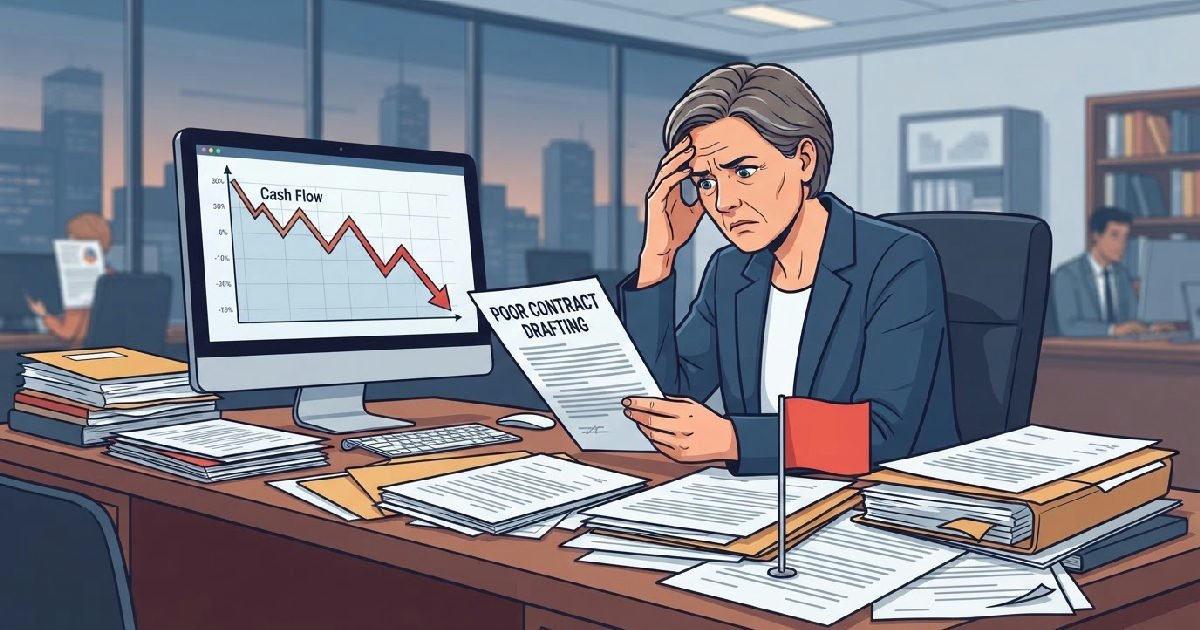
In commercial transactions, poor contract drafting frequently triggers intense business conflicts, leading to substantial financial and operational burdens for companies. When organizations treat their agreements as routine paperwork, they often fail to address critical issues, ultimately weakening their position in legal proceedings.
Many enterprises realize these severe contractual gaps only when a formal commercial dispute forces them into court. Managing the operational differences between different judicial forums becomes highly complex without clear terms, often exposing businesses to immediate operational halts and financial leakage.
How poor contract drafting fuels cash flow disruptions
Unclear payment schedules and missing due dates remain the most frequent drivers of contractual breakdown. When an agreement fails to specify exactly when an invoice becomes due, cash flow quickly grinds to a halt. Parties then interpret the ambiguity to their own financial advantage, stalling critical operations.
Ambiguity in billing milestones often forces companies to stop work entirely. This halt triggers counterclaims for breach of contract, complicating the dispute. Businesses must define exact dates and clear billing cycles to prevent payment delays and protect their revenue stream.
Recovering outstanding funds often depends on how the parties document ongoing transactions. For example, a clear ledger acknowledgment of debt can keep a claim alive in court. However, relying on post-facto ledger entries is a risky substitute for clear payment terms in the initial contract.
Disputes over payment terminology also escalate when milestones are subjective. Terms like “upon satisfactory completion” create massive gray areas for both buyers and suppliers. Ensuring objective criteria, such as third-party sign-offs, eliminates this vulnerability entirely before work begins.
Weak termination clauses that lock companies in
Companies regularly enter long-term agreements without planning an exit strategy. A weak termination clause makes it difficult to end a failing partnership safely. This specific drafting error traps organizations in unprofitable, unproductive business relationships that continuously drain valuable corporate resources.
Standard agreements must detail both termination for cause and termination for convenience. Failing to define what constitutes a material breach leaves the exit door locked. Consequently, one party may attempt to terminate the contract unlawfully, triggering an immediate and expensive breach of contract lawsuit.
The consequences of termination require equal drafting precision. Contracts should specify who retains intellectual property, how transition data is handled, and when final payouts occur. Omitting these exit steps ensures a dispute will continue long after the main work stops.
Termination clauses must also explicitly state which provisions survive the contract’s end. Confidentiality, intellectual property rights, and dispute mechanisms should always persist. Forgetting to list these surviving terms often leads to post-contractual data leaks and prolonged legal liability.
Jurisdictional issues and commercial disputes
Many commercial contracts either omit dispute resolution mechanisms entirely or use poorly worded arbitration clauses. This oversight leads to immediate jurisdictional battles before the actual dispute is even discussed. Parties end up fighting over where to fight, doubling their legal costs.
Choosing the wrong governing law can force a firm to litigate in an expensive, unfamiliar jurisdiction. Businesses must specify the exact municipal court, state, or country that will hear any potential disagreements. This prevents competitors from dragging disputes into highly inconvenient forums.
Complex appellate paths can further delay the resolution of simple commercial conflicts. Companies often face procedural hurdles, such as appealing plaint rejections after early motion defeats. Clear arbitration frameworks bypass these prolonged judicial review processes entirely, saving valuable corporate time.
Ambiguity regarding the seat versus the venue of arbitration is another common pitfall. The seat determines the governing legal framework, while the venue is merely the geographical location of the hearings. Conflating these two terms often leads to conflicting court interventions.
Incomplete scopes of work and shifting deliverables
Vague descriptions of deliverables and timelines create room for deep operational disagreements between partners. When a contract fails to define the exact scope, project requirements inevitably drift. This severe scope creep quickly strains corporate budgets and ruins productive business relationships.
Clients and service providers often hold wildly different expectations of what constitutes a finished product. Without technical annexures, performance benchmarks, and clear milestones, assessing compliance is impossible. Courts struggle to resolve cases where the objective metrics are completely missing.
Change-order processes must be clearly documented within the main agreement. Projects evolve, and parties must have a formal, written mechanism to approve extra work and additional fees. Verbal agreements to modify the scope almost always end in bitter court battles.
Contracts must also detail the process for testing and accepting the work. A silent acceptance clause allows clients to delay payments by claiming the work remains unsatisfactory. Clear timelines for review and automatic acceptance prevent this common stalling tactic.
Missing indemnity and weak liability limitations
Indemnity and limitation of liability clauses protect enterprises from catastrophic financial claims. Omitting these protective shields exposes a company’s entire balance sheet to direct risk. A minor operational mistake can then lead to business-ending damages that could have been avoided with better drafting.
Liability caps should always align with the actual commercial value of the contract. Draftsmen must negotiate clear limits on indirect, consequential, and punitive damages. Failing to exclude consequential damages can make a company liable for a partner’s entire projected lost profits.
Indemnity clauses must specifically target third-party claims, intellectual property infringements, and regulatory breaches. Vague indemnity language often covers general operational losses, which courts may reject as overly broad. Precise drafting successfully limits these obligations to direct, foreseeable harms rather than speculative losses.
The direct financial impact of contract drafting mistakes across key corporate metrics highlights the severity of the issue. The following table illustrates how specific payment term ambiguities relate to primary commercial and legal risks, reflecting documented transaction pitfalls. Addressing these common errors helps companies protect their operational stability.
| Payment Clause Issue | Primary Impact | Legal / Operational Consequence |
|---|---|---|
| Unclear payment schedules | Ambiguity in transaction timing | Reported financial and operational burdens |
| Missing due dates | Unaddressed timeline parameters | Weakened position in legal proceedings |
| Ambiguous language regarding due dates | Subjective billing interpretations | Potential commercial disputes and litigation |
Outdated force majeure clauses in modern markets
In the broader business environment, many legacy contracts reportedly rely on generic “acts of God” language to manage unforeseen disruptions. Legal observers suggest that these clauses are often seen as inadequate during systemic crises, though systematic research stresses that more basic contractual mistakes represent the most immediate threat to a company’s legal position.
While some practitioners argue that agreements should detail various external disruptions to outline clear notification procedures, the most direct threat remains foundational drafting errors. According to commercial legal experts, vague everyday clauses are far more likely to trigger litigation than rare external disruptions.
When an external event persists for months, parties cannot remain indefinitely bound to non-performance without clear guidelines. Defining a clear termination trigger after a set period provides a clean exit path. However, ensuring basic clarity in everyday transaction terms remains the most effective risk management strategy.
Courts typically construe relief clauses strictly against the party seeking to rely on them. If the disruptive event is not explicitly covered, judges will rarely expand the clause’s definition. Therefore, precise and comprehensive listing of rights is the only way to ensure protection.
Practical steps to eliminate contract drafting mistakes
Minimizing contractual risk requires a systematic shift in how companies approach their legal documents. Standardized templates must undergo regular legal audits to reflect changing judicial precedents. Using outdated forms is an open invitation to highly expensive and prolonged court proceedings that drain resources.
Business leaders should never sign agreements without a comprehensive review by qualified commercial counsel. Lawyers ensure that protective clauses are legally enforceable and aligned with actual business intent. This upfront investment prevents years of draining and expensive litigation that threatens business growth.
Clear, plain language should always replace overly dense legalese in modern commercial agreements. Ambiguity thrives in complex, winding sentences that try to cover too many scenarios at once. Keeping the terms simple, direct, and focused on operational realities protects both parties.
Ensure all key stakeholders review the draft before execution. Technical, financial, and operational teams must confirm that the written terms match their actual working capacity. A contract is only useful if it accurately reflects the real-world capabilities and goals of the business.
Documenting the entire pre-contractual negotiation phase is also a vital safety net. Keeping clear records of emails, drafts, and meeting minutes helps clarify intent during disputes. These comprehensive records can resolve ambiguities before a judge must interpret the final executed agreement.
What are the most common contract drafting mistakes that lead to litigation?
Vague payment schedules, missing due dates, and ambiguous language regarding payment terms are the most frequent culprits. When these clauses lack precision, courts or arbitrators must interpret the original intent, which leads to prolonged battles.
How do poor dispute resolution clauses impact commercial litigation costs?
Inadequate dispute clauses force companies to litigate in inconvenient jurisdictions or under unfavorable rules. Clear clauses specify the exact seat of arbitration, saving substantial administrative and travel expenses for both business entities.
Can regular contract template audits prevent commercial disputes?
Yes, auditing templates ensures that clauses reflect current legal precedents and market realities. Regular reviews prevent companies from relying on outdated language that fails to protect against modern commercial risks.