
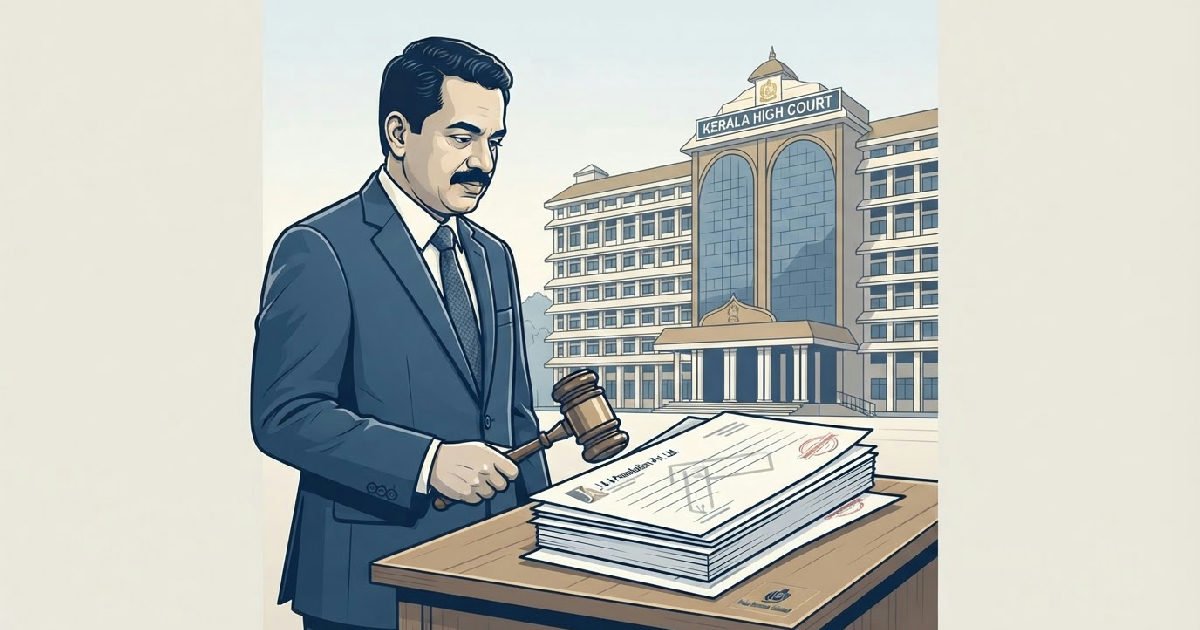
The Kerala High Court has affirmed vicarious liability for cheque dishonour for V.J. Joseph, former MD of J & A Foundation Pvt. Ltd. J. Joseph, the former Managing Director of J & A Foundation Pvt. Ltd., is vicariously liable for the dishonour of cheques issued by the company.
This significant ruling, reported on August 3, 2026, reinforces the legal principle that corporate leaders directly involved in a company’s daily operations and financial transactions bear personal responsibility for financial misconduct.
Justice M.B. Snehalatha dismissed Joseph’s revision petition, thereby upholding his conviction and sentence. The case stemmed from a complaint lodged by The India Cements Limited after three cheques, each valued at ₹2 lakh, bounced due to insufficient funds, totaling ₹6 lakh.
corporate accountability in india’s legal landscape
India’s legal framework has long grappled with balancing corporate entity protection and individual accountability. The Negotiable Instruments Act, 1881 (NI Act), stands as a cornerstone in regulating financial instruments and ensuring transactional integrity.
But the journey to criminalize cheque dishonour, and particularly to extend liability to individuals within a company, has been evolutionary. This ruling highlights the increasing emphasis on holding key managerial personnel responsible.
the Negotiable Instruments Act’s evolution
Enacted on December 9, 1881, the NI Act initially aimed to codify laws surrounding instruments like promissory notes and bills of exchange. Its purpose was to instill trust and predictability in financial dealings across the nation.
A pivotal moment arrived in 1988 with the Banking, Public Financial Institutions and Negotiable Instruments Laws (Amendment) Act. This amendment introduced Section 138, transforming cheque bouncing from a civil wrong into a criminal offense punishable by imprisonment, fines, or both.
Subsequently, Section 141 was added to specifically address offenses committed by companies. It established vicarious liability, stipulating that individuals “in charge of, and … responsible to, the company for the conduct of the business” could also be held accountable alongside the company itself.
role of a managing director in corporate oversight
A Managing Director, or MD, sits at the strategic and operational helm of a company. They’re typically vested with substantial management powers, steering daily operations and making critical financial decisions.
These responsibilities encompass everything from issuing directives to various departments to overseeing financial performance. Critically, MDs often sign contracts and cheques, acting as the company’s chief executive authority in day-to-day matters.
judicial precedent and director liability trends
The Supreme Court of India has provided considerable guidance on the scope of Section 141. Their rulings have consistently underscored the need for specific allegations when prosecuting directors, moving beyond mere designation.
This body of jurisprudence ensures that liability is tied to functional involvement, not just a title. It protects those who aren’t actively engaged in the company’s operational or financial management.
distinguishing executive and non-executive roles
Case law clearly differentiates between various types of directors. For Managing Directors and those who actually sign the dishonoured cheque, liability is often presumed due to their inherent role in financial affairs and daily management.
In contrast, non-executive and independent directors, whose roles are primarily advisory, aren’t typically held liable unless their active involvement in the specific transaction is proven. This distinction is crucial for understanding director liability for cheque dishonour.
For instance, in S.M.S. Pharmaceuticals Ltd. v. Neeta Bhalla (2005), the Supreme Court mandated that complaints must specifically aver how a director was “in charge of, and responsible for, the conduct of the business of the company.” A generic statement isn’t enough.
The K.K. Ahuja v. V.K. Vora (2009) judgment further clarified that for an MD, detailed allegations about daily involvement might not always be strictly necessary. Their role inherently implies responsibility for the company’s conduct.
necessity of including the company as an accused
A landmark ruling in Aneeta Hada v. Godfather Travels & Tours Pvt. Ltd. established another critical point. The Supreme Court held that prosecution of individuals under Section 141 isn’t maintainable unless the company as an accused is also arrayed in the case.
This ensures that the corporate entity, as the primary actor, also faces legal proceedings. Later judgments like Siby Mathews vs. Somany Ceramics Ltd. (2023) and Susela Padmavathy Amma vs. Bharti Airtel Ltd. (2024) have consistently reiterated these principles, reinforcing the need for precise averments regarding responsibility.
the v.j. joseph case: a detailed examination
The recent Kerala High Court decision involving V.J. Joseph serves as a concrete example of these legal principles in action. It offers a clear picture of how corporate leaders can be held personally accountable for a company’s financial missteps.
The judgment specifically focused on Joseph’s twin roles: signing the dishonoured cheques and managing the day-to-day affairs of J & A Foundation Pvt. Ltd.
genesis of the dispute with india cements
The conflict began when J & A Foundation Pvt. Ltd. purchased cement on credit from The India Cements Limited. As part of their payment obligation, the foundation issued three cheques, each for ₹2 lakh.
However, these cheques were subsequently dishonoured due to insufficient funds in the company’s account. This led to The India Cements Limited initiating legal action.
court rulings and evolving sentences
Following the cheque dishonour, The India Cements Limited sent a legal notice to J & A Foundation Pvt. Ltd. and V.J. Joseph. The accused acknowledged the transaction and liability, requesting more time to pay, but ultimately failed to do so.
The trial court found both the company and V.J. Joseph guilty under Section 138 of the Negotiable Instruments Act. Joseph was initially sentenced to one year of simple imprisonment and ordered to pay ₹6 lakh in compensation.
This compensation was mandated under Section 357(3) of the Criminal Procedure Code, with an additional three months of simple imprisonment if he defaulted. Upon appeal, the Sessions Court upheld the conviction but modified the sentence.
The substantive imprisonment was reduced to “till the rising of the court,” a common legal phrase indicating detention for the remainder of the court day, but the ₹6 lakh compensation remained unchanged. The Kerala High Court then dismissed Joseph’s criminal revision petition, solidifying the previous judgments.
| Party Type | Entity Name | Role/Outcome |
|---|---|---|
| Complainant | The India Cements Limited | Recipient of dishonoured cheques |
| Accused (Company) | J & A Foundation Pvt. Ltd. | Issued dishonoured cheques, now in liquidation |
| Accused (Individual) | V.J. Joseph | Former Managing Director, convicted, signed cheques |
| Court of Initial Conviction | Trial Court | Convicted both company and MD |
| First Appellate Court | Sessions Court | Upheld conviction, modified MD’s sentence |
| Final Appellate Court | Kerala High Court | Dismissed MD’s revision, affirmed liability |
implications for corporate governance and financial integrity
This ruling from the Kerala High Court sends a clear message to corporate leaders throughout India. It underscores the profound responsibility that comes with managing a company’s daily financial operations and signing off on its monetary commitments.
It’s not merely a technicality; it’s about ensuring trust within the commercial ecosystem. Businesses rely heavily on the sanctity of financial instruments like cheques.
enhanced scrutiny for company leaders
The decision reaffirms that Managing Directors, by virtue of their position and direct involvement, cannot easily shield themselves behind the corporate veil when cheques they signed are dishonoured. This means a heightened level of diligence is expected from them.
For any MD, understanding the full legal and financial ramifications of cheque issuance is paramount. Their active role in day-to-day affairs means they are presumed to be aware of the company’s financial health.
safeguarding commercial transactions
For creditors like The India Cements Limited, this ruling provides crucial reassurance. It suggests that the law offers robust mechanisms to pursue redress when financial obligations are not met, even when dealing with corporate entities.
The ability to hold an individual personally accountable adds a significant layer of protection. This can foster greater confidence in commercial transactions and reduce the prevalence of cheque dishonour, which can otherwise disrupt supply chains and business relationships.
strengthening the principle of personal responsibility
The Kerala High Court’s decision reflects a broader judicial trend towards strengthening the principle of personal responsibility in corporate settings. While the corporate structure offers certain legal protections, these protections are not absolute, especially when individuals are directly implicated in financial dealings.
The court specifically noted that V.J. Joseph himself admitted during his examination under Section 313(1)(b) Cr. PC that he was in charge of the company’s day-to-day affairs and had issued the cheques. This admission was a critical factor in affirming his liability.
Such rulings serve as a reminder that designations like Managing Director carry inherent legal obligations. These obligations extend beyond merely steering the company’s strategic vision to include direct oversight and accountability for its operational and financial integrity.
Companies and their executives are increasingly expected to demonstrate a high degree of transparency and adherence to financial commitments. This judicial stance helps maintain faith in the enforceability of financial agreements.
looking ahead: the path to greater clarity
The consistent pronouncements from various High Courts and the Supreme Court on vicarious liability are shaping a clearer legal framework. Businesses are advised to review their internal financial protocols and ensure that those in positions of authority fully understand their legal exposure.
Further clarifications might continue to emerge, particularly concerning the nuances of “day-to-day affairs” and the extent of active involvement required for culpability. But the core message is already firm: responsibility flows upwards to those who manage and sign.
This evolving legal landscape mandates proactive measures from corporate boards and management. Implementing stringent financial controls and ensuring clear lines of accountability are more critical than ever to mitigate risks related to financial instruments. The ruling emphasizes prevention as much as punishment.
Companies that prioritize robust governance and ethical financial practices will be better positioned to navigate these legal complexities. It’s about building a culture where financial commitments are honored, and individual accountability is a given.
What is vicarious liability under the Negotiable Instruments Act?
Vicarious liability, under Section 141 of the NI Act, means that individuals responsible for a company’s operations can be held criminally liable for offenses like cheque dishonour committed by the company. It makes key personnel accountable alongside the corporate entity.
Why was V.J. Joseph held liable in this specific case?
V.J. Joseph was held liable because he was the Managing Director who signed the dishonoured cheques and was in charge of the company’s day-to-day affairs. His direct involvement and admission of these facts were crucial to the Kerala High Court’s decision.
How does this ruling impact other company directors?
This ruling primarily impacts Managing Directors and other executive directors directly involved in financial decisions and daily operations. It reinforces that their active role makes them personally accountable for cheque dishonour, distinguishing them from non-executive directors.
Call or Whatsapp for free consultation.
Related Service: https://arpitmarwah.com/cheque-bounce-lawyers-in-delhi/