
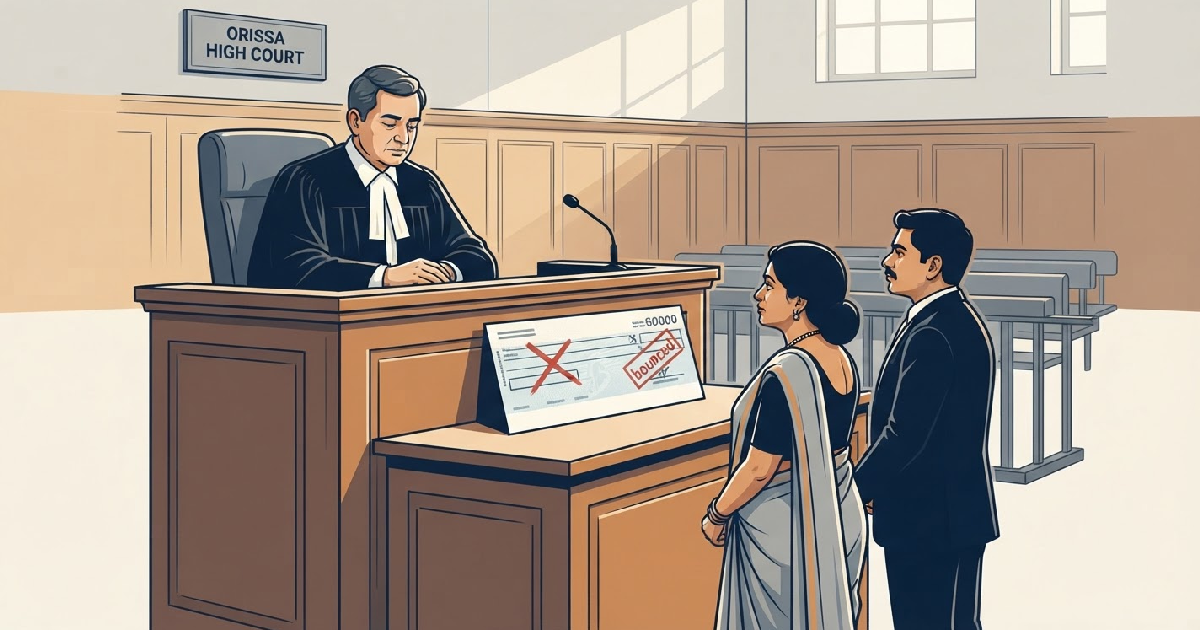
The Orissa High Court delivered a significant ruling on August 4, 2026, in the case of Suniti Sunita Patnaik v. Sajjan Kumar Agrawal, reiterating that a trustee can face a cheque bounce case under the Negotiable Instruments Act, 1881, even if the trust itself isn’t explicitly named as an accused.
This decision firmly aligns the High Court’s stance with the Supreme Court’s definitive 2025 judgment in Sankar Padam Thapa v. Vijaykumar Dineshchandra Agarwal. It solidifies the personal liability of individual trustees for dishonoured cheques, profoundly impacting governance and financial oversight within trust-based organizations across India.
Upholding personal accountability for trustees in cheque bounce cases
The recent Orissa High Court ruling dismissed a petition challenging ongoing proceedings against a trustee. Justice Sibo Sankar Mishra emphasized that simply arraigning and issuing a demand notice to the trustee who issued the cheque on behalf of the trust is sufficient for prosecution.
This clarity means the trust itself, as an entity, doesn’t need to be impleaded in the criminal complaint. The ruling reinforces a crucial principle: those who manage and operate trusts bear direct responsibility for their financial instruments.
The Suniti Sunita Patnaik ruling reinforces liability
The High Court’s judgment in Suniti Sunita Patnaik v. Sajjan Kumar Agrawal provides vital guidance for legal practitioners and trustees alike. It ensures that individuals cannot hide behind the organizational structure of a trust to evade accountability for financial misconduct.
The decision builds on a foundational understanding of trust law and the intent behind cheque dishonour provisions. It underscores the serious nature of issuing cheques without sufficient funds or proper authorization.
Understanding the Negotiable Instruments Act, 1881
Cheque bounce cases in India are primarily governed by the Negotiable Instruments Act, 1881 (NI Act). Specifically, Section 138 of this act makes the dishonour of a cheque a quasi-criminal offense.
This section was introduced to promote financial discipline and uphold the sanctity of commercial transactions. Its provisions aim to deter the casual issuance of cheques that might not be honoured, thereby protecting the payee.
For an offense under Section 138, several conditions must be met. The cheque must have been issued for a legally enforceable debt or liability, presented within its validity period, and returned unpaid. Following this, a legal demand notice must be issued to the drawer.
The drawer then has 15 days to make the payment after receiving the notice. If payment isn’t made within this timeframe, a criminal complaint can be filed within one month.
The Supreme Court’s landmark 2025 clarification
The Orissa High Court’s current position is largely a direct consequence of a significant Supreme Court decision from 2025. The case of Sankar Padam Thapa v. Vijaykumar Dineshchandra Agarwal proved to be a landmark ruling in this area of law.
That Supreme Court judgment resolved long-standing ambiguities regarding the liability of trustees and trusts in cheque dishonour cases. It provided a uniform legal precedent for courts across India.
The Sankar Padam Thapa precedent
In the *Sankar Padam Thapa* case, the Supreme Court unequivocally stated that a trust is neither a “company” nor an “other association of individuals” under Section 141 of the NI Act. This distinction is critical for determining who can be prosecuted.
The case involved a ₹5 crore cheque issued by Vijaykumar Dineshchandra Agarwal, Chairman of Orion Education Trust, which was dishonoured. The Meghalaya High Court had initially quashed the complaint because the trust wasn’t made an accused, but the Supreme Court overturned this.
The highest court affirmed that proceedings against a trustee are valid even if the trust is not a party to the complaint. This ruling highlighted that the individual who signs the cheque on behalf of the trust is the one primarily liable.
Why trusts aren’t companies under section 141
Section 141 of the NI Act extends liability for cheque dishonour to those responsible for the business of a company or an “association of individuals.” However, the Supreme Court clarified that a trust, as defined by the Indian Trusts Act, 1882, does not fit these categories.
A trust is fundamentally an obligation linked to property ownership, not a separate legal entity that can sue or be sued in its own name. This legal characteristic fundamentally differentiates trusts from corporate structures or formal associations that have their own juristic personality.
Therefore, a trust cannot be prosecuted as an accused for a cheque dishonour offence under Section 138 read with Section 141 of the NI Act. Instead, the individual trustee who signed the cheque and managed the funds faces the legal consequences directly.
Previous conflicting high court views
Before the Supreme Court’s 2025 ruling, various High Courts held conflicting views on trustee liability. Some courts had interpreted Section 141 more broadly, trying to include trusts within its ambit, while others maintained a stricter interpretation.
For example, in 2022, the Orissa High Court itself, in Bijaya Manjari Satpathy v State of Orissa, had ruled differently. That earlier Orissa High Court ruling held that a person in charge of a trust could not be impleaded if the trust wasn’t also an accused.
The Supreme Court’s *Sankar Padam Thapa* judgment effectively overruled these conflicting interpretations. It established a uniform standard, forcing High Courts, including Orissa, to revise their earlier stances and align with the national legal framework.
Legal definition and implications for trusts
Understanding the legal nature of a trust is paramount in comprehending this ruling. In India, under the Indian Trusts Act, 1882, a trust is not considered a distinct legal person.
Unlike a company, which has a separate legal existence from its shareholders, a trust functions more as a legal arrangement. This distinction has profound consequences for liability, especially in criminal matters.
Trust as an obligation, not a legal entity
A trust is best described as an obligation attached to property ownership, stemming from confidence placed in the owner – the trustee – for the benefit of another, the beneficiary. It doesn’t possess its own legal identity to initiate or defend lawsuits.
All actions undertaken in the name of a trust are, in essence, performed by its trustees. These individuals hold and manage the trust property, making decisions that carry direct personal implications.
Practical implications for trust operations
This ruling places a heightened emphasis on the operational diligence of trusts. Trustees must now be acutely aware that their signatures on financial instruments carry direct personal criminal liability.
This impacts how trusts manage their finances, from authorization processes to the actual issuance of cheques. Trustees cannot assume the trust entity will shield them from personal legal repercussions.
Navigating trustee responsibilities and risk
The legal landscape now demands greater prudence from individuals serving as trustees. The judgment underscores the need for robust internal controls and clear operational protocols within any trust.
Trustees must recognize that their role carries significant personal legal risks if financial obligations are mishandled. This risk extends beyond civil liabilities to potential criminal charges.
Due diligence in financial management
Trustees are now more than ever compelled to exercise stringent due diligence before issuing cheques. They must verify the availability of funds and ensure proper authorization for every transaction.
This involves meticulous checking of bank balances and adherence to internal financial policies. Any oversight can lead to severe personal legal battles, including imprisonment and substantial fines.
The principle extends to all forms of organizational structures that might not be formal companies. For instance, similar principles apply to sole proprietary concerns, where the individual owner bears direct liability.
Essential record keeping for trustees
Maintaining comprehensive and accurate records is no longer just good practice; it’s a critical defensive measure for trustees. Documenting authorizations, financial resolutions, and board decisions becomes paramount.
These records can serve as crucial evidence in demonstrating a trustee’s adherence to proper procedures. Such documentation can help mitigate personal liability if a cheque is dishonoured despite their best efforts.
Impact on financial transactions and governance
This legal clarification will undoubtedly have ripple effects across the sector involving trusts, particularly in charitable and educational domains. It reshapes how financial agreements are perceived and executed.
The ruling enforces a stricter interpretation of accountability, pushing trustees to adopt more conservative financial practices. This approach aims to safeguard beneficiaries and maintain public trust in these organizations.
Enhanced scrutiny on cheque issuance
Financial institutions and beneficiaries will likely exercise enhanced scrutiny over cheques issued by trusts. Payees will have clearer avenues for recourse if payments fail, knowing they can directly pursue the signatory trustee.
This could lead to a shift towards more secure payment methods or stricter pre-payment verification processes within trusts. It’s a move towards greater transparency and reliability in financial dealings.
Broader implications for non-profit and charitable sectors
The non-profit and charitable sectors, heavily reliant on trust structures, will particularly feel the weight of this ruling. Trustees of NGOs, religious trusts, and educational institutions must re-evaluate their operational frameworks.
The increased personal liability could make individuals more hesitant to take on trustee roles without adequate understanding of the legal risks. However, it also serves to professionalize the management of such entities.
The question of NGO secretary liability in cheque bounce cases becomes more pertinent. Individuals holding key positions within non-profit organizations must be fully aware of their legal obligations and potential personal consequences.
The evolving landscape of cheque dishonour law
This ruling from the Orissa High Court reflects an ongoing evolution in India’s legal system to strengthen financial accountability. Courts are increasingly prioritizing the protection of payees and the enforceability of commercial instruments.
The shift aims to reduce instances of financial fraud and to instill confidence in cheque-based transactions. It represents a move towards greater individual responsibility in managing institutional finances.
Promoting financial discipline
By making trustees personally liable, the courts are sending a strong message about financial discipline. It encourages more cautious and responsible cheque issuance, thereby reducing the prevalence of dishonoured cheques.
This approach aligns with broader economic goals of fostering a reliable and trustworthy financial environment. It serves as a deterrent against casual or negligent financial practices.
Future outlook for trustees and trust compliance
In the coming years, trusts will likely invest more in legal compliance training for their trustees. New trustees might demand more comprehensive indemnity clauses or insurance coverage to protect themselves.
Legal advisors will also play a more critical role in guiding trusts through complex financial decisions. The emphasis will be on proactive risk management rather than reactive damage control.
| Entity Type | Legal Personality | Liability for Cheque Dishonour (NI Act, Section 138) | Basis of Liability |
|---|---|---|---|
| Trust | Not a juristic person | Trustee who signed cheque is personally liable. Trust itself not an accused. | Individual act of trustee, not entity |
| Company | Juristic person | Company is liable; officers responsible under Section 141 also liable. | Entity liability, extended to responsible individuals |
| Sole Proprietorship | Not a separate legal entity | Sole proprietor (individual) is personally liable. | Individual act of proprietor |
| Partnership Firm | Not a juristic person (generally) | Firm is liable; partners responsible under Section 141 also liable. | Partners’ collective and individual liability |
What does the Orissa High Court ruling mean for trustees?
The ruling clarifies that if a cheque issued on behalf of a trust bounces, the individual trustee who signed it can be prosecuted under the Negotiable Instruments Act. The trust itself doesn’t need to be named as an accused in the case.
Why is a trust not considered an accused in these cases?
Under Indian law, a trust isn’t recognized as a separate legal entity or a “juristic person” in the same way a company is. Therefore, it cannot be formally prosecuted for a criminal offense like cheque dishonour under Section 138 of the NI Act.
How can trustees protect themselves from personal liability?
Trustees should exercise extreme caution and due diligence when handling financial matters. This includes verifying fund availability, ensuring proper authorization for cheque issuance, and meticulously documenting all financial decisions and resolutions to demonstrate responsible conduct.