
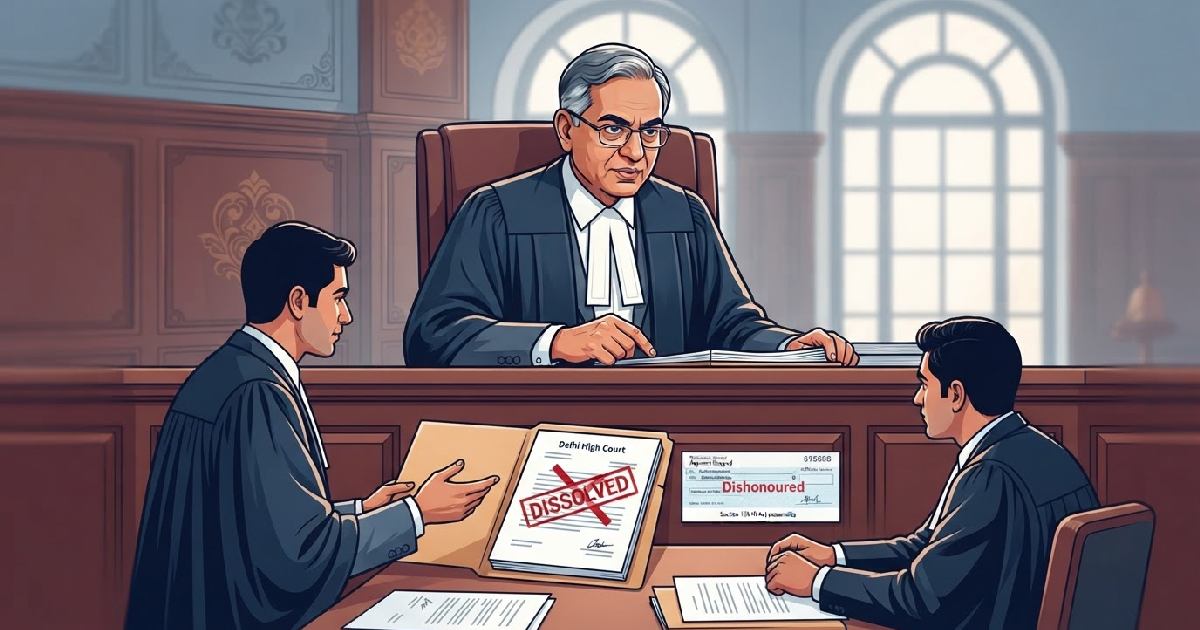
Legal proceedings for cheque dishonour are not sustainable for a dissolved company, the Delhi High Court ruled on Section 138 of the Negotiable Instruments Act, 1881.
The ruling, delivered by Justice Arun Monga on October 8, 2025, from the Delhi High Court, explicitly states that a company which has been formally “struck off and stands dissolved” loses its legal identity, known as juristic personality.
Dissolved company status impacts cheque dishonour proceedings
This means any actions taken on its behalf become “void ab initio,” effectively ending the possibility of criminal prosecution for cheque dishonour. The judgment stems from petitions challenging the validity of such cases, setting a crucial precedent for corporations and creditors navigating the complexities of corporate dissolution in India.
Justice Arun Monga’s ruling provides significant clarity on the legal standing of dissolved entities under India’s financial statutes. The court emphasised that once a company loses its juristic personality through dissolution, it cannot be considered a valid drawer or account-holder in legal terms. Consequently, a cheque associated with such a defunct entity loses its enforceability under the Negotiable Instruments Act.
This principle asserts that the very foundation for a Section 138 proceeding—a legally enforceable instrument and a valid drawer—ceases to exist. The implications are far-reaching for creditors who might hold cheques from companies that subsequently undergo dissolution, highlighting the importance of understanding a company’s corporate status.
The specific case: Raghav Aditya Chits versus Space Services
The Delhi High Court’s definitive judgment arose from two specific criminal complaint cases, CC No. 2619/2020 and CC No. 4753/2020. These cases involved Raghav Aditya Chits Pvt Ltd. as the complainant company and Space Services (India) Pvt Ltd. & Ors. as the accused parties. The petitions, CRL.M.C. 7534/2023 and 7559/2023, sought to quash the ongoing criminal proceedings.
The core of the dispute revolved around cheques issued by Space Services (India) Pvt Ltd. One notable cheque, number 033217, was dated November 10, 2019, for a substantial sum of ₹1,93,00,000. This cheque was subsequently dishonoured on November 27, 2019, with the bank noting “Contact Drawer/Drawee Bank and Present Again.”
Another cheque, number 033216, dated October 10, 2019, for an undisclosed amount, was also part of a separate complaint, CC No. 4735/2020. The common order issued on October 8, 2025, resolved both petitions, establishing the unenforceability of such instruments post-dissolution.
Understanding Section 138 of the Negotiable Instruments Act
Section 138 of the Negotiable Instruments Act, 1881, is a critical piece of legislation aimed at ensuring the reliability of cheques in commercial transactions. It imposes criminal liability on individuals or entities that issue cheques which are subsequently dishonoured due to insufficient funds or other specified reasons. The law seeks to build confidence in cheque-based payments.
For a criminal complaint under Section 138 to be valid, several conditions must be met. The cheque must have been issued to discharge a legally enforceable debt or liability. It must also be presented to the bank within three months of its issue date or its period of validity, whichever is earlier.
Upon dishonour, the payee must issue a demand notice within 30 days to the drawer.
The drawer then has 15 days to make payment. Failure to do so within this period allows the payee to file a criminal complaint within one month. Penalties for conviction can include imprisonment for up to two years, a fine up to twice the cheque amount, or both. This framework underscores the seriousness with which cheque dishonour is treated under Indian law.
Corporate dissolution process in India
In India, a company can cease to exist through various legal avenues, with dissolution being the final stage of its termination. This process typically occurs after a company has been wound up, its assets realised, and liabilities settled. Upon dissolution, the company is formally removed from the Registrar of Companies (ROC) records.
The “struck off” status, under Section 248 of the Companies Act, 2013, offers a faster route for inactive or defunct companies to be deregistred. This process is distinct from the more involved liquidation process, which focuses on asset distribution and debt settlement. However, both ultimately lead to the loss of the company’s legal personality.
Once dissolved, a company can no longer legally operate, sue, or be sued. Any acts undertaken on its behalf are rendered invalid from the outset. This cessation of legal identity is what the Delhi High Court has centred its recent judgment on, drawing a clear line for ongoing cheque dishonour cases.
Dissolution versus other corporate distress scenarios
The Delhi High Court’s ruling on dissolved companies is critical because it highlights a specific legal status. It’s important to distinguish dissolution from other corporate distress scenarios, such as liquidation or proceedings under the Insolvency and Bankruptcy Code (IBC). These distinctions significantly alter the applicability of Section 138 of the Negotiable Instruments Act.
A company undergoing liquidation, for instance, still retains its legal personality for the purpose of winding up its affairs. Similarly, a company under a Corporate Insolvency Resolution Process (CIRP) also maintains its legal existence, albeit with a moratorium on certain legal actions. Courts have often upheld director liability under Section 138 even in these insolvency contexts, recognising the penal nature of the offense.
The Delhi High Court’s decision, therefore, carves out a definitive exception: only fully dissolved companies are exempt from Section 138 proceedings because they entirely lack legal standing. This judicial distinction provides a vital framework for legal practitioners and creditors to assess their options based on the precise corporate status of the debtor entity.
| Company Status | Legal Personality | Relevant Companies Act Section | Section 138 NI Act Applicability |
|---|---|---|---|
| Active Company | Retained (Full) | N/A | Applicable |
| Company in Liquidation | Retained (Limited for winding-up) | Chapter III (Part I) of IBC, 2016 | Potentially applicable, depending on specific circumstances and stage of liquidation. Directors often remain liable. |
| Company under CIRP | Retained (Under moratorium) | Sections 7, 9, 10 of IBC, 2016 | Generally subject to moratorium, but director liability often upheld post-moratorium. |
| Dissolved Company | Lost | Section 252 (restoration), Section 248 (struck off) | Not applicable; cheque void ab initio. |
What this ruling means for creditors and corporate governance
This ruling from the Delhi High Court sends a clear message to creditors: diligence in monitoring the corporate status of their debtors is paramount. Holding a cheque from a company that subsequently dissolves renders that instrument useless for a criminal complaint under Section 138 NI Act. This could force a re-evaluation of risk assessment and recovery strategies.
For corporate entities, the decision reinforces the finality of dissolution. It suggests that while dissolving a company provides a clean break from certain liabilities, the process must be thoroughly understood by all stakeholders. Directors and management should be acutely aware of the implications of dissolution on outstanding financial instruments.
The judgment also indirectly promotes timely action on bounced cheques. Waiting too long might risk the debtor company dissolving, thereby eliminating the criminal remedy under the NI Act. This could push creditors to pursue civil remedies more aggressively or to act swiftly on dishonoured cheques.
Comparative analysis with other high court judgments
The Delhi High Court’s stance aligns with similar judicial interpretations from other High Courts across India. For instance, the Karnataka High Court, in a ruling on July 1, 2026, also determined that Section 138 proceedings are not maintainable if the cheque was issued by a company already struck off and dissolved. Such a cheque, they found, could not be considered a legally enforceable instrument.
These consistent rulings across various high courts underscore a growing consensus regarding the legal ramifications of corporate dissolution. They highlight the importance of juristic personality as a prerequisite for liabilities under the Negotiable Instruments Act. This trend suggests a more harmonised approach to corporate accountability post-dissolution.
The uniformity in these judgments provides greater predictability for legal practitioners and businesses alike. It clarifies the boundaries of criminal liability for cheque dishonour, particularly in scenarios involving defunct corporate entities. This judicial clarity helps in avoiding protracted litigation over legally untenable claims.