
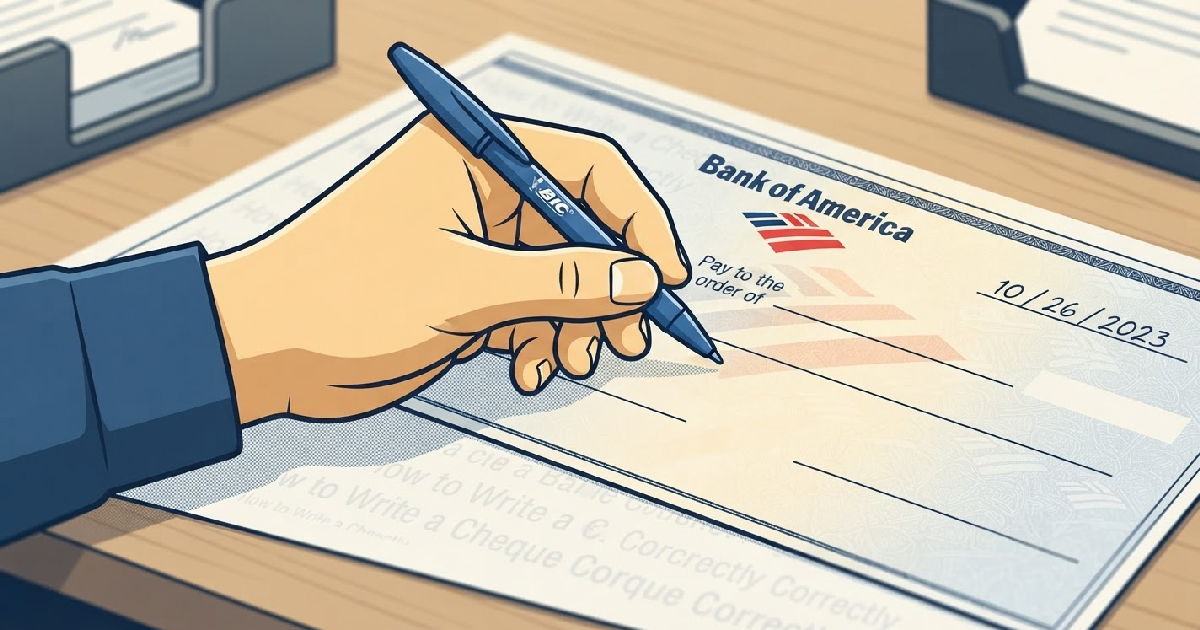
Even with the rise of digital payments, knowing how to write a cheque correctly remains a vital skill for managing financial transactions. Cheques are still necessary for various payments, such as rent, security deposits, or when dealing with individuals and organizations preferring this traditional method.
This guide provides a precise, step-by-step approach to filling out a cheque accurately. Proper completion of each section helps ensure your payment is processed without issues, making the transaction smooth for all parties involved.
Understanding cheques and their purpose
A cheque is a dated, written, and signed financial instrument. It directs a bank or other financial institution to pay a specific sum of money from the drawer’s account to the named payee.
It’s crucial to understand that a cheque isn’t cash; it represents money held in a bank account. For the payment to be completed, the cheque must be redeemed or cleared through a bank, a process integral to its function.
Key parties in every cheque transaction
Every cheque involves three main parties, each playing a distinct role in the transaction. Identifying these roles clarifies the flow and responsibilities within the payment process.
The Drawer is the person or entity who writes and signs the cheque, thereby authorizing the payment from their account. The Drawee is the bank or financial institution holding the drawer’s account; this institution is responsible for honoring the cheque. The Payee is the individual or entity designated to receive the funds specified on the cheque.
Deciphering the cheque’s anatomy
Understanding the various parts of a cheque is fundamental for filling it out correctly and securely. Each component serves a specific purpose in ensuring the cheque’s validity and proper processing.
Careful attention to these details can help prevent common issues like rejection. Misspellings on the payee line, for instance, can lead to a cheque being refused by a bank.
Essential information on the cheque face
Located in the upper left corner, the Drawer’s Personal Information typically includes the account holder’s name and address. A Check Number appears in both the upper and bottom right for easy record-keeping and tracking.
The Date Line, found in the upper right, is where the current date is entered. This date is vital as it determines the cheque’s validity, which typically extends up to three months from its issue date.
On the “Pay to the Order of” line, the full name of the payee must be written clearly and accurately. To the right, the Amount in Numerals, or Dollar Box, displays the payment amount numerically, for example, “$130.45.” Below the payee’s name, the Amount in Words spells out this same value.
If the numerical and written amounts differ, the written amount is considered legally binding by banks, according to the Consumer Financial Protection Bureau.
Bank-specific details and security elements
An optional Memo Line at the bottom left offers a space for a brief note about the payment’s purpose, aiding personal or business records. The Signature Line in the bottom right is where the drawer signs to authenticate the cheque, as it cannot typically be deposited without this crucial authorization.
The Bank Name and Logo identify the financial institution that issued the cheque. A nine-digit Routing Number, located at the bottom left, acts as an electronic address for the bank, directing funds to the correct institution. The unique Account Number, found between the routing and check numbers, specifies the drawer’s bank account from which the money will be drawn.
Step-by-step guide to writing a cheque correctly
Adhering to a precise method when filling out a cheque is paramount for security and accurate processing. It’s recommended to use blue or black indelible ink to prevent any potential alterations to the document.
Following these steps ensures that banks and payees can process the transaction without ambiguity or unnecessary delays. It also supports the proper functioning of the broader financial system.
Ensuring accuracy in every field
- Date the Cheque: Write the current date in the top right-hand corner. Using a format like DD/MM/YYYY or spelling out the month (e.g., “31 July 2026”) helps avoid confusion about the issue date.
- Write the Payee’s Name: On the line marked “Pay to the order of,” clearly write the full name of the person or organization receiving the payment. Double-check for correct spelling, as misspellings can cause the cheque to be rejected by the bank.
- Enter the Amount in Numerals: In the small box to the right of the payee line, write the exact payment amount in numbers, such as “$130.45.” Start writing the numbers at the far left of the box to prevent alteration, and always include cents, even for round numbers (e.g., “$1,000.00”).
- Write the Amount in Words: Spell out the dollar amount on the line below the payee’s name. For cents, write them as a fraction over 100 (e.g., “One hundred thirty and 45/100”). If it’s a whole dollar amount, write “and 00/100” (e.g., “Five thousand two hundred fifty and 00/100”). Fill the entire section from the left, and draw a line through any remaining blank space to prevent additions.
- Add a Memo (Optional): Use the “Memo” line in the bottom-left corner to briefly describe the payment’s purpose. This detail can be helpful for your personal records or for the payee’s accounting.
- Sign the Cheque: Finally, sign your name on the signature line in the bottom right corner. Your signature provides the legal authorization for the bank to release the funds from your account, and an unsigned cheque is invalid.
The importance of precision in cheque preparation
Accuracy when writing a cheque carries significant weight in financial transactions. Errors like mismatched numerical and written amounts, or an invalid date, can cause a cheque to be dishonored or rejected.
Such mistakes can lead to delays in payment or require the re-issuance of the cheque. Ensuring every field is completed clearly and correctly helps protect both the drawer and the payee, contributing to efficient financial transactions.
Broader context of cheque usage
While electronic payment systems dominate many daily financial interactions, physical cheques maintain their relevance for specific purposes. Their structured format and defined roles provide a tangible record of transactions.
The legal framework surrounding financial instruments like cheques is robust, dictating how they are handled and disputes resolved. For example, understanding cheque dishonour case law provides insight into the broader legal landscape.
The precise execution of cheque writing steps reinforces confidence in the payment system. This attention to detail can also influence areas such as payee bank jurisdiction when complaints arise.
| Cheque Component | Purpose | Importance for Processing |
|---|---|---|
| Date Line | Indicates issue date | Determines validity period (typically 3 months) |
| “Pay to the Order of” Line | Identifies recipient | Ensures funds reach correct individual/entity; misspellings cause rejection |
| Amount in Numerals | Numerical value of payment | Provides quick visual check; must align with written amount for accuracy |
| Amount in Words | Spelled-out value of payment | Considered legally binding if discrepancy with numerical amount; prevents additions |
| Signature Line | Drawer’s authorization | Authenticates the cheque; an unsigned cheque is invalid |
| Routing Number | Bank identifier | Directs funds to the correct financial institution |
What makes a cheque legally binding?
A cheque is a written, dated, and signed financial instrument. The research states that if the numerical and written amounts differ, the written amount is considered legally binding by banks, according to the Consumer Financial Protection Bureau.
How long is a cheque valid after its issue date?
A cheque’s validity is typically up to three months from its date of issue. After this period, banks may refuse to honor the cheque, making it non-processable.
What happens if the numerical and written amounts on a cheque differ?
If there is a discrepancy between the numerical amount and the amount written in words on a cheque, the written amount is considered legally binding by banks. This standard helps maintain clarity in payment instructions.