
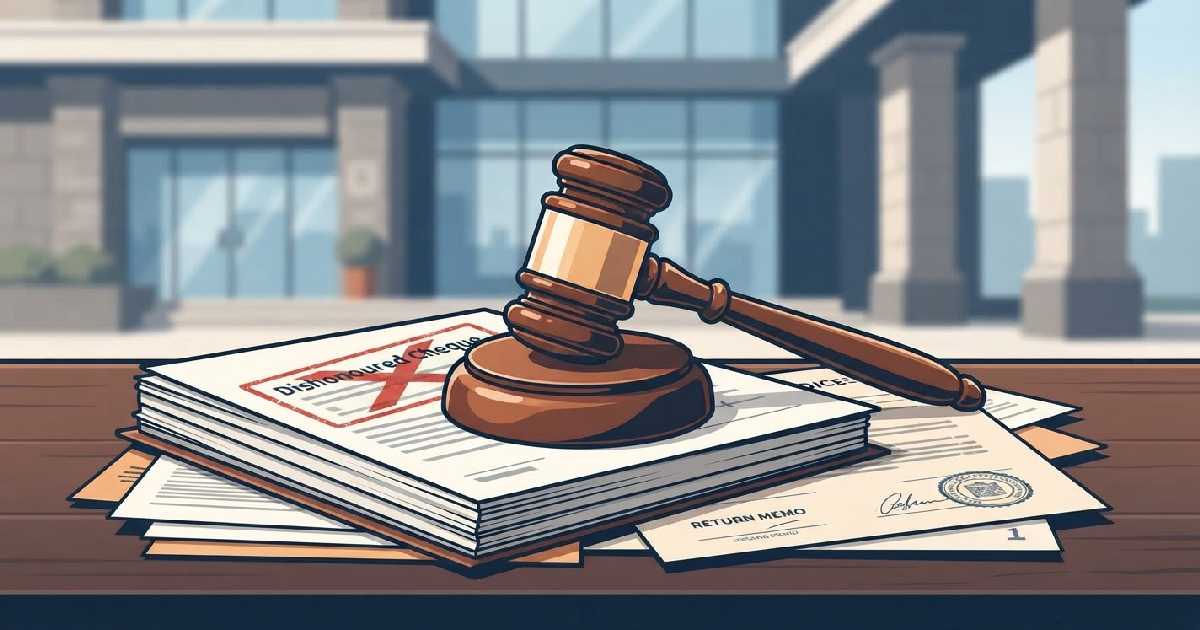
Legal action for dishonoured cheques involves a structured process, typically including formal notices and the subsequent filing of complaints. This framework addresses instances where a bank refuses to honor a cheque, impacting both those who issue cheques and those who receive them. Understanding these procedures is critical for anyone engaged in cheque transactions, given the varying legal and financial ramifications.
For those unfamiliar, legal action for dishonoured cheques can be initiated with an understanding of the required procedures.
Taking legal action for dishonoured cheques is vital in protecting one’s financial interests.
A cheque is considered “dishonoured” when the bank it’s drawn upon refuses to pay the specified amount to the payee. While often informally termed a “bounced cheque,” the formal legal terminology, “dishonoured cheque,” encompasses all reasons for non-payment, from insufficient funds to technical discrepancies.
The implications of not pursuing legal action for dishonoured cheques can be severe.
Understanding dishonoured cheques: key definitions and causes
A dishonoured cheque, also known informally as a bounced cheque or bad cheque, occurs when the drawee bank declines to process it for payment. This non-payment can stem from various issues, not solely a lack of sufficient funds in the account. The legal distinctions and underlying reasons for dishonour are crucial for understanding the subsequent legal steps involved.
The importance of legal action for dishonoured cheques cannot be overstated.
Core parties and documentation in cheque transactions
Understanding the necessity of legal action for dishonoured cheques helps prevent future issues.
Many individuals are unaware of the legal action for dishonoured cheques they must consider.
Grasping the specific terminology is the first step in navigating the legal landscape surrounding unpaid cheques. The Drawer is the individual or entity who originally issues the cheque. Conversely, the Payee is the person or entity to whom the cheque is issued, thus expecting payment.
Legal action for dishonoured cheques can be initiated quickly if the proper steps are taken.
This is where the legal action for dishonoured cheques becomes a critical consideration.
The Drawee Bank is the institution holding the drawer’s account, upon which the cheque is drawn. The Collecting Bank is the payee’s bank where the cheque is deposited for processing. When a cheque is dishonoured, the drawee bank formally communicates this refusal via a Cheque Return Memo, which specifies the exact reason for non-payment.
One must be aware of the potential for legal action for dishonoured cheques to protect their rights.
Engaging in legal action for dishonoured cheques often involves a detailed understanding of the law.
The consequences of neglecting legal action for dishonoured cheques can be far-reaching.
Knowing how to initiate legal action for dishonoured cheques is essential for all payees.
Seek legal action for dishonoured cheques promptly to enhance your chances of recovery.
Taking swift legal action for dishonoured cheques can prevent significant financial loss.
Common reasons for non-payment and dishonour
Cheques can be dishonoured for several reasons, though insufficient funds remains the most frequent cause. However, other issues like a signature mismatch or various technical errors also commonly lead to a cheque bounce. Banks are quite meticulous about these details, and any deviation can result in non-payment.
Reasons beyond a lack of money include presenting a cheque too early (post-dated) or too late (stale cheque). A drawer might also issue a stop payment instruction to their bank, preventing payment on a previously issued cheque. Furthermore, material alterations, incorrect details, or even physical damage to the cheque itself can trigger dishonour.
| Reason for Dishonour | Description |
|---|---|
| Insufficient Funds (NSF) | The drawer’s account does not have enough money to cover the cheque amount. |
| Signature Mismatch | The signature on the cheque does not match the specimen signature held by the bank. |
| Stale Cheque | A cheque presented for payment after its validity period has expired, typically three months from the date of issue. |
| Stop Payment Instruction | An instruction from the drawer to their bank to prevent payment on a previously issued cheque. |
| Material Alterations/Incorrect Details | Any unauthorized change or overwriting on the cheque, such as alterations to the amount or payee name, which can lead to dishonour. |
Pursuing legal recourse for unpaid cheques
The legal recourse available to a payee for a dishonoured cheque varies considerably depending on the specific jurisdiction. While many regions primarily treat non-payment as a civil matter, some, like India, impose significant criminal liabilities for certain types of dishonour. This jurisdictional variation impacts the entire process, from the initial notice to potential penalties.
Understanding when to initiate legal action for dishonoured cheques is vital for recovering funds.
The effects of a dishonoured cheque often necessitate legal action for dishonoured cheques.
Generally, the process begins with formal notification to the drawer, demanding payment for the unpaid instrument. Failure to comply within a stipulated period often paves the way for formal legal complaints. Payees must be fully aware of their local laws to pursue effective recourse.
Many individuals find themselves needing legal action for dishonoured cheques due to unexpected issues.
Legal action for dishonoured cheques is sometimes the only way to resolve disputes over payment.
Establishing the need for legal action for dishonoured cheques helps prevent further complications.
India’s strict stance under section 138 NI Act
In India, the dishonour of a cheque due to insufficient funds or exceeding the arranged amount constitutes a criminal offense. This specific provision falls under Section 138 of the Negotiable Instruments Act, 1881 (NI Act). The Act was primarily introduced to enhance financial discipline and build greater trust in cheque transactions across the country.
Every party involved in cheque transactions should be prepared to take legal action for dishonoured cheques when necessary.
The process mandates specific steps for the payee to follow once a cheque bounces. First, the payee must present the cheque to the bank within its period of validity, which is typically three months from the date of issue. This initial step is crucial for establishing the grounds for subsequent legal action.
Being proactive about the potential for legal action for dishonoured cheques can save time and resources.
There’s a strong emphasis on the importance of legal action for dishonoured cheques in financial dealings.
Navigating jurisdictional interpretations for complaints
Having thorough knowledge of the legal action for dishonoured cheques can greatly assist both parties.
Ultimately, understanding the legal action for dishonoured cheques is crucial for anyone involved in cheque transactions.
Following the presentation, if the cheque is dishonoured, the drawee bank issues a Cheque Return Memo to the collecting bank, clearly stating the reason. The collecting bank then provides this memo to the payee. This memo serves as official proof of dishonour and is essential for any legal proceedings.
The legal landscape surrounding these cases can be complex. For instance, recent judicial interpretations have clarified that cheque bounce complaints can be filed after 15 days, rejecting previous assumptions about longer waiting periods. Additionally, courts like those in India can hear foreign cheque complaints, underscoring broader jurisdictional reach.
The formal process: notices and complaints
Regardless of the specific jurisdiction, initiating legal action for dishonoured cheques generally follows a structured pattern. The initial step always involves the payee receiving official notification from their bank regarding the cheque’s dishonour. This notification usually accompanies the Cheque Return Memo, detailing the precise reason for non-payment.
Mandating a formal demand notice
Following receipt of the cheque return memo, the payee must send a written demand notice to the drawer. In India, this notice must be dispatched within 30 days of receiving the memo from the bank. This notice formally demands payment of the cheque amount and warns of legal action under Section 138 of the NI Act if the demand is not met.
The notice should include key details such as the cheque number and date, ensuring clarity and serving as a formal record. This demand notice acts as a final opportunity for the drawer to rectify the default before formal legal proceedings commence. Strict adherence to these timelines is essential for maintaining the validity of a legal claim.
It’s also important to note that the Supreme Court of India has ruled against courts hearing premature cheque bounce complaints. This highlights the necessity of following the prescribed sequence of sending the demand notice and allowing the specified period before filing a case.
Implications of a bounced cheque
The consequences of a dishonoured cheque can be significant, impacting both the drawer’s financial standing and, in some cases, their legal record. Penalties are designed to deter the misuse of cheques and protect the payee’s interests, varying widely based on the jurisdiction and the specific reasons for the dishonour.
Penalties under Indian law
In jurisdictions with criminal provisions, such as India under Section 138 of the NI Act, the dishonour of a cheque is treated with severity. This criminal offense carries penalties, which may include imprisonment or a monetary fine, or both. These stringent measures reflect the seriousness with which the Indian legal system treats cheque integrity and financial obligations.
Best practices for cheque transactions
Both drawers and payees play crucial roles in preventing cheque dishonour. For drawers, maintaining sufficient funds in their account is paramount. Regularly reconciling bank statements and ensuring their signature consistently matches bank records can also help prevent accidental bounces due to technicalities.
Payees should always verify the validity of a cheque before accepting it, paying close attention to the date and ensuring all details are correctly filled out. Prompt presentation of cheques to the bank, well within the validity period, is also critical to avoid the cheque becoming stale.
Diligence and clear communication from both transacting parties can significantly reduce the incidence of dishonoured cheques and the need for legal action.
What exactly is a dishonoured cheque?
A dishonoured cheque, commonly known as a bounced cheque, is one that a bank refuses to process for payment to the payee. This can occur for various reasons, including insufficient funds, a signature mismatch, or if the cheque is presented too early or too late. The bank issues a cheque return memo explaining the specific reason for non-payment.
What is the timeframe for sending a legal demand notice after a cheque bounces in India?
In India, under the Negotiable Instruments Act, the payee must send a written demand notice to the drawer within 30 days of receiving the cheque return memo from the bank. This notice formally demands payment of the cheque amount and warns of potential legal action under Section 138 if payment is not made.
Are there criminal penalties for dishonoured cheques in all jurisdictions?
No, criminal penalties for dishonoured cheques are not universal across all jurisdictions. While many regions treat cheque dishonour primarily as a civil matter, leading to financial liabilities or civil suits, some countries, like India, have specific laws that classify it as a criminal offense, particularly when due to insufficient funds.
These laws can impose fines, imprisonment, or both, reflecting a stricter stance on cheque validity and trust.
Facing a bounced cheque or unpaid commercial dues?
A legal notice and the correct next step (cheque bounce case, recovery suit, or both) can save months of delay.
WhatsApp or call for a free consultation. We help companies and individuals take the right legal action after cheque dishonour.