
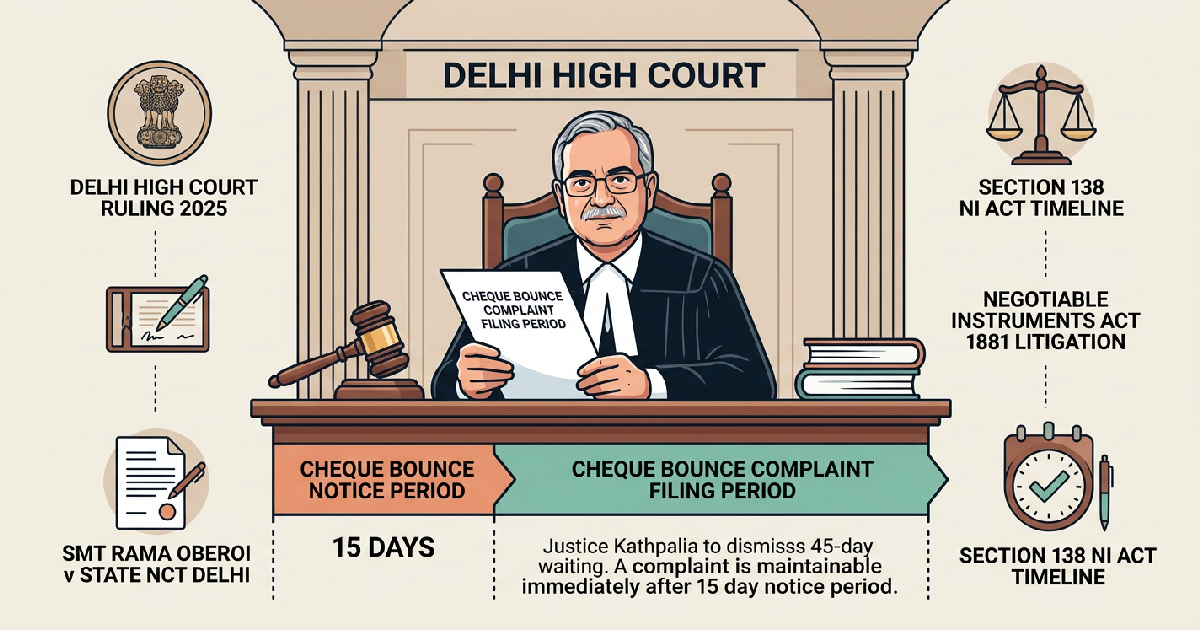
Justice Girish Kathpalia of the Delhi High Court has officially clarified the statutory timeline for cheque bounce litigation, ruling that a complaint under Section 138 of the Negotiable Instruments Act, 1881, is maintainable immediately after the 15-day notice period ends. Justice Kathpalia delivered this decision in the case of Smt. Rama Oberoi v.
State NCT of Delhi and Anr, where he explicitly rejected the “frivolous” legal argument that a complainant must wait for 45 days before approaching the court. The ruling settles a common point of confusion among litigants regarding the transition from the grace period to the limitation window.
The decision stems from a petition filed by Smt. Rama Oberoi, who sought to quash a summoning order on the grounds that the complaint was filed prematurely. In this instance, the demand notice was served on September 22, 2022, and the 15-day grace period for payment expired on October 7, 2022.
Can I file a case on the 10th day after serving the notice if the debtor refuses to pay?
No, you cannot. You must wait for the full 15-day grace period to expire. The Delhi High Court has ruled that a complaint filed even a single day before the 15-day window ends is not valid in the eyes of the law, as the cause of action only arises once that period is complete.
Is the one-month filing period counted from the date I sent the notice?
The one-month limitation period for filing the complaint is calculated from the date the 15-day grace period expires. First, you wait 15 days from the date the debtor received the notice. Once those 15 days are over, you have exactly one month to file your complaint in the Magistrate’s court.
What happens if I miss the one-month deadline to file my complaint?
If you fail to file within the one-month window, the court may dismiss your complaint as time-barred. However, Section 142 of the NI Act allows the court to excuse the delay if you can show “sufficient cause” for why you couldn’t file on time. This is at the court’s discretion and is not guaranteed.