
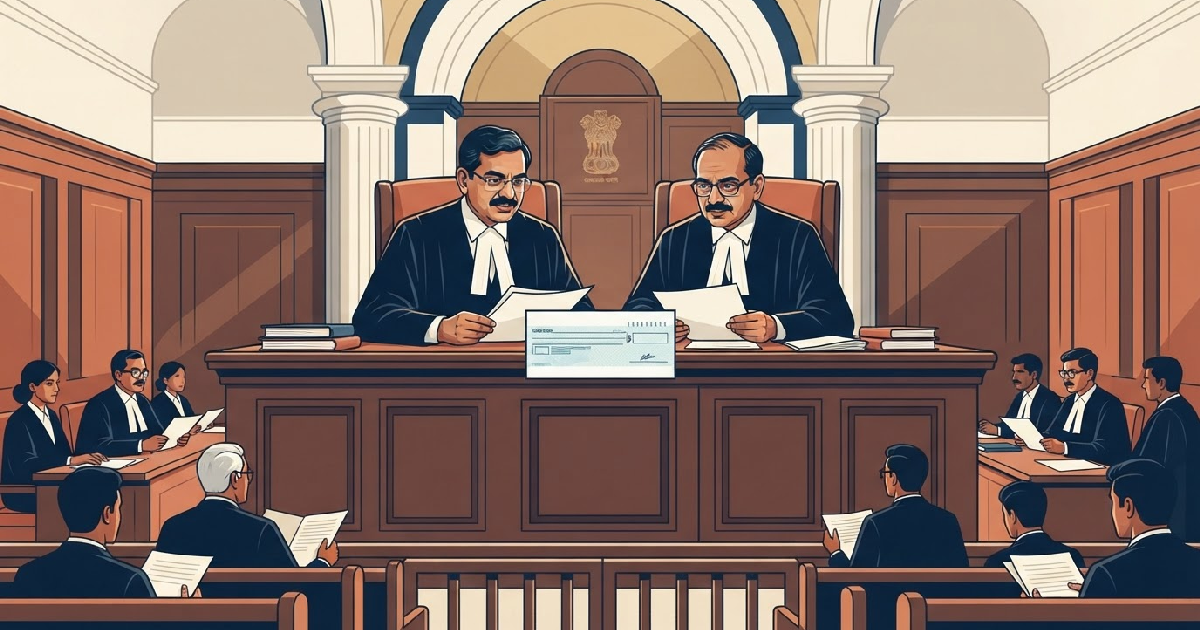
On December 18, 2025, the Supreme Court of India questioned precedents exempting directors from the mandatory 20% deposit in cheque dishonour cases. Justices Aravind Kumar and N.V.
Anjaria referred this contentious issue to a larger bench, signaling a pivotal shift in corporate liability under Section 148 of the Negotiable Instruments (NI) Act, 1881.
Supreme Court questions directors’ cheque dishonour deposit exemption
This referral aims to resolve a critical interpretive conflict within the judiciary. It addresses the practical challenge of enforcing accountability, particularly when the company itself faces legal impediments like winding up. The outcome could redefine personal responsibility for directors facing such charges.
The Supreme Court’s decision critically scrutinizes two prior rulings by benches of equal strength. These earlier judgments had held that the deposit obligation under Section 148 NI Act applied only to the “drawer” of the cheque, typically the company as a legal entity, not to directors or authorized signatories. Such individuals are often held vicariously liable under Section 141 of the Act.
But Justices Kumar and Anjaria explicitly stated a “blanket exemption” for directors from this appellate deposit isn’t always appropriate. They emphasized that the necessity of such a deposit should depend on the specific facts of each case. This approach seeks to prevent individuals from using legal technicalities to evade accountability.
Legislative intent behind Section 148 of the NI Act
Section 148 was integrated into the Negotiable Instruments Act through the 2018 amendment, which came into effect on September 1, 2018. This legislative change empowered appellate courts to require a convicted appellant to deposit a minimum of 20% of the fine or compensation awarded by the trial court. This deposit acts as a condition for suspending the sentence during the appeal process.
The primary goal of Section 148 was to bolster the credibility of cheques as financial instruments. Lawmakers intended to expedite the resolution of cheque dishonour disputes by deterring baseless appeals and dilatory tactics. They also aimed to provide interim financial relief to wronged payees.
Interpreting “may” as “shall” in deposit mandates
Parliament’s intent was clear: to curb delays in adjudication and protect complainants. The Supreme Court, in its 2019 judgment Surinder Singh Deswal v. Virender Gandhi, clarified that the word “may” in Section 148 should be interpreted as “shall.” This interpretation effectively made the minimum 20% deposit mandatory in most circumstances.
Justices Kumar and Anjaria expressed concern that a narrow interpretation risks “rendering the purpose and intent of Sections 143A and 148 wholly nugatory.” They noted such an approach would transform these vital provisions into “a lifeless statutory form devoid of practical efficacy.” This judicial commitment aims to uphold legislative goals in commercial transactions.
Conflicting precedents and the core legal debate
The Supreme Court’s current doubts target earlier rulings that shaped the interpretation of Section 148 regarding director liability. These include Bijay Agarwal v. M/s Medilines (2020) and Shri Gurudatta Sugars Marketing Pvt. Ltd. v. Prithviraj Sayajirao Deshmukh & Ors. (2022). Both judgments had adopted a strict reading of the term “drawer” within the NI Act.
They concluded that an authorized signatory or director, while vicariously liable under Section 141, isn’t the “drawer” of the cheque. Therefore, these precedents exempted them from making deposits under Sections 143A or 148. This distinction formed the basis of previous exemptions for directors.
The question before the larger bench
The fundamental question referred to a larger bench is crucial for corporate law in India. “The question that arises is whether under Section 138 read with Section 141 of NI Act, the appellate deposit contemplated under Section 148 can be directed against a convicted director or authorised signatory or whether such deposit is confined to the juristic drawer in all situations,” the Supreme Court observed.
This debate centers on balancing protection for individuals in corporate roles against the need for accountability in financial transactions. The outcome will clarify the extent to which a director, even with vicarious liability, can be compelled to personally bear the burden of the interim deposit.
The Bharat Mittal case: impetus for judicial review
The immediate trigger for this referral is the case of Bharat Mittal, a former director of Shiv Mahima Ispat Private Limited. Mittal faced legal action after a cheque for ₹4,82,72,269/-, issued to Steel Authority of India Ltd. (SAIL), was dishonoured on January 3, 2013, due to “Exceeds Arrangement.”
SAIL filed a complaint under Section 138 NI Act against the company and its directors. However, the High Court ordered Shiv Mahima Ispat Private Limited to be wound up on April 22, 2016, with finality on December 1, 2016. This liquidation effectively stayed further prosecution of the company itself.
Mittal’s journey through the appellate process
With the company’s prosecution halted, the trial against Bharat Mittal continued individually. The Trial Court convicted Mittal under Section 138 NI Act. It sentenced him to two years of imprisonment and directed him to pay ₹8.10 crores in compensation. This substantial compensation amount highlighted the seriousness of the offense.
On appeal, the Appellate Court suspended Mittal’s sentence but stipulated a condition. He had to deposit a minimum of 20% of the compensation amount under Section 148 NI Act. Mittal defaulted on this payment and sought exemption, arguing he wasn’t the “drawer” and citing the company’s liquidation, as well as partial recovery from the Official Liquidator, and financial difficulties.
High court’s affirmation and Supreme Court appeal
The High Court rejected Mittal’s plea for exemption, upholding the appellate court’s directive for the deposit. This decision reaffirmed the stringent application of Section 148. Mittal then appealed to the Supreme Court, setting the stage for the current re-evaluation of director liability in cheque cases.
This complex case, involving a company’s winding up and an individual director’s responsibility, illuminated ambiguities in existing interpretations. It created a situation where the legislative intent behind Section 148 appeared to conflict with judicial precedents concerning deposit obligations.
Impact on corporate directors and the judicial system
This referral to a larger bench carries significant implications for corporate directors across India. Should the larger bench overturn the previous precedents, directors who are vicariously liable for cheque dishonour could face a more direct financial obligation during appeals. This would undoubtedly increase the personal stakes involved in corporate financial management.
It also signals a potential shift in how companies and their directors approach compliance with financial commitments. The increased personal burden might encourage greater diligence in ensuring cheques are honored. Directors could become more proactive in overseeing financial transactions to avoid personal liability and the mandatory appellate deposit.
Addressing India’s substantial judicial backlog
Cheque dishonour cases under Section 138 NI Act contribute significantly to India’s overwhelming judicial backlog. As of December 18, 2024, over 43 lakh (4.3 million) cheque bounce cases were pending across Indian courts, a staggering figure. Rajasthan alone accounted for more than 6.4 lakh cases, while Delhi’s trial courts had 5.55 lakh pending cases as of October 9, 2025.
This volume represents approximately 36% of Delhi’s total trial court pendency. The sheer number of these cases underscores the critical need for clear and effective legal frameworks.
An amici curiae report in April 2022 highlighted that cheque dishonour cases constituted 8.81% of all criminal cases, with an increase of 7,37,124 cases in just over five months. The average pendency for Section 138 NI Act cases in subordinate courts was a troubling 1,326 days (over three years and seven months).
| Region/Category | Pending Cheque Dishonour Cases (as of Dec 2024/Oct 2025) | Percentage of Total Criminal Cases (Amici Curiae Report 2022) | Average Pendency (Subordinate Courts) |
|---|---|---|---|
| All Indian Courts | Over 43,00,000 | 8.81% | 1,326 days |
| Rajasthan | Over 6,40,000 | N/A | N/A |
| Delhi Trial Courts | 5,55,000 | ~36% of total pendency in Delhi | N/A |
The path ahead for judicial clarity
The current judicial conflict, highlighted by varying interpretations of director liability, adds to procedural complexity and delays. A definitive interpretation from a larger bench is essential to provide clarity and consistency across the judiciary. This clarity will help streamline proceedings and reduce the scope for prolonged litigation based on legal ambiguities.
It’s about more than just abstract legal principle; it’s about making the system work more efficiently for everyone involved. Clear guidelines can reduce the burden on courts and ensure faster resolution for both creditors and those accused of cheque dishonour. Such a ruling might also influence related areas of corporate governance.
What this means for businesses and future impact
For businesses and their management, this development signals a need for increased vigilance in financial dealings. Directors could face heightened personal accountability for corporate financial defaults, moving beyond purely vicarious liability. It reinforces the importance of robust internal controls and responsible cheque management practices.
This isn’t merely a legal technicality; it’s a practical business concern. A stricter interpretation means that a director’s personal assets might be at risk more readily during an appeal. This could lead to a more conservative approach to issuing cheques and potentially fewer instances of financial disputes.
Anticipated outcomes from the larger bench
The larger bench’s decision is expected to significantly impact how courts handle cheque dishonour appeals involving company directors. It will likely strengthen the position of complainants by ensuring that convicted directors cannot easily sidestep the financial obligations imposed during the appellate process. This could, in turn, reduce the number of frivolous appeals.
Moreover, a definitive ruling could help alleviate the burden on the judicial system by clarifying legal ambiguities. This would lead to more consistent judgments and potentially faster resolution of cases. The Supreme Court’s proactive stance aims to reinforce the integrity of negotiable instruments within India’s commercial ecosystem.
What is Section 148 of the Negotiable Instruments Act?
Section 148 of the Negotiable Instruments Act, 1881, empowers appellate courts to order a person convicted in a cheque dishonour case to deposit a minimum of 20% of the fine or compensation awarded by the trial court. This mandatory deposit is a condition for suspending the sentence during an appeal, introduced in 2018 to discourage frivolous appeals and provide interim relief to complainants.
Why did the Supreme Court refer this matter to a larger bench?
The Supreme Court referred the matter to a larger bench because two previous rulings by benches of equal strength had exempted convicted company directors from the mandatory deposit under Section 148. The current bench doubted these precedents, believing a blanket exemption is inappropriate. A larger bench is required to resolve this judicial conflict and provide an authoritative interpretation that binds all lower courts.
What are the potential implications for company directors?
If the larger bench rules against blanket exemptions, company directors found vicariously liable for cheque dishonour could face a direct personal obligation to deposit a minimum of 20% of the compensation during appeals. This would increase their personal financial risk and likely prompt greater diligence in corporate financial management.
It also means potentially fewer ways for directors to escape accountability, even if the company itself faces liquidation.