
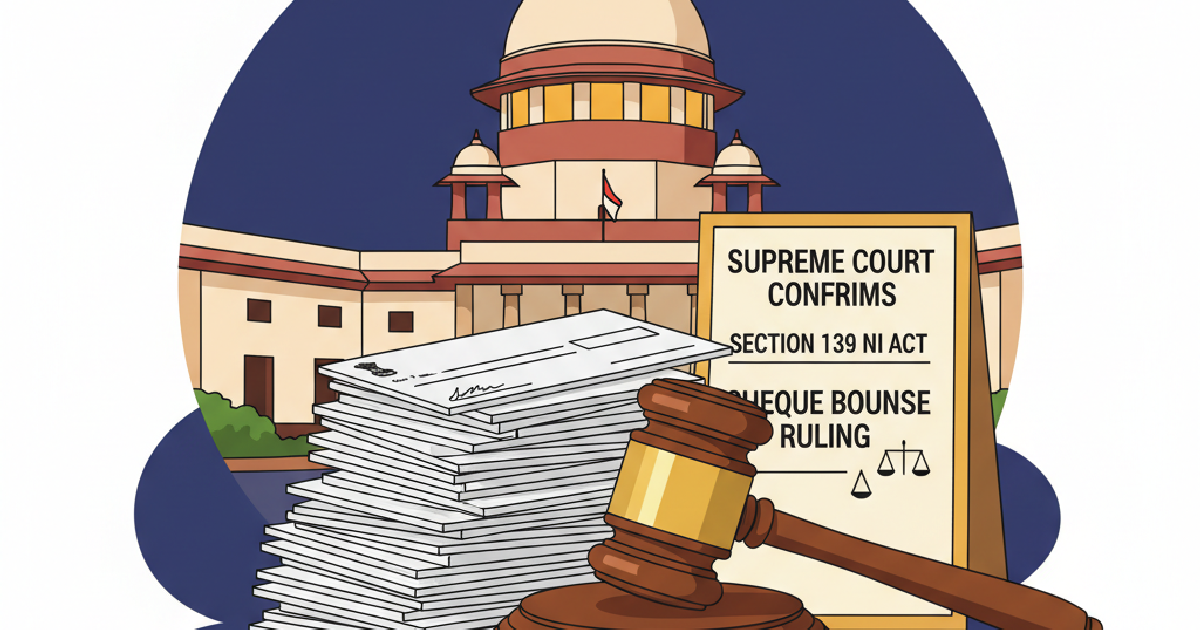
The Supreme Court of India, on February 22, 2024, decisively reaffirmed a crucial aspect of cheque dishonour cases, stating that signed blank cheques, voluntarily signed and handed over by a drawer towards payment, triggers a legal presumption of debt under Section 139 of the Negotiable Instruments Act, 1881 (NI Act). This significant ruling, delivered by a bench comprising Justice B.V. Nagarathna and Justice Augustine George Masih, has far-reaching implications for financial transactions and commercial credibility across the nation.
The decision emphasizes that the act of signing a blank instrument for payment inherently grants authorization for the holder to complete the necessary particulars. This stance aims to bolster the sanctity of negotiable instruments and streamline the process of adjudicating cheque bounce cases.
The core of the Negotiable Instruments Act
The ruling stems from a “meaningful reading” of several key provisions within the Negotiable Instruments Act, 1881. This legislation specifically governs promissory notes, bills of exchange, and cheques, serving as the bedrock for ensuring trust and reliability in India’s financial dealings. It’s a law that has seen amendments over the years, all designed to instil greater confidence in transactions.
Among its crucial sections, Section 139 of the NI Act stands out. It establishes a presumption that a cheque received by its holder is for the discharge of a legally enforceable debt or liability, unless there is proof to the contrary. This presumption is rebuttable, meaning the onus then shifts to the accused to present “cogent evidence” demonstrating that the cheque was not issued for a valid debt.
Understanding the presumption under Section 139: Signed Blank Cheques
Section 139 of the NI Act dictates that if a cheque is issued, it is presumed to be for a legally enforceable debt or liability. This legal presumption, however, isn’t absolute. It can be challenged by the drawer, but the burden of proof to overturn this presumption rests squarely on their shoulders. This means merely denying liability isn’t enough; concrete evidence is required to disprove the existence of such a debt.
The Supreme Court’s decision underscored that it remains “immaterial” if the particulars on the cheque, other than the signature, were filled in by someone other than the drawer, provided the cheque was duly signed. This aspect is crucial for lenders and businesses that often accept blank cheques as security or for future payments, as it prevents debtors from easily evading responsibility by claiming the cheque was incomplete when issued.
The pivotal role of Section 20 of the NI Act
The Court’s reasoning relies heavily on Section 20 of the Negotiable Instruments Act, which deals with “Inchoate Stamped Instruments.” This section, in essence, grants prima facie authority to the holder of a signed blank or incomplete instrument to complete it. For example, if someone hands over a cheque with only their signature, Section 20 implies that they have authorized the recipient to fill in the amount, payee’s name, and date.
This statutory provision legally validates the common practice of issuing blank signed cheques, provided it’s done voluntarily and for a specific payment. It aims to prevent individuals from escaping liability by later claiming the cheque was not fully completed by them. This legal framework reinforces the dependability of cheques in commercial transactions.
Burden of proof on the accused-drawer
When a blank cheque is dishonoured, and the matter goes to court, the law places the burden of proof on the accused-drawer. They must provide “cogent evidence” to demonstrate that the cheque was not issued in discharge of a debt or liability. This requires more than just making a statement; it demands solid proof.
The Supreme Court explicitly overturned a High Court decision that had allowed an accused-drawer to seek a forensic opinion concerning the handwriting on a blank cheque. The apex court found such an exercise to be “immaterial” if the signature itself was admitted. The ultimate question is whether the cheque was voluntarily signed and handed over for payment, not who filled in the other details. Simply raising doubts without credible evidence isn’t enough to rebut the presumption.
Significance of previous rulings influencing the Supreme Court
This recent ruling isn’t an isolated development. It builds upon a robust foundation of earlier judgments that have consistently upheld the sanctity of cheques and the enforceability of liabilities under the NI Act. Several landmark cases have shaped the legal landscape, cumulatively strengthening the position articulated by the Supreme Court on February 22, 2024.
Bir Singh v. Mukesh Kumar (2019): a foundational judgment
A crucial precedent, the two-judge bench decision in Bir Singh v. Mukesh Kumar, delivered on February 6, 2019, laid down a clear principle. It established that even a blank cheque leaf, voluntarily signed and handed over by the accused towards some payment, would attract the presumption under Section 139 of the Negotiable Instruments Act.
This presumption holds unless there is concrete evidence to show that the cheque was not issued in discharge of a debt. The Bir Singh judgment emphasized that the act of voluntarily signing and delivering a blank cheque implies an understanding and acceptance of potential liability.
M/s. Kalamani Tex & Anr v. P. Balasubramanian (2021): reinforcing the principle
Further solidifying this legal stance, a three-judge bench of the Supreme Court, on February 10, 2021, ruled in M/s. Kalamani Tex & Anr v. P. Balasubramanian. This case held that blank cheques would indeed attract the presumption under Section 139 of the NI Act if the accused admitted their signatures on the cheque and the deed of undertaking.
This reiteration highlights the judiciary’s consistent approach to upholding the spirit of the NI Act, ensuring that financial commitments made through cheques are taken seriously. It underlines that mere admission of signature is often sufficient to invoke the presumption.
Rangappa v. Sri Mohan (2010): defining rebuttable presumption
An earlier, yet equally significant, three-judge bench decision in Rangappa v. Sri Mohan (2010) clarified the nature of the presumption under Section 139. It held that the presumption as to a legally enforceable debt or liability is rebuttable. The onus is on the accused to raise a probable defense, meaning they must present credible evidence to cast doubt on the existence of the debt or liability.
This ruling set the stage for how defendants in cheque bounce cases must approach their defense. They can’t simply deny; they must actively present an alternative, plausible explanation for the cheque’s issuance or the absence of a debt.
Oriental Bank of Commerce v. Prabodh Kumar Tewari (2022): consistent application
The principles established in Bir Singh v. Mukesh Kumar were again reaffirmed in 2022 by Justices Dhananjaya Y Chandrachud and A S Bopanna in Oriental Bank of Commerce v. Prabodh Kumar Tewari. This continuous re-affirmation across different Supreme Court benches consistently underscores the judiciary’s commitment to the established legal position regarding blank cheques and the presumption of debt.
The consistent application of this principle across various cases strengthens its legal standing and provides clarity for both creditors and debtors regarding the implications of issuing or accepting blank cheques.
The purpose of Chapter XVII of the NI Act
The Supreme Court’s continued emphasis on upholding the presumption under Section 139 serves a broader purpose encapsulated in Chapter XVII of the Negotiable Instruments Act. This chapter was designed specifically to infuse credibility into financial instruments like cheques and promote their widespread use as a trustworthy alternative to cash payments. It’s all about encouraging financial discipline and ensuring that commercial transactions proceed smoothly and reliably.
The legal framework treats cheques not just as pieces of paper, but as serious financial commitments. By making it difficult for individuals to default on these commitments, the Act encourages a more disciplined approach to financial dealings, benefiting both individuals and the wider economy.
Implications for individuals and businesses
This reiterated legal position has significant practical implications for both individuals and businesses engaging in financial transactions involving cheques. For payees, especially lenders, who often receive blank or post-dated cheques as security or for future payments, this ruling provides a strong legal shield.
It makes it considerably harder for drawers to escape liability by asserting that the cheque was blank or merely for security and not intended to discharge a current debt. However, it also necessitates careful documentation and record-keeping on the part of payees to avoid future disputes.
Increased accountability for drawers
For drawers, the ruling stresses increased accountability. Voluntarily signing and handing over a blank cheque now unequivocally implies an acceptance of the presumption that it was issued against a legally enforceable debt. This means that anyone issuing such a cheque must be acutely aware of its legal ramifications and the robust presumption that will be drawn by courts if it is dishonoured.
It places a significant responsibility on the drawer to maintain meticulous records if they intend to argue that the cheque was for a purpose other than a debt. This might involve written agreements or acknowledgements outlining the specific conditions under which the blank cheque was given.
Strategic value of documentary evidence
In light of this strong legal presumption, the strategic importance of documentary evidence cannot be overstated. For drawers seeking to rebut the presumption under Section 139, presenting “cogent evidence” becomes paramount. This could include bank statements, official loan settlement receipts, or clear written agreements documenting the exact purpose for which a blank cheque was issued.
Any discrepancies in the complainant’s narrative or proof of their inability to actually lend the amount claimed could also form part of a probable defense. This makes detailed record-keeping essential for both parties involved in such transactions.
Cheque dishonour cases and the judicial system
Cheque dishonour cases, particularly those falling under Section 138 of the NI Act, constitute a substantial portion of the judicial backlog in India. Reports indicate that over 3.5 million such cases are currently pending, accounting for a significant 33% to 40% of all cases in district courts. The Supreme Court’s clear stance on blank cheques is aimed, in part, at expediting the resolution of these cases by limiting avenues for technical defenses.
The sheer volume of these cases often leads to prolonged litigation, where securing meaningful recovery can be uncertain for years. This ruling aims to simplify the evidentiary process in many such disputes.
Impact on judicial caseload
The Supreme Court’s reiteration of the presumption concerning blank cheques could have a noticeable impact on the judicial caseload related to cheque bounce cases. By clarifying that a forensic examination of handwriting (other than the signature) is immaterial, and by placing a higher bar for the accused to rebut the presumption, the ruling streamlines the trial process. This could potentially reduce the scope for protracted legal battles based on minor technicalities related to how a cheque was filled out.
This is a positive development for a legal system often burdened by an overwhelming number of cases. Clearer guidelines mean quicker and more decisive judgments in many instances.
Provisions related to cheque dishonour
Beyond Section 139, understanding other related provisions within the NI Act is crucial for a comprehensive grasp of cheque dishonour laws. Section 138, for instance, criminalizes the dishonour of cheques due to insufficient funds or if the amount exceeds the arrangement with the bank. It outlines specific conditions that must be met for an offense to be established.
These conditions include the cheque being presented within its validity period, a demand notice being issued by the payee within 30 days of dishonour, and the drawer failing to make payment within 15 days of receiving this notice. Understanding these steps is vital for anyone initiating or defending a cheque bounce case.
The legal landscape surrounding cheque dishonour has been consistently refined through various judgments. The Supreme Court has specified that demand notices served after 15 days of dishonour are still valid. This clarification helps ensure that legitimate claims are not dismissed on technicalities, reinforcing the protective aspects of the NI Act.
Furthermore, Section 143A of the NI Act allows courts to direct interim compensation to the complainant in certain circumstances. This provision helps mitigate the financial hardship faced by payees during the often-lengthy legal proceedings. In specific instances, such as when an NGO signatory with plenary control is involved, the Supreme Court has ruled that such individuals can be held criminally liable, expanding the scope of accountability.
| NI Act Section | Purpose | Key Feature |
|---|---|---|
| Section 20 | Inchoate Stamped Instruments | Grants holder authority to complete incomplete instruments upon signature. |
| Section 118(a) | Presumption as to Consideration | Presumes instruments are for consideration unless proven otherwise. |
| Section 138 | Dishonour of Cheque | Criminalizes cheque dishonour due to insufficient funds/exceeding arrangements. |
| Section 139 | Presumption in favour of holder | Presumes cheque was for legally enforceable debt/liability. |
| Section 143A | Interim Compensation | Allows courts to order interim compensation to the complainant. |
Looking ahead: continued credibility of cheques
The Supreme Court’s unwavering stance on the validity of blank cheques, coupled with the robust legal framework of the Negotiable Instruments Act, ensures that cheques remain a credible and widely accepted mode of payment in India. This judicial clarity minimises ambiguity and provides a strong legal basis for enforcing financial obligations.
As the economy progresses and digital payment methods become more prevalent, the foundational principles enshrined in the NI Act and interpreted by the Supreme Court will continue to play a vital role in maintaining trust within the financial ecosystem. It sends a clear message that financial commitments, particularly those formalized through cheques, carry significant legal weight and must be honoured.
Frequently Asked Questions
What does “presumption under Section 139 NI Act” actually mean for me?
It means if you sign and hand over a blank cheque, the law automatically assumes you did so to settle a legitimate debt. If that cheque bounces, the burden shifts to you, the drawer, to prove in court that there was no such debt or liability. You’ll need compelling evidence to convince the court otherwise, as merely denying it won’t suffice.
Can I be convicted if I didn’t fill in the amount on the cheque?
Yes, you can be convicted under Section 138. The Supreme Court has ruled that if you voluntarily sign a blank cheque and hand it over for payment, you have authorized the payee to fill in the details. The law presumes the amount filled was for a valid debt unless you can prove otherwise with strong evidence.
Is a handwriting expert’s testimony still useful in these trials?
A handwriting expert is only useful if you are disputing the signature itself—claiming it is a forgery. If you admit that you signed the cheque but argue that someone else filled in the date or amount, the Supreme Court has stated that an expert’s opinion is “immaterial” because the law allows others to fill in those details on a signed instrument.
Call or Whatsapp for free consultation.
Related Service: https://arpitmarwah.com/cheque-bounce-lawyers-in-delhi/