
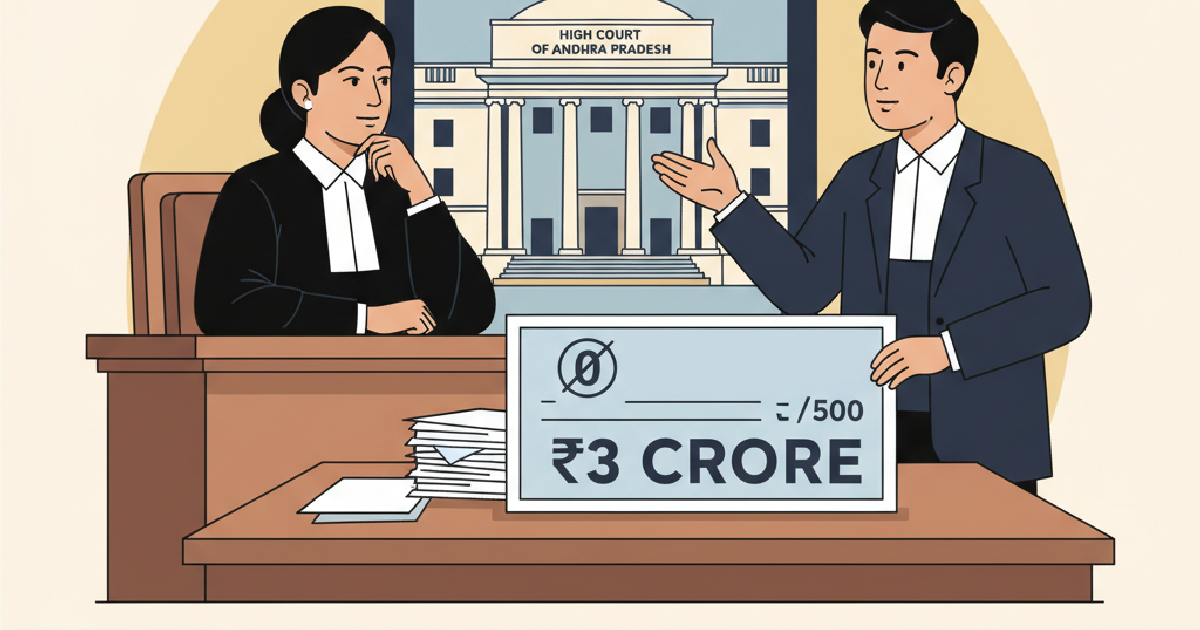
The High Court has upheld the acquittal of a defendant in a high-value cheque bounce case after the complainant failed to demonstrate the financial capacity to have invested ₹3 crore in a petrol bunk venture. THE HONOURABLE JUSTICE G. SRI DEVI presided over Criminal Appeal No. 2852 of 2018, which challenged a trial court judgment dated September 12, 2018, that cleared the first respondent, Smt. K.Yakamma @ Kalyani, of charges under Section 138 of the Negotiable Instruments Act, 1881.
The original private complaint, filed by R. Narender, alleged that two cheques totalling ₹69,50,000 had been dishonoured. This judgment by Justice G. Sri Devi of the High Court of Andhra Pradesh, delivered on April 28, 2021, reinforces the critical role of financial transparency, particularly income tax declarations, in establishing a legally enforceable debt.
High Court confirms lower court’s acquittal reasoning
The High Court meticulously reviewed the trial court’s decision to acquit Smt. K.Yakamma @ Kalyani. The core of the appeal rested on whether the cheques, Exs.P1 and P2, were indeed issued to clear a legally binding debt.
The complainant, R. Narender, alleged that Smt. K.Yakamma @ Kalyani had sought his help in establishing a Bharat Petroleum Corporation Limited petrol bunk. He claimed to have invested a substantial ₹3 crore to procure suitable land and prepare for the retail outlet in Ibrahimpatnam.
Complainant’s financial capacity under scrutiny
During cross-examination, R. Narender admitted he hadn’t filed any documentation to prove he spent ₹3 crore for the petrol bunk land. He also failed to provide any bank statements showing he possessed such a large sum.
Even though he was an income tax assessee, R. Narender didn’t declare this ₹3 crore investment in his tax returns for that period. This omission seriously undermined his claim of financial capability, raising significant doubts for the courts.
The trial court had rightly noted this lack of financial evidence. Without corroboration, the complainant’s version could not be accepted at face value, particularly when dealing with such a large amount.
Legal precedent on income tax declarations
The High Court referenced the Bombay High Court’s ruling in Sanjay Mishra Vs. Ms. Kanishka Kappor @ Nikki and Another. This precedent clarifies that while not every undeclared loan rebuts the presumption under Section 139 of the Negotiable Instruments Act, large, non-short-term advances not disclosed in income tax returns or books of accounts can indeed be sufficient to do so.
In this specific case, the ₹3 crore investment claimed by R. Narender clearly falls into the category of a large amount. Its absence from his income tax returns strongly supported the accused’s defence.
Challenging the presumption of debt under Section 139
Section 139 of the Negotiable Instruments Act, 1881, presumes that a cheque was issued for a legally enforceable debt or liability. However, this presumption is rebuttable, meaning the accused can present evidence to prove otherwise.
Smt. K.Yakamma @ Kalyani successfully argued that the cheques were given solely for security purposes, as explicitly stated in the settlement agreement (Ex.P6).
Discrepancies in the settlement agreement and cheques
The settlement agreement, dated October 15, 2016, stipulated that Smt. K.Yakamma @ Kalyani would pay R. Narender ₹70 lakh in full and final settlement. An advance of ₹50,000 was paid, with the remaining ₹69,50,000 due by November 1, 2016.
However, the agreement did not specify the numbers, dates, or individual amounts of the two cheques handed over. The cheques themselves, Exs.P1 and P2, were drawn on State Bank of Hyderabad, bearing numbers 627842 for ₹34,50,000 and 627844 for ₹35,00,000, both dated November 1, 2016.
Furthermore, the cheques had a printed limit, stating “Not over Rs. 10,00,000/-“. Yet, they were filled out for amounts significantly exceeding this limit. This discrepancy meant the cheques were technically invalid instruments for the stated values.
The trial court observed that the signatures on Exs.P1 and P2 differed from other writings on the cheques, suggesting they were blank cheques given for security. This further weakened the complainant’s claim that they represented an explicit discharge of a debt.
These findings illustrate a common legal hurdle in cheque bounce cases under the Negotiable Instruments Act. A discrepancy between the agreed-upon security and the alleged debt amount creates ambiguity. The ruling highlights that evidence, such as the complainant proving the underlying financial deal validity, becomes paramount.
Role of stop payment instructions
The cheques were dishonoured on November 5, 2016, with the reason “Payment stopped by the drawer.” A statutory notice was issued to Smt. K.Yakamma @ Kalyani on November 15, 2016, and served on November 18, 2016, but she neither paid nor replied.
Crucially, Smt. K.Yakamma @ Kalyani had already issued a notice to R. Narender on October 27, 2016, alleging that he had violated the settlement agreement by removing important files related to the petrol bunk and making illegal demands for excess amounts. She stated she had no choice but to stop payment on the two cheques, which she maintained were for security.
Precedent on stop payment scenarios
The complainant’s counsel argued that prosecution under Section 138 of the Negotiable Instruments Act is permissible even if cheques are returned due to “Stop payment instructions”, citing M/s. Laxmi Dyechem v. State of Gujarat. This legal point is generally valid; a stop payment instruction does not automatically absolve the drawer of liability.
However, in this case, the context of the stop payment was critical. The timely notice from Smt. K.Yakamma @ Kalyani on October 27, 2016, preceding the presentation of the cheques on November 1, 2016 (and their subsequent dishonour), along with her assertion that the cheques were for security and that the complainant had breached the agreement, allowed her to effectively rebut the presumption of a legally enforceable debt.
The timing of these events indicates a proactive defense rather than an attempt to evade a clear liability. This nuanced interpretation of “stop payment” demonstrates that the circumstances surrounding the instruction are vital to the court’s determination.
The settlement agreement and its ambiguities
The settlement agreement (Ex.P6), executed on October 15, 2016, between Smt. K.Yakamma @ Kalyani (first party) and R. Narender (second party), aimed to resolve disputes over the “Adidas Guru Petros” petrol bunk in Ibrahimpatnam.
Under this agreement, the first party agreed to pay ₹70,00,000 as a total settlement, with ₹50,000 paid as an advance. The balance of ₹69,50,000 was to be paid by November 1, 2016, for which two cheques were handed over to the second party “as security for the amount”.
Interpreting “security cheque” clauses
The explicit mention of the cheques being “as security for the amount” in the settlement deed significantly influenced the court’s finding. This wording provides a strong basis for the defence that the cheques were not intended for immediate encashment against an existing, crystallized debt but rather as a guarantee against future obligations or potential breaches.
The High Court found that the trial court was justified in concluding that the accused had successfully rebutted the Section 139 presumption.
This situation underscores the complexities of transactions involving security cheques and the need for clear agreements on their purpose and conditions for presentation. The ruling aligns with broader judicial trends concerning the enforceability of cheque bounce complaints, particularly when the underlying debt itself is disputed on valid grounds.
Broader implications for cheque dishonor cases
This judgment serves as a reminder for individuals and businesses to maintain thorough financial records. It underlines the importance of accurate income tax declarations, especially when large sums are involved in private transactions that might lead to legal disputes.
| Key Fact | Complainant’s Claim | Accused’s Defence / Court Finding |
|---|---|---|
| Investment Amount | ₹3 crore for petrol bunk | No documented proof or income tax declaration |
| Cheque Purpose | Discharge of legally enforceable debt | Issued for security only, as per Ex.P6 |
| Cheque Validity | Valid for full amount | Invalid due to “Not over Rs. 10,00,000/-” caption, filled for higher amounts |
| Stop Payment | Irrelevant, prosecution still valid | Issued notice before presentation alleging breach, justifying stop payment |
| Settlement Agreement (Ex.P6) | Confirmed debt | Lacked specifics like cheque numbers/dates, stated cheques were “as security” |
The case also highlights the judicial scrutiny of the “legal liability” aspect of Section 138. It’s not enough for cheques to bounce; there must be a clear, undisputed and legally enforceable debt that the cheques were intended to discharge.
With thousands of cheque bounce cases pending in Indian courts, decisions like these refine the interpretative framework for the Negotiable Instruments Act. As of December 18, 2024, there were 43 lakh (4.3 million) cheque bounce cases pending across India, with Delhi alone having 5.55 lakh cases pending in trial courts as of October 2025.
The significant number of pending cases underscores the need for clear judicial guidance. This verdict contributes to that clarity by emphasizing the rigorous standards of proof required from complainants, especially regarding their financial capacity and the explicit terms of any underlying agreements. It suggests a move away from simply relying on the statutory presumption without strong corroborating evidence for large transactions.
Frequently Asked Questions
What is Section 138 of the Negotiable Instruments Act?
Section 138 of the Negotiable Instruments Act, 1881, makes the dishonour of a cheque a criminal offence in India. This applies when a cheque, issued for a legally enforceable debt or liability, bounces due to reasons like insufficient funds or stop payment instructions, followed by the drawer’s failure to pay after receiving a demand notice.
Can a “stop payment” instruction prevent a cheque bounce prosecution?
While a “stop payment” instruction does not automatically prevent prosecution under Section 138 of the NI Act, the context and reasons behind it are critical. If the drawer can prove the cheque was issued for security, or if there was a legitimate dispute or alleged breach of agreement leading to the stop payment, they might successfully rebut the presumption of a legally enforceable debt, as seen in this case.
Why are income tax returns important in cheque bounce cases?
Income tax returns can be crucial evidence, particularly for large transactions. A complainant’s failure to disclose a substantial loan or investment in their income tax returns can cast doubt on their financial capacity to have made such an advance. This can weaken their claim that a bounced cheque was issued to discharge a legally enforceable debt, helping the accused to rebut the statutory presumption under Section 139 of the Act.