
Indian legal practitioners and business owners are increasingly leaning on a structured framework of digital evidence and specialized statutes to address the chronic issue of unpaid dues.
From the mandatory mediation requirements under Section 12A of the Commercial Courts Act to the potent threat of imprisonment under Section 138 of the Negotiable Instruments Act, the path to recovering money in India has become more defined for those who maintain rigorous documentation.
Are WhatsApp messages actually valid in Indian courts for debt recovery?
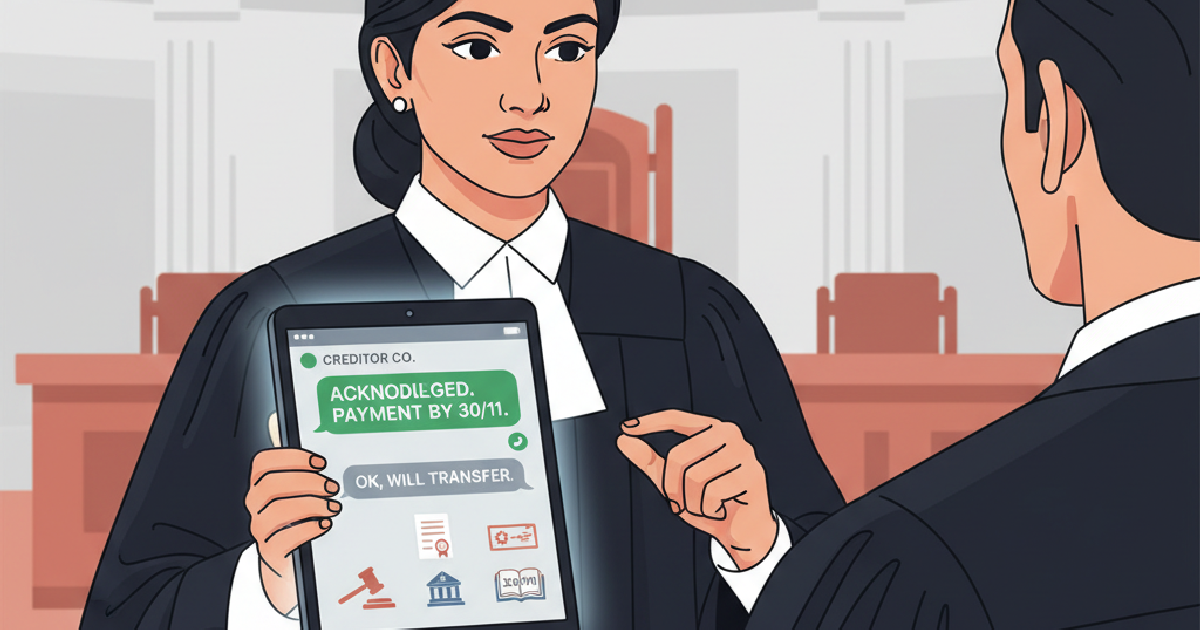
Yes. Under the Indian Evidence Act and the Information Technology Act, messages sent via WhatsApp, email, or SMS that acknowledge a debt are legally admissible evidence. These digital records can be used to prove that the debtor accepted the liability or promised a specific payment date, which significantly strengthens a creditor’s case.
How does the MSME Samadhaan portal help small businesses?
MSME Samadhaan allows registered small businesses to file complaints against buyers for unpaid dues. The process aims to resolve disputes within 90 days through the Facilitation Council. A key feature is the penalty for late payment, which involves the buyer paying compound interest at three times the RBI bank rate to the MSME.
What is a Summary Suit and how is it different from a regular suit?
A Summary Suit under Order XXXVII of the CPC is a faster route used when there is clear written proof of debt, like a signed invoice or contract.
Unlike a regular suit where a debtor can easily contest the claims, in a Summary Suit, the debtor must ask the court for permission to defend themselves by proving they have a valid case. If they fail, the court can issue a decree quickly.
Gathering irrefutable evidence before legal action
Before any formal legal notice is dispatched or a court case initiated, the foundational step for Indian creditors to leverage electronic trails to recover unpaid dues is the meticulous collection of all pertinent evidence. Courts won’t just take your word against theirs; they demand verifiable proof.
This includes a comprehensive array of documents and communications. You’ll need everything from signed contracts and purchase orders to delivery receipts and work acceptance records. Even seemingly informal exchanges can be critical.
The power of digital communication as evidence
Crucially, digital communications like WhatsApp messages, emails, and SMS threads affirming the debt are legally admissible. Both the Indian Evidence Act and the Information Technology Act recognize these as valid proof in court. A simple message saying, “I’ll pay you by Friday,” can be a powerful piece of evidence.
It’s vital never to delete any communication, even if it appears unfavourable at first glance. Destroying evidence, accidentally or intentionally, could severely damage your case or even constitute a separate offence.
Sending a formal legal notice for non-payment
Once you’ve gathered all your evidence, the next crucial step is sending a formal legal notice for non-payment. This isn’t just a polite reminder; it’s a legally binding document drafted by an advocate that signals your serious intent to recover the owed amount.
A well-drafted legal notice often prompts payment without further escalation, saving significant time and costs associated with court proceedings. It explicitly puts the debtor on record and outlines the imminent legal consequences if payment isn’t made.
What makes a legal notice effective?
For a legal notice to be effective, it must clearly state the full details of both parties involved. It needs to articulate precisely what was agreed upon and what remains unpaid, including the exact amount owed and any applicable interest. A firm deadline for payment, typically between 15 and 30 days, must also be specified.
You should send this notice via registered post with acknowledgment due (RPAD) and simultaneously by email. This dual approach ensures you have undeniable proof of delivery on both channels.
Mandatory mediation for commercial disputes
Before launching into potentially lengthy court battles, mediation offers a structured and often quicker alternative. For commercial disputes exceeding a certain pecuniary limit, pre-institution mediation is not just an option; it’s mandatory under Section 12A of the Commercial Courts Act, 2015.
This process involves a neutral third party guiding negotiations between the involved parties. It could save months, if not years, of litigation if a settlement is reached.
Benefits of pre-institution mediation
If mediation proves successful, the resulting settlement is officially recorded by the court, making it enforceable as a judicial decree. This grants the agreement the same legal weight as a court order, but without the extensive time and expense of a full trial.
The process is typically resolved within 30 to 60 days and is far more cost-effective than traditional court proceedings. It also allows parties to potentially preserve valuable business relationships, which can be critical for ongoing commercial activities.
Navigating the spectrum of money recovery mechanisms
India’s legal landscape offers a diverse array of pathways for money recovery, each tailored to specific circumstances, amounts, and types of debt. Choosing the most appropriate route is critical for an efficient and successful recovery.
Understanding these different mechanisms allows creditors to strategically select the path that aligns best with their specific claim, ensuring a targeted and effective approach.
| Legal Route | Best For | Typical Timeframe | Key Legislation |
|---|---|---|---|
| Legal Notice | All disputes — initial step | 2–4 weeks | Advocate / Indian Penal Code |
| Mediation (Section 12A) | Commercial B2B disputes | 30–60 days | Commercial Courts Act |
| Summary Suit | Clear documentary debts | 6–12 months | CPC Order XXXVII |
| Civil Money Suit | Any debt, any party | 1–3 years | Code of Civil Procedure |
| Section 138 NI Act | Dishonoured cheques | 6 months–2 years | Negotiable Instruments Act |
| MSME Samadhaan | MSMEs with unpaid buyer dues | 45–90 days | MSMED Act 2006 |
| Consumer Forum | Individual consumer disputes | 3–6 months | Consumer Protection Act 2019 |
| Debt Recovery Tribunal | Bank / NBFC loans > Rs. 20 lakh | 1–2 years | RDDBFI Act 1993 |
Civil suits and the faster Summary Suit option
The civil money recovery suit forms the bedrock of debt recovery law in India, suitable for nearly any unpaid amount from loans to service fees. The appropriate court depends on the claim value: District Munsiff Court for up to Rs. 1 lakh, Civil Judge (Junior Division) for Rs. 1 lakh to Rs. 20 lakh, and District Court or High Court for amounts exceeding Rs. 20 lakh.
For commercial disputes above the pecuniary limit, the Commercial Court is often the preferred and faster forum. A particularly efficient route for debts evidenced by clear documents like contracts or promissory notes is a Summary Suit under Order XXXVII CPC.
With a Summary Suit, the defendant does not have an automatic right to challenge the claim; they must first obtain court permission, which is granted only if they can present a genuine defence. If they fail to do so, a decree can be passed swiftly, avoiding a full-blown trial. This significantly accelerates the recovery process for creditors with robust documentation, enabling Indian creditors to leverage electronic trails to recover unpaid dues efficiently.
Section 138 NI Act: The powerful cheque bounce weapon
One of the most potent and frequently utilized legal tools for money recovery in India involves dishonoured cheques, governed by Section 138 of the Negotiable Instruments Act. This provision transforms a bounced cheque into a criminal matter, placing significant pressure on the debtor.
Unlike a civil suit, which seeks financial compensation, a Section 138 case can result in criminal liability, including imprisonment for up to two years or a fine of up to twice the cheque amount. This criminal dimension often incentivizes debtors to settle quickly to avoid facing criminal proceedings.
Strict timelines for cheque bounce cases
The process under Section 138 is precise and unforgiving regarding deadlines. The payee must send a demand notice to the drawer within 30 days of receiving the cheque dishonour memo from their bank. If the drawer fails to pay the amount within 15 days of receiving this notice, a complaint must be filed in the Magistrate court within 30 days of that 15-day period expiring.
Missing any of these strict 30-day windows means forfeiting the right to pursue action under Section 138, making prompt action absolutely essential. The Delhi High Court has also clarified that a specific demand for the cheque amount is mandatory for a valid notice under Section 138 of the NI Act, as highlighted in a recent ruling regarding Section 138 NI Act legal notice cheque amount requirements.
MSME Samadhaan for small business fast-track recovery
For India’s micro, small, and medium enterprises (MSMEs) facing payment delays, the MSME Samadhaan portal offers a dedicated, expedited, and highly effective legal recourse. Established under the MSME Development Act, 2006, this online platform is designed to resolve unpaid dues quickly.
MSME Samadhaan is arguably the most accessible and fastest route for small businesses. It bypasses many complexities of traditional courts and focuses squarely on timely resolution.
How MSME Samadhaan works for eligible businesses
Eligible MSMEs can file an online complaint at samadhaan.msme.gov.in. The case is then referred to the Micro and Small Enterprises Facilitation Council (MSEFC) for resolution. The council initially attempts conciliation between the parties.
If conciliation fails, the MSEFC proceeds to arbitration, with a strict mandate to pass an award within 90 days. A critical provision of this Act is the penalty for delayed payments: buyers become liable to pay compound interest at three times the RBI bank rate on the outstanding amount if payments are overdue beyond 30 days from acceptance or the agreed credit period, whichever is shorter.
Key timelines and essential considerations for creditors
Navigating the legal landscape for money recovery in India demands a keen awareness of critical timelines and best practices. Most money recovery suits, under the Limitation Act, 1963, must be filed within three years from the date the debt became due. Missing this window means permanently losing the legal right to claim the money.
Beyond general limitation periods, specific statutes impose their own strict deadlines, as seen with the Negotiable Instruments Act.
Dos and Don’ts for a successful recovery
To maximize the chances of a successful recovery, a few fundamental principles should always be followed. Firstly, document everything diligently from day one: contracts, invoices, messages, and delivery records are all vital. Always start with a legal notice, as it often resolves cases efficiently without court intervention.
Act quickly to meet limitation periods and choose the correct legal forum, such as a Commercial Court for B2B disputes or a Consumer Forum for individual claims. Always consult a lawyer before filing, as initial errors can jeopardize the entire case. Crucially, never threaten criminal action unless unequivocally justified by the facts, and never delete any messages or records.
Frequently Asked Questions
Q1. What is the fastest way to legally recover money in India?
The fastest route depends on your specific situation. A well-executed legal notice often prompts payment within 2–4 weeks, avoiding court. For commercial disputes, Section 12A mediation can resolve matters in 30–60 days. Bounced cheques allow for strong criminal pressure quickly through Section 138 NI Act, while MSME Samadhaan aims to resolve small business dues within 90 days.
Q2. Can WhatsApp messages be used as evidence in money recovery cases?
Yes. WhatsApp messages, emails, and SMS threads are legally admissible evidence under the Indian Evidence Act and the Information Technology Act. Any message where a debtor acknowledges a debt or promises payment is significant in court. It is crucial never to delete such digital communications.
Conclusion: taking control of unpaid dues
Facing unpaid dues can be incredibly frustrating, but Indian law provides a robust arsenal of tools to help creditors recover what they are owed. From formal legal notices and mandatory mediation to powerful civil suits and specialized avenues like Section 138 NI Act and MSME Samadhaan, there’s a clear path forward.
The key lies in early action, meticulous documentation, and selecting the most appropriate legal route for your specific situation. And for those concerned about legal costs, innovative solutions like litigation funding ensure that financial barriers don’t prevent the pursuit of justice. Stop waiting and start acting to recover your legitimate claims.