
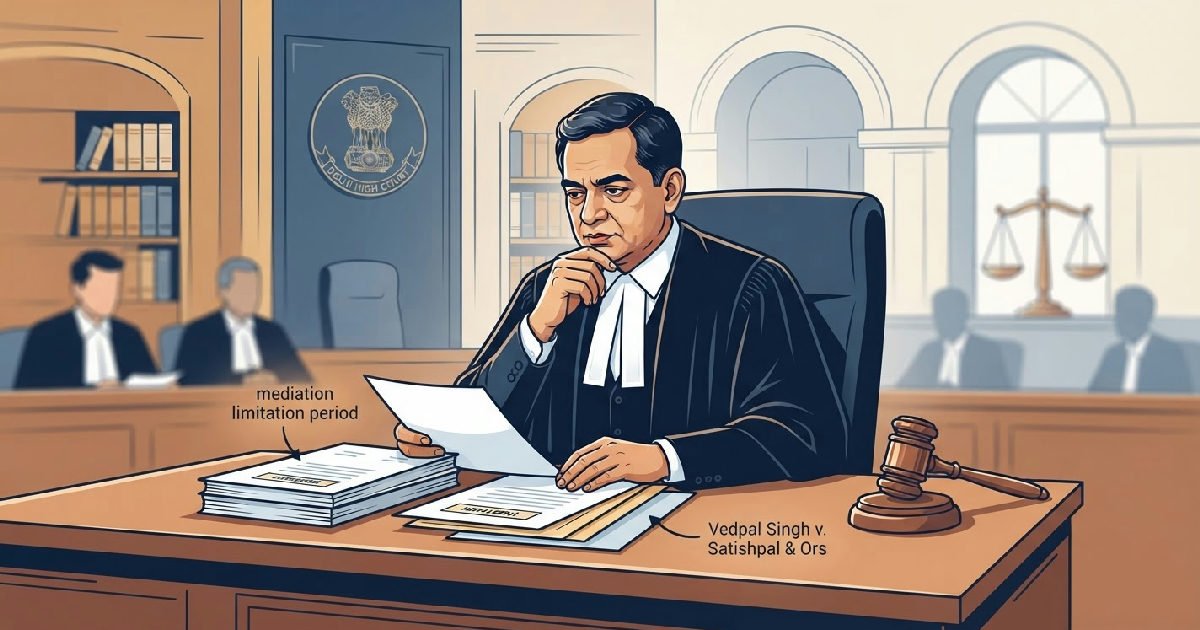
The Delhi High Court is deciding if time in court-mandated mediation pauses the mediation limitation period for filing written statements or replications in civil suits.
This significant referral, made by Justice Subramonium Prasad on July 1, 2026, in the case of Vedpal Singh v. Satishpal & Ors., aims to bring much-needed clarity and uniformity to judicial decisions across the court.
Conflicting views on mediation period exclusion
The issue stems from divergent rulings within the Delhi High Court, creating uncertainty for litigants and judicial officers alike. An authoritative pronouncement is now deemed essential, particularly as India pushes for “Vivad Mukt Bharat,” a nation free from disputes, by promoting alternative dispute resolution mechanisms like mediation.
For some time, benches within the Delhi High Court have held differing opinions on how to treat the period spent in mediation when assessing the deadline for submitting a written statement. This judicial discord has highlighted a fundamental tension between strict procedural timelines and the encouragement of amicable dispute resolution.
One line of judgments has adhered strictly to the 120-day outer limit for filing written statements under the Delhi High Court (Original Side) Rules, 2018. These rulings, such as Harjyot Singh v. Manpreet Kaur (2021) and the Division Bench decision in Amit Tara v. Deepak Tara (2024), effectively state that this period cannot be extended, even if parties are actively engaged in settlement talks.
The strict interpretation of filing deadlines
This strict approach finds its roots in pronouncements by higher courts regarding procedural limits. The Supreme Court, in SCG Contracts (India) v KS Chamankar Infrastructure (2019), affirmed the mandatory nature of the 120-day limit for commercial suits. Similarly, a Division Bench in Ram Sarup Lugani (2020) applied this stringent interpretation to Chapter VII of the Delhi High Court (Original Side) Rules.
Those who uphold this view argue that procedural certainty is paramount for efficient litigation. Allowing exceptions, even for mediation, could open the floodgates to delays and undermine the very purpose of statutory limitation periods.
Equitable considerations for dispute resolution
Conversely, other decisions have championed a more equitable stance. They argue that excluding the mediation period aligns with the broader objective of Section 89 of the Code of Civil Procedure (CPC), which promotes alternative dispute resolution. Cases like Bharat Singh v. Karan Singh (2025) and Sangeeta Rai Sandhu v. Charanjit Sandhu (2025) have supported the exclusion of mediation time.
Justice Subramonium Prasad, who made the current referral, was notably part of the bench that decided Ram Sarup Lugani. However, he later took a divergent view in Bharat Singh, signaling the evolving thought process within the judiciary regarding this complex issue.
The case of Vedpal Singh v. Satishpal & Ors.
The impetus for this crucial referral arose from a chamber appeal in the case of Vedpal Singh v. Satishpal & Ors. The plaintiff, Vedpal Singh, challenged an order issued by a Joint Registrar on May 5, 2026. This order had condoned a delay in the defendants’, Satishpal & Ors., filing a written statement by excluding the time they spent in mediation.
The original civil suit was instituted in 2023, with summons served on the defendants between June and September 2023. Parties agreed to explore an amicable settlement and were referred to the Delhi High Court Mediation Centre on September 12, 2023. This mediation process continued until January 12, 2024, when it ultimately failed to yield a settlement.
Timeline of events leading to referral
The defendants then filed their combined written statement on January 18, 2024. The Joint Registrar, recognizing the period of good-faith mediation, decided to exclude this time from the calculation of the limitation period. This decision, however, directly conflicted with the stricter precedents.
| Event Description | Date | Significance |
|---|---|---|
| Civil Suit Instigated | 2023 | Start of the legal proceeding |
| Summons Served (Defendants) | June – Sep 2023 | Trigger for written statement filing timeline |
| Parties Referred to Mediation | September 12, 2023 | Initiation of alternative dispute resolution |
| Mediation Concluded (Failed) | January 12, 2024 | End of mediation period, return to litigation |
| Defendants File Written Statement | January 18, 2024 | Act challenged for exceeding limitation |
| Joint Registrar’s Order | May 5, 2026 | Excluded mediation time, condoned delay |
| Justice Prasad’s Referral to Larger Bench | July 1, 2026 | Formal decision to seek authoritative ruling |
Promoting alternative dispute resolution in India
Justice Subramonium Prasad emphasized that compelling parties to file written statements while they are actively engaged in mediation would fundamentally undermine the entire purpose of the process. This sentiment aligns with India’s broader national initiative, “Vivad Mukt Bharat,” which aims to foster a dispute-free society by encouraging amicable settlements outside traditional courtrooms.
The judge specifically noted that forcing an adversarial litigation mindset during ongoing mediation would be “swimming against the tide” of promoting dispute resolution. This judicial perspective underscores the growing recognition of mediation as a vital tool in reducing case backlogs and providing more accessible justice.
The role of Section 89 CPC and recent legal reforms
Section 89 of the Code of Civil Procedure (CPC), introduced in 1999, specifically mandates courts to encourage alternative dispute resolution methods, including mediation. This legislative push aims to ease the burden on the judicial system and empower parties to find mutually agreeable solutions.
More recently, the Mediation Act, 2023, has further institutionalized mediation, offering a comprehensive legal framework for its operation. This Act, along with amendments to the Commercial Courts Act, 2015, demonstrates a clear legislative intent to protect and promote mediation, often by excluding the time spent in it from limitation periods in certain contexts.
Implications for litigants and judicial uniformity
The lack of a unified stance on excluding mediation time has created significant uncertainty for litigants. Defendants, particularly, face a dilemma: do they diligently pursue mediation, risking their right to file a timely written statement, or do they prioritize litigation timelines, potentially sabotaging settlement efforts?
The Delhi High Court’s referral signals a clear intent to resolve this ambiguity. A definitive ruling from a larger bench will provide a uniform standard, ensuring that similar cases are treated consistently by Joint Registrars and other judicial authorities.
Impact on commercial and non-commercial disputes
The distinction between commercial and non-commercial suits further complicates the matter. While the 120-day limit for commercial suits is generally considered mandatory, the Supreme Court has indicated more flexibility for non-commercial suits, allowing extensions in “exceptional and rare cases.” The larger bench’s decision could clarify how these distinctions apply in the context of mediation.
This clarification is especially important for businesses and individuals engaged in commercial disputes, where timely resolution and predictable legal processes are critical. An unambiguous ruling would support both the efficiency of the commercial court system and the efficacy of mediation.
The larger bench’s critical task
The Chief Justice of the Delhi High Court will now constitute an appropriate larger bench, likely comprising two or three judges, to deliberate on this complex legal question. Their decision will have far-reaching implications for procedural law and the promotion of alternative dispute resolution across India.
This bench will need to carefully balance the foundational principles of limitation laws, which ensure timely justice and prevent stale claims, against the modern imperative of encouraging mediation as a viable path to dispute resolution. The judgment could set a crucial precedent for other High Courts grappling with similar issues.
Balancing statutory mandates with public policy
The larger bench’s task won’t be simple. They’ll be tasked with reconciling strict statutory provisions on filing deadlines with the public policy goal of reducing litigation through mediation. The outcome will shape how future disputes are managed, potentially offering greater incentives for parties to engage in good-faith settlement discussions.
This decision could also influence how other high courts handle similar questions regarding procedural time limits. Its impact might extend beyond the Delhi High Court, affecting the judicial landscape nationwide and strengthening the country’s commitment to “Vivad Mukt Bharat.”
Looking ahead: potential ramifications
A ruling in favor of excluding mediation time would likely bolster the confidence of litigants and legal practitioners in the mediation process. It would signal that the judiciary is willing to adapt procedural rules to foster collaborative dispute resolution, rather than penalizing parties for attempting to settle amicably.
Conversely, a decision upholding the strict interpretation could mean that parties, particularly in commercial cases, might feel compelled to file their written statements even while mediation is ongoing. This could reduce the effectiveness of mediation by introducing an adversarial element prematurely.
Ensuring fair play and efficient justice
Ultimately, the larger bench’s pronouncement will aim to ensure fair play for all parties involved while also upholding the efficiency of the justice system. The goal is to create a legal environment where mediation is not just an option, but a genuinely viable and protected pathway to resolving conflicts.
This landmark decision could also influence the interpretation of written statement rules in other jurisdictions. It underscores the continuous evolution of legal frameworks to meet contemporary needs, especially in promoting out-of-court settlements.
What is the core legal question the Delhi High Court’s larger bench will decide?
The larger bench will determine whether the time parties spend in court-referred mediation should be excluded when calculating the limitation period for filing a written statement or replication in civil suits, particularly under the Delhi High Court (Original Side) Rules, 2018.
Why did Justice Subramonium Prasad refer this matter to a larger bench?
Justice Prasad noted the existence of conflicting judicial opinions within the Delhi High Court on this issue. He referred the matter to ensure an authoritative and uniform pronouncement, which is crucial for consistent decisions by Joint Registrars and to promote alternative dispute resolution as part of the “Vivad Mukt Bharat” initiative.
What is the “Vivad Mukt Bharat” initiative mentioned by the court?
The “Vivad Mukt Bharat” initiative, or “Dispute-Free India,” is a national push to encourage amicable settlement of disputes outside formal litigation. By emphasizing mediation, the government and judiciary aim to reduce the burden on courts, speed up justice delivery, and foster a more harmonious society.