
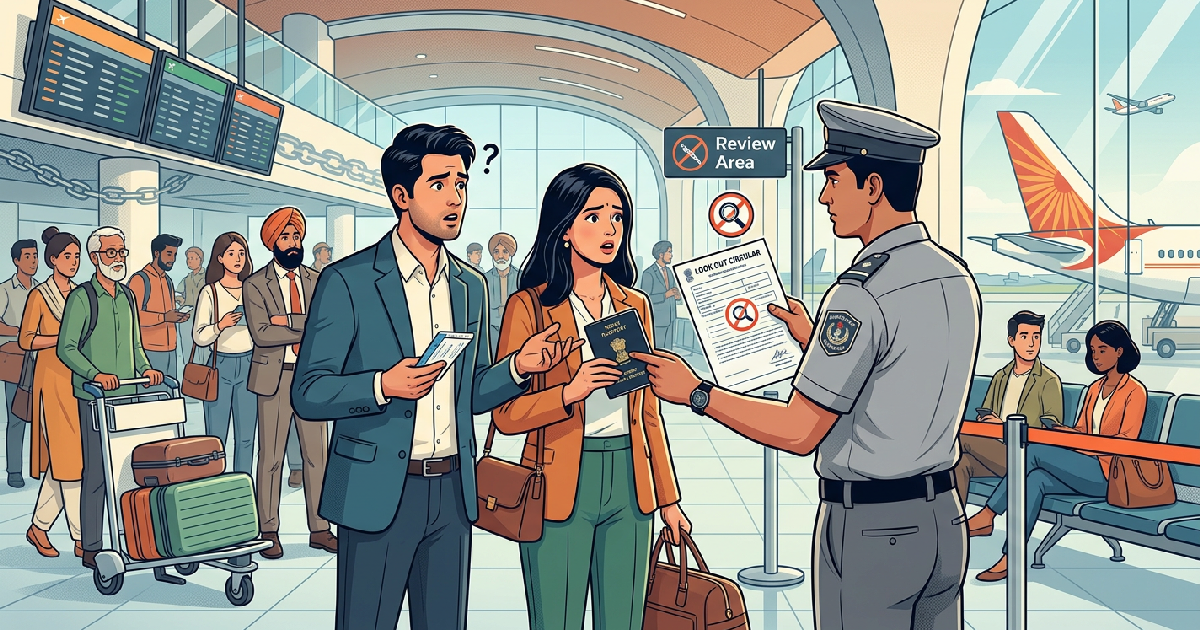
Indian authorities continue to utilize Look Out Circulars (LOCs) as a primary administrative tool to monitor movement at international ports, often resulting in the unexpected detention of Non-Resident Indians (NRIs). These circulars serve as executive instructions to immigration officials to track individuals involved in criminal investigations, matrimonial disputes, or significant loan defaults. Unlike a judicial warrant, an LOC is an administrative monitoring mechanism that can lead to the denial of exit from India or questioning at the immigration counter without prior notice.
For many NRIs and Persons of Indian Origin (PIOs), the existence of an LOC only becomes apparent at the airport. This lack of communication can lead to severe personal and professional consequences, including the loss of employment abroad and the inability to return to their country of residence. Because these circulars are administrative rather than judicial, they are governed by executive guidelines from the Ministry of Home Affairs (MHA), rather than a single specific statute.
The legal framework for these restrictions rests on a combination of MHA Office Memorandums, the Code of Criminal Procedure, 1973, and the Passports Act, 1967. While agencies have broad powers to monitor movement, the Supreme Court confirms directors remain liable for specific financial defaults even after company-level resolutions, highlighting the individual legal accountability that often underlies the issuance of such circulars.
Entities authorized to request Look Out Circulars
Not all government departments possess the power to initiate an LOC. The Ministry of Home Affairs restricts this authority to specific agencies that must demonstrate a legitimate need for tracking a person’s movement. These typically include police authorities investigating cognizable offenses and central investigative agencies like the Central Bureau of Investigation (CBI). Enforcement agencies dealing with economic offenses also hold this power to prevent individuals from evading investigations.
In recent years, the scope has expanded to include public financial institutions under strict conditions. Public sector banks may request an LOC if they believe a borrower involved with large public funds is a flight risk. However, courts have emphasized that these circulars cannot be used merely as recovery tools for debt. They must be backed by a genuine apprehension that the individual will abscond to frustrate legal proceedings.
Agencies and grounds for LOC issuance
| Requesting Authority | Primary Grounds for Request | Possible Directive to Immigration |
|---|---|---|
| Central Bureau of Investigation (CBI) | Pending federal criminal investigations | Detain or prevent departure |
| Police Authorities | Cognizable offenses or matrimonial disputes | Inform agency or allow travel with intimation |
| Public Sector Banks | Loan defaults involving large public funds | Prevent departure due to risk of absconding |
| Indian Courts | Non-compliance with summons or warrants | Follow specific judicial directions |
Impact on NRIs in matrimonial and economic cases
Matrimonial litigation remains one of the most common triggers for LOCs against NRIs. Under provisions like Section 498A of the Indian Penal Code, police may seek a circular to ensure a spouse’s presence during an investigation. However, judicial view from various High Courts has cautioned against the routine use of travel bans in domestic matters. Courts advocate for proportionality, balancing the needs of the investigation against the constitutional right to personal liberty.
Economic offenses involving alleged fraud, cheating, or corporate irregularities also frequently lead to travel restrictions. Because the right to travel abroad is considered part of personal liberty under Article 21 of the Constitution, any restriction must be fair and reasonable. In complex financial disputes, knowing how the Telangana High Court clarifies the 120-day limit for filing certain legal statements can be critical for individuals attempting to resolve the underlying cases that triggered the LOC.
Legal process for the revocation of circulars
The process of revoking an LOC begins with identifying the specific agency that requested it, which can be done through immigration officials or court records. Once the issuing authority is known, the individual can submit a representation to that agency. This submission should provide evidence that the individual is not a flight risk or that the reasons for the circular no longer exist. If the agency does not act, the individual may seek judicial review.
High Courts have the jurisdiction to examine whether an LOC was issued in compliance with MHA guidelines. They often assess whether the restriction is a proportionate response to the investigation’s requirements. If the circular was issued based on procedural errors or without recorded reasons, the court may order its withdrawal. For those dealing with cheque-related financial disputes, it is useful to note that the Madras High Court allows photocopies as secondary evidence in some cases, which may be relevant when presenting documentation to clear one’s legal standing.
Frequently Asked Questions
Can a private individual directly request an LOC?
No, private individuals are not empowered to directly request the issuance of a Look Out Circular. However, a private complaint or FIR filed with the police or other investigative agencies can lead to those authorities requesting an LOC if they believe the accused may flee the country.
What are the typical actions taken by immigration officials?
Depending on the specific directions in the circular, immigration authorities may detain the individual, prevent their departure from India, inform the requesting agency of their movement, or allow travel while providing an intimation to the concerned authorities.
Do authorities have to give prior notice before issuing an LOC?
Authorities generally do not provide prior notice to individuals before an LOC is issued. This lack of notification is often intended to prevent the person from leaving the country before the circular is active. Most travelers only discover the LOC when stopped at a port of entry or exit.