
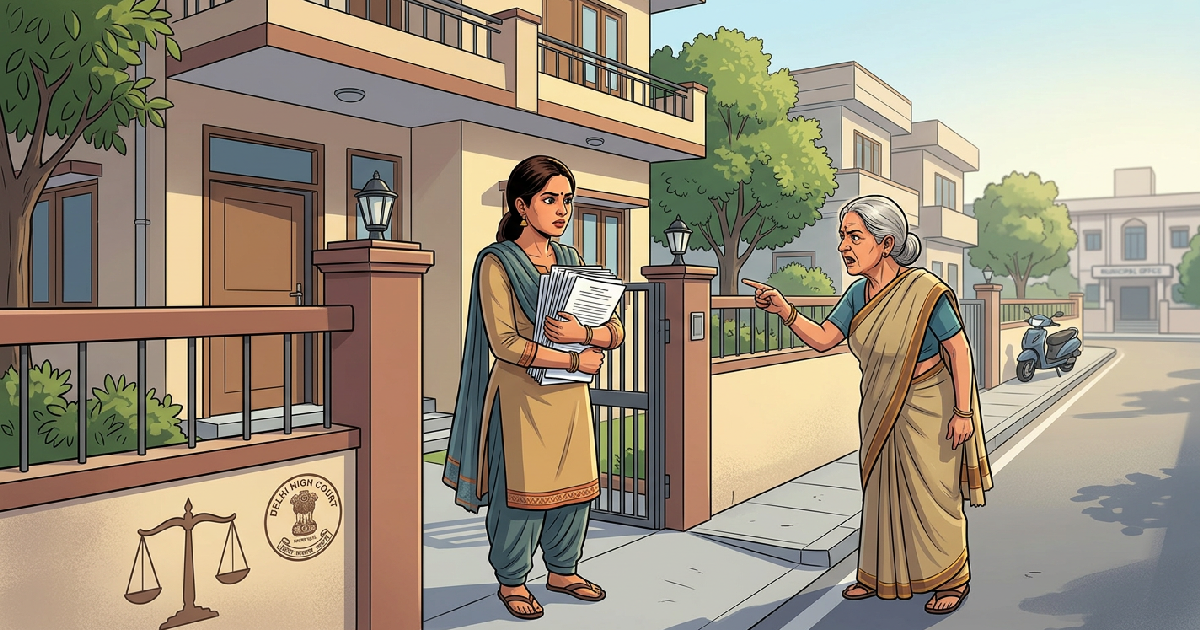
The Delhi High Court ruled on May 23, 2026, that property disputes with in-laws and a daughter-in-law do not fall under the exclusive jurisdiction of Family Courts. Justice Amit Sharma upheld the dismissal of a plea that sought to transfer a mother-in-law’s injunction suit to the specialized family tribunal, clarifying that such proprietary conflicts are not matrimonial in nature. The court observed that the mere existence of a marital relationship between the parties does not automatically trigger the provisions of the Family Courts Act, 1984.
The ruling clarifies a critical point of jurisdiction for senior citizens seeking to protect their assets from relatives. By determining that these disputes are primarily about property titles rather than marital rights, the court has ensured that owners of self-acquired homes can pursue remedies in Civil Court. This distinction is vital because proprietary disputes do not always arise from the marital bond, which remains the determinative test for Family Court authority under Sections 7 and 8 of the Family Courts Act.
In his judgment, Justice Amit Sharma relied on the legal precedent established by a Division Bench in the case of Geeta Anand v. Tanya Arjun. That ruling clarified that the primary question is whether the cause of action directly arises from the marriage. When a mother-in-law files for a permanent injunction regarding her own property, she is exercising a right as a property owner. This decision mirrors broader judicial efforts to ensure that property status is treated as a triable issue when ownership is contested.
Distinguishing proprietary rights from shared household protections With Respect to Property Disputes with In-Laws
The Delhi High Court emphasized that while the Protection of Women from Domestic Violence Act, 2005 (PWDV Act) provides a right of residence, this right is protective and not proprietary. A daughter-in-law’s right to a “shared household” does not equal an ownership stake in a home her in-laws purchased themselves. The judiciary continues to balance these residence rights against the right of senior citizens to live peacefully and with dignity.
Another significant aspect of the court’s recent findings is the impact of divorce on residence claims. Once a marriage is dissolved by a valid decree of divorce, the domestic relationship ends. Consequently, the foundation for the right of residence under the PWDV Act no longer survives. This creates a clear boundary: a claim for residence cannot be sustained unless a separate statutory right is shown to exist. The rejection of a plaint is often pursued in such cases where the legal basis for the claim has evaporated due to the termination of the marriage.
Balancing senior citizen welfare with maintenance obligations
The court has also clarified the limits of the Maintenance and Welfare of Parents and Senior Citizens Act, 2007. On May 12, 2026, in the case of Parmal & Anr. v. The State & Ors., Justice Purushaindra Kumar Kaurav ruled that in-laws cannot be legally compelled to provide “permanent alternate accommodation.” The proceedings under the 2007 Act are meant to secure peace for senior citizens and cannot be used to adjudicate complex civil disputes over financial entitlements.
In the Parmal case, the court modified an order to ensure the elderly parents’ rights were respected while still supporting the daughter-in-law. The petitioners were directed to pay a combined monthly sum of ₹30,000 for maintenance and accommodation. This allowed the in-laws to reclaim their home while ensuring the daughter-in-law and her children were not left without resources. Similar logic appeared in the October 30, 2025, ruling in Manju Arora v. Neelam Arora & Anr., where an eviction was upheld provided the in-laws covered rent for alternate housing.
Recent Delhi High Court Property and Jurisdictional Rulings
| Case Title / Context | Date of Ruling | Presiding Judge(s) | Decision Summary |
|---|---|---|---|
| In-laws v. Daughter-in-law (Jurisdiction) | May 23, 2026 | Justice Amit Sharma | Self-acquired property disputes not restricted to Family Court. |
| Parmal & Anr. v. The State & Ors. | May 12, 2026 | Justice Purushaindra Kumar Kaurav | Petitioners ordered to pay ₹30,000 monthly for maintenance. |
| Manju Arora v. Neelam Arora & Anr. | October 30, 2025 | Justice Anil Kshetrapal & Justice Harish V. Shankar | Daughter-in-law evicted; in-laws to pay up to ₹65,000 rent. |
These decisions collectively reinforce the 2007 Senior Citizens Act, which aims to protect the elderly from harassment in their homes. While the law protects daughters-in-law from immediate homelessness, it does not allow matrimonial statutes to be used as a forum for ownership claims. The court continues to maintain that the Civil Court remains the proper venue whenever the dispute centers on title deeds rather than the marital relationship itself.
Frequently Asked Questions
Why can property disputes go to Civil Court instead of Family Court?
The Delhi High Court held that if a dispute over self-acquired property is based on ownership title rather than a cause of action arising directly from marriage, the Family Court does not have exclusive jurisdiction. The determinative factor is whether the claim is proprietary or matrimonial.
What is the “shared household” right under the PWDV Act?
The “shared household” right is a protective measure that allows a daughter-in-law to reside in the home. However, it does not grant her any proprietary interest or ownership rights in property that her in-laws acquired with their own funds.
Can in-laws be forced to provide a permanent house for a daughter-in-law?
No, the High Court ruled on May 12, 2026, that senior citizens cannot be legally compelled to provide permanent alternate accommodation. Instead, the court can direct the payment of monthly maintenance and rent to satisfy household requirements.
Call or Whatsapp for free consultation.
Related Services: https://arpitmarwah.com/family-law/