
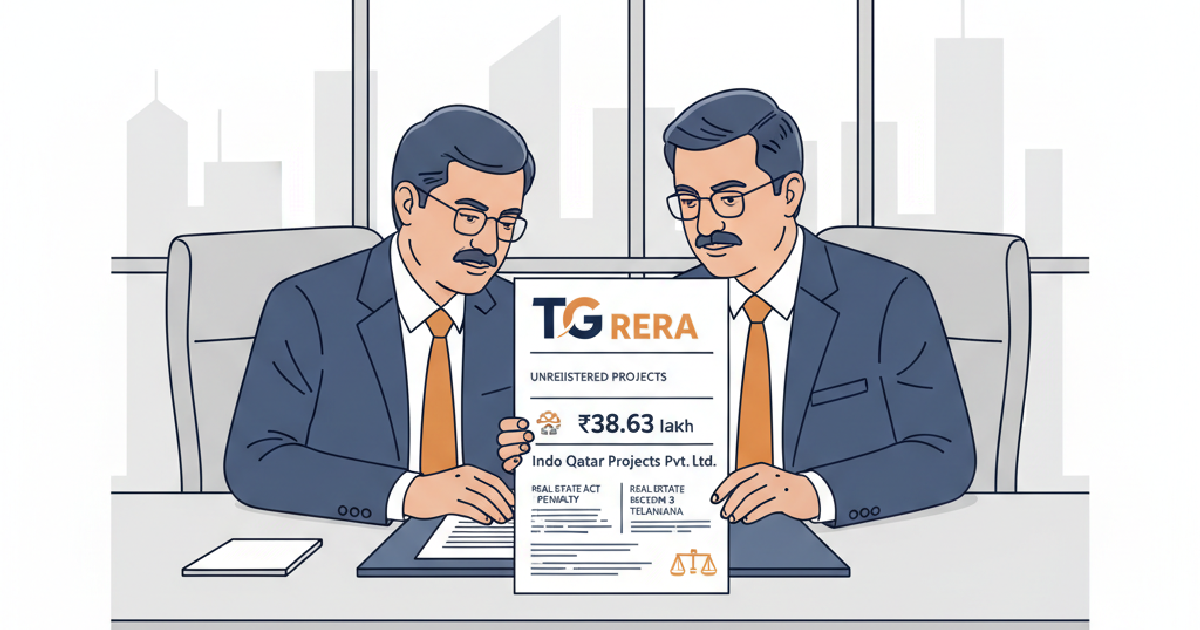
The Telangana Real Estate Regulatory Authority (TG RERA) has officially penalized Indo Qatar Projects Pvt. Ltd. with a consolidated fine of ₹38.63 lakh for marketing unregistered real estate projects and acting as an unauthorized real estate agent.
In an order issued on June 27, 2026, the regulatory body’s coram, comprising members Laxmi Narayana Jannu and K. Srinivasa Rao, found the developer in direct violation of the Real Estate (Regulation and Development) Act, 2016, following a formal complaint by N. Ramu, a resident of Khammam.
Telangana RERA delivers substantial fine for compliance failures
This hefty fine underscores TG RERA’s unwavering commitment to upholding the Real Estate (Regulation and Development) Act, 2016 (RERA Act). The authority emphasized that registration is a mandatory pre-condition for any commercial or promotional activity involving real estate projects.
Promoters must secure this registration before they can even advertise, market, solicit bookings, sell, or offer for sale any plot, apartment, or building.
The specific penalty for marketing unregistered projects totalled ₹30.66 lakh. A separate fine of ₹7.97 lakh was levied for operating as an unregistered real estate agent, specifically concerning the marketing of the Pranamam Project.
Indo Qatar Projects Pvt. Ltd. has been given 30 days from the order date to deposit the consolidated penalty. They must also remove all advertisements for these unregistered projects within seven days and submit a compliance report within 10 days.
The sweeping scope of RERA Act requirements
The RERA Act, a landmark piece of Indian legislation, aims to bring transparency and accountability to the real estate sector. Its core purpose is to protect homebuyers and streamline dispute resolution.
Section 3 of the Act is particularly crucial. It prohibits developers from undertaking any form of marketing or sales activity for residential or commercial projects until they gain RERA registration.
This stringent requirement ensures that buyers are not enticed by projects lacking necessary approvals and safeguards.
Protecting residential property buyers
The RERA Act mandates registration for projects where the land area exceeds 500 square meters or involves more than eight units. This wide scope covers a significant portion of new residential and commercial developments.
It means that consumers purchasing property within Telangana can expect a heightened level of due diligence and regulatory oversight, reducing instances of fraud and delays.
The Act also provides a clear mechanism for redressal, empowering authorities like TG RERA to impose penalties and ensure compliance.
Company’s response and RERA’s findings
Indo Qatar Projects Pvt. Ltd. attempted to defend itself against the allegations. They claimed some of their projects already possessed valid RERA registrations, while others belonged to third parties or had commenced prior to the RERA regime coming into full effect.
TG RERA meticulously reviewed these claims. They accepted explanations for projects possessing valid registrations, demonstrating a fair and evidence-based approach to enforcement.
The authority also found no material evidence linking the company to the Indrasena Project, indicating a thorough investigation.
Projects under scrutiny revealed
Critically, the RERA order highlighted several projects that Indo Qatar Projects Pvt. Ltd. was advertising and marketing without proper registration. These included “Indraprastha,” “Rajahamsa,” “Vaikunthapuram,” “Dharani,” “Janmabhoomi,” “Manoharam,” “Hastina,” and “Dhruva.”
These projects, many of which are part of the company’s portfolio of luxurious gated communities in areas like Khammam, fell squarely under the RERA Act’s purview.
The investigation also revealed that the company facilitated the sale of the Pranamam Project without obtaining the requisite real estate agent registration, adding another layer to their non-compliance.
The growing enforcement trend in Telangana’s real estate sector
This penalty against Indo Qatar Projects Pvt. Ltd. reflects a broader trend of increased regulatory scrutiny across Telangana’s real estate market. TG RERA, operational since 2017, has been consistently strengthening its enforcement mechanisms.
The authority aims to ensure all developers and agents adhere strictly to legal requirements, fostering a more secure environment for property transactions.
Dr. N. Satyanarayana, IAS (Retd.), who served as the first full-time Chairman of TG RERA until May 2026, played a pivotal role in these efforts. During his tenure, he focused on clearing a substantial backlog of complaints and implementing stringent compliance measures.
Impact on developers and buyers
For developers, this means a non-negotiable imperative to register all projects and operate with full transparency. Ignoring RERA mandates carries significant financial penalties and reputational damage.
For buyers, these actions provide enhanced protection. They can confidently invest in RERA-registered projects, knowing that their investments are safeguarded by a robust regulatory framework.
This is particularly reassuring for those who are purchasing residential properties, as it mitigates risks associated with unapproved developments and unethical marketing practices. Many non-resident Indians often look for guidance on understanding the mandatory rights of NRIs under the RERA Act in India to ensure their investments are secure.
What this ruling means for future compliance
The TG RERA order serves as a stark reminder to all real estate stakeholders in Telangana about the critical importance of compliance. It clearly demonstrates that the authority will not hesitate to impose significant penalties for violations of the RERA Act.
Developers must ensure comprehensive registration of all their projects and, if acting as agents, must also secure the necessary agent registrations.
This ruling reinforces the message that adherence to the RERA Act is not optional but a fundamental prerequisite for operating in the state’s real estate sector.
Stricter oversight for marketing and sales
The emphasis on marketing and sales activities is particularly noteworthy. The Act aims to prevent developers from making premature promises or taking bookings before a project has received the necessary legal green light.
This proactive approach by TG RERA helps to curb misleading advertisements and fraudulent practices, ensuring that consumers have accurate information before making significant financial commitments.
Such regulatory actions also create a level playing field for compliant developers.
A closer look at regulatory penalties
The calculation of penalties under RERA typically considers the total project cost or the estimated value of the properties marketed without registration. In this case, the ₹38.63 lakh penalty reflects the severity of the dual infractions.
It’s a punitive measure designed to deter future non-compliance and compensate for the regulatory oversight required to identify and address these violations.
The authority’s ability to recover unpaid amounts as arrears of land revenue gives its orders significant teeth, ensuring that developers cannot easily evade their financial obligations.
| Violation Type | Penalty Amount (₹ Lakh) | Associated Act Section |
|---|---|---|
| Marketing Unregistered Projects | 30.66 | Section 3 of RERA Act |
| Operating as Unregistered Agent | 7.97 | Section 3 of RERA Act |
| Total Consolidated Penalty | 38.63 |
These figures highlight the direct financial repercussions developers face when they fail to comply with RERA regulations. Ensuring proper registration is not just a legal formality but a crucial aspect of responsible business practice.
Importance of agent registration
The penalty for operating as an unregistered real estate agent also highlights another critical aspect of RERA compliance. Agents play a pivotal role in connecting buyers with properties.
They too must be registered, ensuring they operate ethically and possess the necessary knowledge of the RERA Act to guide homebuyers accurately. This helps prevent instances where agents inadvertently or intentionally promote unregistered properties.
Many individuals, especially NRIs, often wonder how to file a RERA complaint against a builder from abroad when they encounter such issues, underscoring the need for registered agents.
Broader implications for the real estate sector
This ruling will likely encourage greater vigilance among real estate developers and agents throughout Telangana. It establishes a strong precedent that regulatory compliance is paramount.
The increasing digital footprint of real estate marketing, where companies advertise extensively online and through brochures, means that such materials are easily scrutinized by vigilant residents and regulatory bodies alike.
The case of Indo Qatar Projects serves as a cautionary tale.
Investor confidence and market transparency
Ultimately, strict enforcement of RERA provisions boosts investor confidence. Buyers, both domestic and international, are more likely to invest in markets where regulations are clear and robustly enforced, reducing the perceived risks of property acquisition.
This transparency is vital for the sustained growth of the real estate sector. It also supports the overall health of the residential market by rooting out non-compliant players.
The ability of government bodies to regulate and penalize ensures a more trustworthy environment for all parties involved in real estate transactions.
Frequently Asked Questions
What is the Real Estate (Regulation and Development) Act, 2016?
The RERA Act, 2016, is an Indian parliamentary act designed to protect homebuyers and boost investments in the real estate sector. It mandates project registration, ensures transparency, and establishes a grievance redressal mechanism for consumers.
Why is it mandatory for projects to be registered with RERA?
Project registration with RERA is mandatory to ensure transparency and accountability. It guarantees that developers meet all legal requirements and have necessary approvals before marketing or selling properties, safeguarding buyer interests.
What recourse do consumers have if a developer markets an unregistered project?
Consumers encountering unregistered projects being marketed can file a complaint with their respective state RERA authority. The authority will then investigate the matter and take appropriate action, which can include imposing penalties on the developer.