
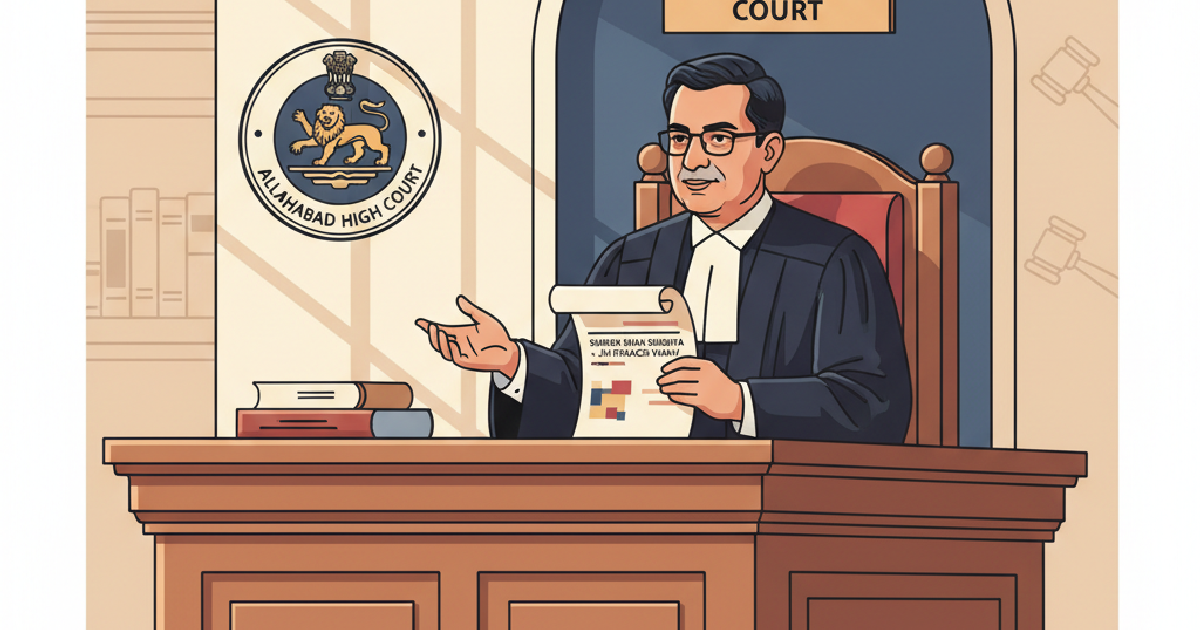
Dr. Justice Yogendra Kumar Srivastava of the Allahabad High Court has issued a definitive ruling regarding the jurisdictional boundaries of Small Cause Courts, clarifying that these bodies must return any plaint where a bona fide title dispute exists that cannot be resolved through summary proceedings.
In the judgment delivered on May 5, 2026, in the case of Suresh Shah Sisodiya v. Jai Prakash Yadav (S.C.C. REVISION No. 16 of 2026), the court established that a Small Cause Court cannot simply dismiss a suit once a genuine title dispute is found. Instead, it must return the plaint under Section 23 of the Provincial Small Cause Courts Act, 1887, allowing it to be filed in a court with the proper jurisdiction and procedural framework to adjudicate such complex matters.
Clarifying jurisdictional limits for property disputes
The Allahabad High Court’s recent ruling, spearheaded by Dr. Justice Yogendra Kumar Srivastava, reaffirms a critical procedural requirement for Small Cause Courts across the state. This decision, announced on May 5, 2026, and reported on June 27, 2026, specifically addresses situations where a property dispute involves a genuine, good-faith disagreement over title.
It clarifies that while Small Cause Courts are designed for expeditious resolution of minor civil disputes, they are not equipped to definitively rule on intricate questions of property ownership. This judgment provides essential guidance for lawyers and litigants grappling with the choice of forum for property-related claims.
The mandate of Section 23 of the Act
The core of the Allahabad High Court’s pronouncement lies in its interpretation and enforcement of Section 23 of the Provincial Small Cause Courts Act, 1887. This section explicitly states that if a Small Cause Court concludes that a suit involves a question of title which it cannot finally determine, it is obligated to return the plaint. This return facilitates its presentation to a court that does possess the jurisdiction to resolve such detailed title issues.
Justice Srivastava’s ruling underscores that the intent behind Section 23 is to prevent complex property disputes from being adjudicated in a summary manner without the full scope of evidence and appellate review typically available in ordinary civil courts. It’s a protective measure for both the courts and the litigants.
Distinguishing incidental findings from decisive title adjudication
An important nuance highlighted by the court is the distinction between a Small Cause Court deciding a title question “incidentally” and making a final determination of title. Small Cause Courts retain the discretion to consider title issues if it’s merely a collateral aspect necessary to resolve the main dispute, such as a landlord-tenant matter.
However, this incidental power does not extend to cases where the very right of the plaintiff and the relief sought are fundamentally dependent on proving or disproving a bona fide and intricate title to immovable property. In such instances, the court loses its ability to proceed summarily and must divest itself of the case.
| Aspect | Small Cause Courts | Regular Civil Courts |
|---|---|---|
| Jurisdiction Scope | Summary proceedings for specific civil suits | Broad civil jurisdiction, including complex property and title disputes |
| Title Dispute Resolution | Can sometimes decide incidentally if not central | Equipped to finally determine intricate title questions |
| Discretion to Return Plaint | Mandatory under Section 23 for bona fide title disputes | Not applicable; typically retains jurisdiction for such matters |
| Evidentiary Procedure | More concise and summary | Full recording of evidence, detailed examination |
| Appellate Avenues | Often limited or different from regular civil appeals | Comprehensive appeal processes available |
Procedural safeguards: return of plaint vs. dismissal of suit
The Allahabad High Court was precise in differentiating between returning a plaint and dismissing a suit. A dismissal typically concludes the litigation, often barring future action on the same grounds, or at least making it significantly harder. But the return of a plaint under Section 23 is a procedural directive, not a judgment on the merits.
When a plaint is returned, the plaintiff receives it back with an endorsement specifying the reasons for its return. They can then present the identical plaint in the appropriate regular court. This ensures that a litigant’s legitimate claim isn’t extinguished due to an initial misfiling, preserving their rights and allowing the case to proceed in the correct forum.
This procedural mechanism aligns with Order VII Rule 10 of the Code of Civil Procedure (CPC), 1908, which dictates the return of plaints due to jurisdictional deficiencies. Furthermore, Section 14 of the Limitation Act, 1963, typically allows for the exclusion of time spent prosecuting the case in the wrong forum when re-filing, preventing undue prejudice to the plaintiff. For instance, the Supreme Court has also clarified when a rejection of a plaint under Order VII Rule 11 CPC might require a clear bar of law to reject a plaint, underscoring the importance of proper procedural application.
Impact on legal proceedings and judicial efficiency
This ruling is set to have a meaningful impact on how property-related disputes are handled in Uttar Pradesh and reinforces the principles of judicial efficiency. By mandating the transfer of complex title disputes to regular civil courts, the Allahabad High Court ensures that cases receive the rigorous scrutiny they require.
It prevents Small Cause Courts, with their summary procedures, from being burdened with matters that demand extensive evidentiary processes and detailed legal analysis beyond their intended scope. This approach ultimately aims to provide more just and comprehensive outcomes for litigants.
The decision also provides clarity for legal practitioners, helping them better advise clients on the appropriate forum for their claims from the outset. This could reduce delays and the expenditure of resources associated with litigating in the wrong court.
Broader implications of the ruling
The judgment from Dr. Justice Yogendra Kumar Srivastava of the Allahabad High Court echoes broader legal principles established by higher courts regarding the proper adjudication of property rights. The Supreme Court of India has consistently emphasized that complex property matters, especially those involving title, require proper civil adjudication rather than summary proceedings.
A “bona fide dispute” is a genuine, good-faith disagreement over ownership, backed by plausible evidence. Distinguishing such a dispute from a frivolous claim is crucial. This ruling prevents parties from attempting to bypass the more rigorous procedures of a civil court by filing complex title disputes in a Small Cause Court.
The principle articulated here is vital for maintaining the integrity of the judicial system. It confirms that the specialized nature of Small Cause Courts should not be overridden when fundamental questions of property ownership are at stake. This ensures transparency and fairness in legal processes, safeguarding the rights of property holders.
Frequently Asked Questions
What is a Small Cause Court?
A Small Cause Court is a specialized civil court established under the Provincial Small Cause Courts Act, 1887, designed to rapidly resolve civil suits of a limited monetary value and specific nature, such as claims for money due on contract or for movable property, through summary procedures.
What does a “bona fide title dispute” mean in this context?
A bona fide title dispute refers to a genuine, good-faith disagreement over the ownership of property, supported by credible evidence, rather than a frivolous or manufactured claim. When such a dispute is genuinely complex and central to the case, Small Cause Courts are deemed unsuitable to resolve it finally.
What happens if a plaint is returned by a Small Cause Court?
If a plaint is returned, the litigant can then re-file it in the appropriate regular court of competent jurisdiction. This procedural step ensures that the case is heard in a forum capable of handling detailed examination, evidence, and appeals related to complex property title issues, preserving the plaintiff’s right to pursue their claim.