
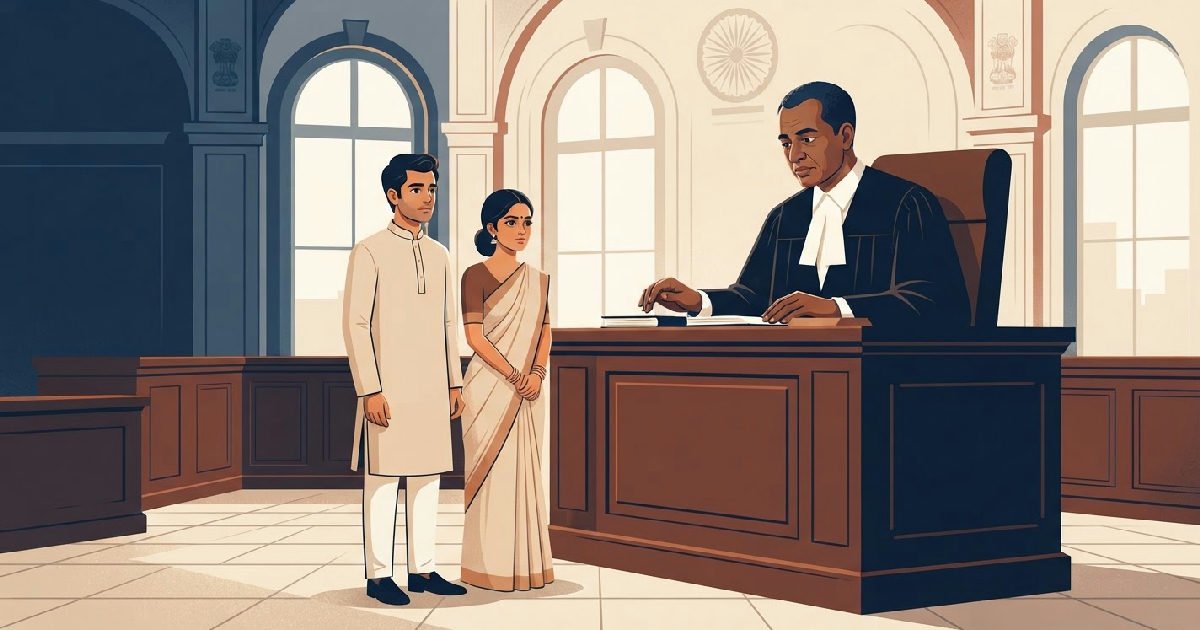
Delhi courts can issue decrees for Restitution of Conjugal Rights (RCR), a specific legal remedy for spouses whose partners have withdrawn from their society without a justifiable reason. Governed primarily by Section 9 of the Hindu Marriage Act (HMA), 1955, such a court order directs the absent spouse to resume cohabitation.
However, this legal mechanism distinctly does not involve physical compulsion or police intervention, underscoring its unique judicial nature.
Understanding Restitution of Conjugal Rights in Delhi
While an RCR decree serves as a formal declaration of marital duty to cohabitate, its implementation is strictly limited to legal pronouncement. Understanding the precise scope and limitations of an RCR order is crucial for anyone navigating matrimonial cases in Delhi, as it defines what the court can, and cannot, enforce.
The concept of Restitution of Conjugal Rights operates as a legal means to preserve the marital bond. It allows an aggrieved spouse to petition the court when their partner has left the marital home or ceased cohabitation without a legally recognised excuse. The court then assesses the reasons behind this separation.
This civil remedy aims to encourage reconciliation and ensure that matrimonial obligations are acknowledged. Its application is strictly defined by statute, particularly within the Hindu legal framework. It serves as a judicial affirmation of the marital relationship.
The Legal Framework: Section 9 HMA
Section 9 of the Hindu Marriage Act, 1955, provides the specific legal foundation for RCR petitions in Delhi. This section stipulates that when either the husband or the wife has withdrawn from the society of the other without reasonable excuse, the aggrieved party can apply to the district court.
The court will then determine if the statements in the petition are true and if there are no legal grounds to deny the application.
A clear demonstration that one spouse has indeed withdrawn from the other’s society is required by law. Crucially, this withdrawal must be “without reasonable excuse,” a central point of contention in these cases. Careful legal argumentation and supporting evidence are typically necessary.
Court’s Mandate: Cohabitation, Not Compulsion
An RCR decree is a court order directing the respondent spouse to return and resume cohabitation with the petitioner. It’s vital to recognise that this order does not permit any form of physical force. The court will not dispatch police or any other authority to compel a spouse to return.
Instead, the decree functions as a judicial declaration of the marital duty to cohabitate. Its effectiveness stems from its formal legal standing, rather than direct physical enforcement. This distinction is paramount for parties considering or responding to such a petition. Filing for divorce requires separate legal grounds.
Strategic Considerations in Matrimonial Cases
Initiating an RCR petition isn’t always about immediately forcing a spouse to return. It can be a considered legal step within a broader matrimonial strategy. A decree of RCR, if granted, formalises the court’s recognition of the marital relationship and the obligation for cohabitation.
It establishes a judicial precedent regarding the withdrawal from society. This can be pivotal in later legal considerations, influencing how courts perceive the efforts made towards preserving the marriage.
Understanding Non-Compliance
The court’s order to resume cohabitation is a directive, but as noted, it doesn’t lead to physical enforcement. Should a spouse fail to comply with an RCR decree, the legal system does not resort to compelling their return. This absence of physical force is a defining characteristic of RCR enforcement.
Therefore, the implications of non-compliance are limited to the declaratory nature of the decree itself. While it formally acknowledges a spouse’s withdrawal without reasonable cause, it does not lead to direct, immediate legal consequences beyond that declaration.
Avoiding Conflicting Claims
Legal practitioners and parties must consider the potential for conflicting claims carefully. For instance, seeking RCR, which implies a desire to resume conjugal life, while simultaneously alleging severe conditions that make cohabitation impossible, can undermine both arguments. Courts expect consistency in legal strategies.
Presenting contradictory claims can weaken a petitioner’s position. It’s often advisable for lawyers to guide clients towards a primary legal path that aligns with their ultimate goal and the specific facts of their case. This approach helps avoid the perception of an inconsistent legal strategy, which can be detrimental.
RCR: Intent and Purpose
Many individuals initiate RCR petitions to demonstrate their sincerity in preserving the marriage. Such a petition can present a narrative to the court that one party genuinely sought to salvage the relationship. This formal record can be significant in the overall context of matrimonial disputes.
However, an RCR petition is less effective if the primary motivation is solely financial gain. The courts are generally adept at discerning genuine intent from purely tactical manoeuvres. It’s crucial to understand the remedy’s specific purpose.
Financial Aspects and RCR
An RCR petition is not designed as a direct means to secure financial maintenance or property rights. The RCR decree itself does not order financial relief. Spouses primarily seeking monetary outcomes may find this route inefficient and indirect for their immediate goals.
Other legal provisions specifically address financial support for spouses and children during separation or divorce. Petitioners need to understand the distinct objectives of different legal remedies available within matrimonial law.
Genuine Reasons for Withdrawal and Defense
The success of an RCR petition depends on the absence of a “reasonable excuse” for the respondent’s withdrawal from society. Proving such an excuse is the primary defence against an RCR decree. These reasons must be substantial and legally recognisable, demonstrating why cohabitation is untenable or unsafe.
Common examples include documented physical or mental cruelty, adultery, or desertion by the petitioner themselves. If the respondent can present compelling evidence for grounds like cruelty or other valid reasons, the petition can be dismissed. The burden of proof typically falls on the respondent.
For example, if a separate domestic violence case is active, it can provide a strong legal justification for a spouse to live separately. A court would likely view the need for safety and protection as a valid reason not to return.
Similarly, if the petitioner has engaged in actions constituting legal cruelty, the respondent has a clear defence against an RCR order. Navigating such situations effectively often requires detailed evidence and a skilled legal approach to present the circumstances clearly, especially in contested divorce proceedings.
Ultimately, a successful defence against an RCR petition can significantly reconfigure the matrimonial dispute. It can shift the focus towards other potential legal pathways or even bolster the respondent’s position in separate proceedings. This underscores the importance of a well-articulated and evidence-backed defence.
Judicial Scrutiny and Future Outlook
Delhi courts carefully scrutinise RCR petitions. Judges often look beyond technicalities to understand the underlying dynamics of the marital relationship, considering the welfare of the parties and the overall context of the dispute. The aim is to prevent misuse of the provision for coercive purposes or as mere leverage.
There’s an evolving understanding within the judiciary about the efficacy and implications of RCR. While the law remains on the books, its application increasingly balances preserving marital harmony with respecting individual autonomy. This approach acknowledges that forcing cohabitation is neither practical nor desirable in many contentious relationships.
The broader trend in matrimonial law suggests a move towards resolving disputes equitably, prioritising the well-being of individuals over strict adherence to traditional marital obligations when conflict is irreconcilable. The RCR decree, therefore, primarily serves as a legal instrument to formally direct cohabitation, with its enforcement strictly limited to that directive.
This requires both petitioners and respondents to approach RCR cases with a clear understanding of its specific objectives and limitations.
Key Aspects of Restitution of Conjugal Rights
| Aspect | Description | Implication |
|---|---|---|
| Legal Basis | Section 9, Hindu Marriage Act, 1955 | Specific statutory provision for Hindu spouses |
| Purpose | To order resumption of cohabitation | Aims to preserve marital bond and duties |
| Enforcement | No physical compulsion or police involvement | Relies on legal consequences of non-compliance |
| Condition | Withdrawal without “reasonable excuse” | Presence of valid excuse nullifies petition |
| Strategic Use | Formalises marital duty; does not compel physical return | Establishes a judicial declaration of cohabitation |
What does a Restitution of Conjugal Rights order actually mean?
A court order for Restitution of Conjugal Rights means the court has directed the spouse who left to return and resume living with their partner. It’s a judicial declaration affirming the marital duty to cohabitate, but it doesn’t involve physical enforcement.
Can I be forced to return home if a court orders Restitution of Conjugal Rights?
No, you cannot be physically forced to return home by police or any other authority. The court’s decree is a legal directive, and while non-compliance carries legal implications, it does not involve physical compulsion.
What happens if a spouse does not comply with an RCR decree?
If a spouse does not comply with an RCR decree, it’s important to remember that the court’s order does not involve physical compulsion or police intervention. The legal system will not physically force the spouse to return.
Considering Restitution of conjugal rights in Delhi? Call or Whatsapp for consultation.
Related: https://arpitmarwah.com/matrimonial-lawyers-in-delhi/