
On August 24, 2026, the Haryana High Court acquitted a husband and three in-laws, overturning their prior convictions for abetting a young married woman’s suicide.
The court, presided over by Justice Mandeep Pannu, found the prosecution failed to prove that the woman’s death was a suicide, a fundamental requirement for a charge under Section 306 of the Indian Penal Code (IPC).
Haryana High Court reviews conflicting evidence
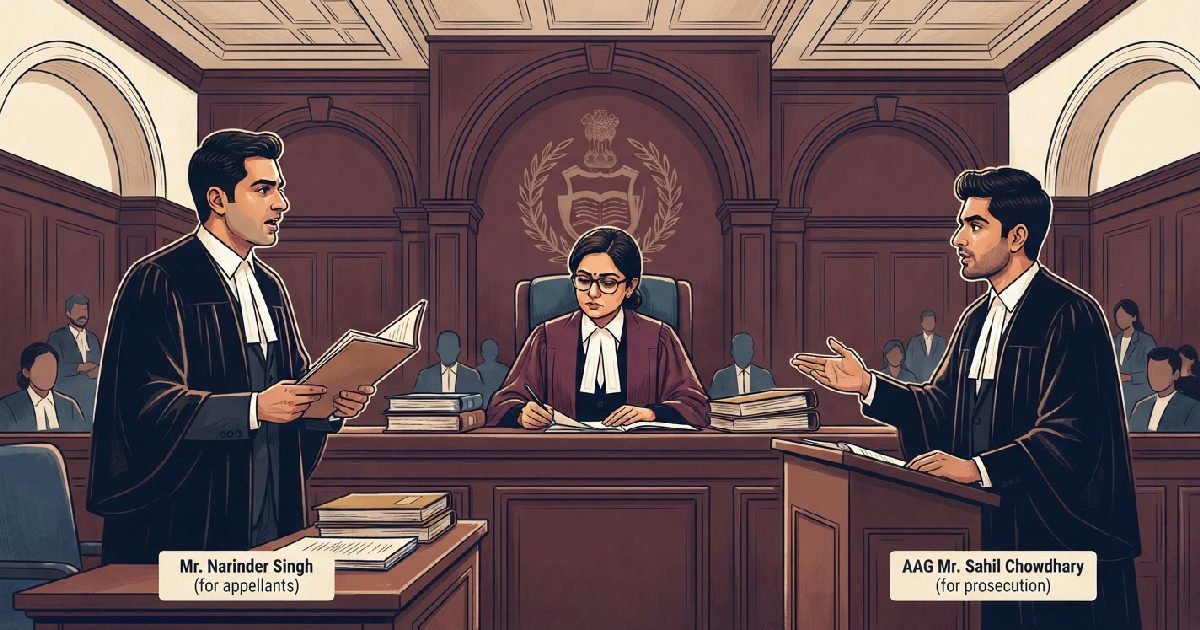
This decision underscores the critical distinction between finding a deceased person hanging and definitively establishing a suicidal death, particularly when medical and observational evidence conflict. Mr. Narinder Singh, Advocate, represented the appellants, while Mr. Sahil Chowdhary, AAG, Punjab, represented the prosecution in this complex case.
The original Sessions Court had convicted all four accused, sentencing each to seven years of rigorous imprisonment following the woman’s death in August 2003. The prosecution’s case hinged on the parents’ account of finding their daughter hanging from an iron rod at her matrimonial home, mere hours after an alleged confrontation.
However, the High Court identified a glaring inconsistency. The post-mortem doctor’s opinion attributed the cause of death not to suicide by hanging, but to strangulation. This medical finding cast substantial doubt on the ocular evidence provided by the parents, who had arrived at the scene after the incident had occurred and hadn’t witnessed her taking her own life.
Justice Pannu emphasized that “seeing a person hanging and establishing that the person had committed suicide are two different matters.” This crucial distinction highlights the prosecution’s initial burden to establish the act of suicide itself before any presumptions of abetment can be considered under Indian criminal law.
The foundational requirement to prove suicide
A charge of abetment of suicide under Section 306 IPC requires the commission of suicide as its foundation. Without conclusive proof that the deceased actually took their own life, the subsequent elements of abetment cannot logically follow.
The court clarified that the presumption under Section 113-A of the Evidence Act, which relates to abetment by a husband or his relatives in the case of a married woman’s suicide, only arises after the suicidal nature of the death has been established beyond reasonable doubt.
In this instance, the medical evidence directly contradicted the circumstantial observations. The post-mortem report, which definitively cited strangulation as the cause of death, became paramount. The court relied on the precedent set in Mahavir Singh v. State of Madhya Pradesh, noting that while ocular evidence typically carries weight, medical evidence can render it improbable or even entirely dismissible.
Abetment of suicide claims found unproven
Even if the High Court had accepted the possibility of suicide, it concluded that the prosecution still failed to establish the critical ingredients of abetment. Abetment requires a clear intent to instigate, encourage, or assist in the act of suicide, often referred to as mens rea, or a “guilty mind.”
The father of the deceased woman admitted during testimony that his daughter had been living happily just three days before the incident. Furthermore, allegations that the deceased was accused of an illicit relationship lacked specific supporting evidence. The court noted that even if “objectionable remarks” about the woman’s character were made, these alone couldn’t establish the direct nexus required for abetment.
The prosecution needed to demonstrate a clear and direct link between the accused’s actions and the deceased’s decision to end her life. The mere presence of the accused at or around the house didn’t, by itself, prove either suicide or abetment, leaving a fundamental gap in the prosecution’s case.
In-laws living separately and lack of specific roles
A key aspect of the acquittal for the in-laws — the husband’s elder brother, sister-in-law, and sister — centered on their separate living arrangements. The court highlighted that they lived apart from the deceased and her husband, diminishing the likelihood of continuous harassment or direct control over her matrimonial life.
There was no convincing evidence presented to suggest that these relatives exerted undue influence or subjected the deceased to a sustained course of cruelty. This separation of residence and the absence of specific, demonstrable acts of instigation further weakened the prosecution’s case against them, granting them the benefit of doubt.
Broader challenges in proving abetment cases
This ruling from the Punjab and Haryana High Court reflects a broader pattern of difficulty in securing convictions for abetment of suicide across India. Legal experts often point to the inherently challenging nature of proving intent in such cases, which frequently rely on circumstantial evidence rather than direct proof.
Senior advocate Rajalaxmi Ankalagi has emphasized that allegations must be direct, coherent, and supported by robust evidence to establish a conviction.
Former Director General and Inspector General of Police S.T. Ramesh also noted that a suicide note, while sometimes present, is rarely sufficient on its own and typically requires multiple pieces of corroborative evidence. The lack of clear, direct instigation or intentional provocation makes these cases particularly complex for prosecutors to prove beyond a reasonable doubt.
| Case Status | Abetment of Suicide (Section 306 IPC) | All IPC Crimes (Overall) |
|---|---|---|
| Conviction Rate (NCRB 2022) | 17.5% | 69.8% |
| Specific Challenges | Proving mens rea, nexus to death | Varies by offense |
| Evidentiary Requirements | Clear instigation, corroboration | Direct/circumstantial evidence |
Judicial scrutiny and Supreme Court directives
Justice Mandeep Pannu’s approach in this case aligns with a consistent judicial philosophy of scrutinizing the foundational elements of a charge before applying legal presumptions. This has been evident in other rulings, such as an August 20, 2026, decision where Justice Pannu acquitted a man in a 1998 dowry death case, reiterating that core ingredients must be established before invoking statutory presumptions.
The Supreme Court of India has also repeatedly cautioned against the “mechanical” invocation of abetment of suicide charges. In January 2025, Justices Abhay S. Oka and K.V. Viswanathan highlighted the need to sensitize investigative agencies and courts to the legal principles governing Section 306 IPC, aiming to prevent misuse and abuse of the judicial process.
Recent Supreme Court rulings have further clarified the boundaries of what constitutes abetment. For instance, an August 24, 2026, ruling by Justices Manoj Misra and Vijay Bishnoi clarified that lodging an FIR or initiating legal proceedings, even if deemed “false” later, does not inherently amount to instigation to commit suicide.
This ruling, for example, quashed proceedings against a woman’s family after her husband’s suicide following a domestic violence complaint.
Additionally, the Supreme Court has ruled that stern behavior from a superior, administrative directions, or even adverse remarks, without a clear intention to drive someone to suicide, cannot be elevated to the offense of abetment.
These precedents collectively underscore the high bar of proof required to secure convictions under Section 306 IPC, particularly the necessity of demonstrating a direct and culpable link between the accused’s actions and the tragic outcome.
The nuanced interpretation of abetment is crucial for upholding justice and preventing the misapplication of laws designed to protect vulnerable individuals. It ensures that criminal charges are not based solely on emotional responses or speculative connections, but rather on concrete evidence of intent and a direct causal link. This judicial rigor helps maintain the integrity of the criminal justice system.
Navigating legal complexities in sensitive cases
Cases involving the death of a married woman within the matrimonial home are inherently sensitive and often fraught with emotional testimony. Society rightly demands accountability when abuse is suspected. However, the legal system must also uphold the principle of innocent until proven guilty, requiring prosecutors to meet stringent evidentiary standards.
The Punjab and Haryana High Court’s decision serves as a reminder that suspicion, no matter how strong, cannot substitute for concrete proof, especially when medical evidence points in a different direction. It reinforces the importance of thorough investigation and the careful weighing of all evidence presented, ensuring that justice is served impartially.
Moreover, the acquittal highlights the judiciary’s role in safeguarding individuals from convictions based on insufficient evidence or legal presumptions that are not properly founded. For families facing similar legal challenges, understanding the stringent requirements for proving abetment of suicide, particularly the need to establish the act of suicide itself, becomes paramount.
Such cases necessitate meticulous legal representation and a clear strategy to address every facet of the prosecution’s claims, from the cause of death to the alleged instigation.
The road ahead for criminal justice
The implications of this judgment extend beyond the immediate parties, reinforcing established legal principles concerning the burden of proof in criminal trials. It will likely influence how similar cases are investigated and prosecuted, especially those involving conflicting medical and ocular evidence. Prosecutors will need to ensure that the initial cause of death is unequivocally established as suicidal before pursuing abetment charges.
Furthermore, the ruling subtly emphasizes the importance of a clear and specific role for each accused in an alleged act of abetment. General accusations or mere familial relationship to the deceased are insufficient. This heightened standard helps prevent the wrongful implication of individuals who may not have had direct involvement or the requisite criminal intent.
It also encourages a more focused approach to evidence gathering, rather than relying on broad allegations.
What was the core reason for the acquittal in this case?
The primary reason for the acquittal was the prosecution’s failure to prove beyond a reasonable doubt that the woman’s death was suicidal. There was a significant conflict between the parents’ account of finding her hanging and the post-mortem doctor’s opinion, which cited strangulation as the cause of death.
What is Section 306 of the Indian Penal Code?
Section 306 IPC deals with the abetment of suicide. It criminalizes individuals who instigate, encourage, or intentionally aid another person in taking their own life. A conviction under this section requires proof that suicide actually occurred and that the accused had the necessary intent to abet it.
How does medical evidence impact abetment of suicide cases?
Medical evidence, such as a post-mortem report, is crucial in abetment of suicide cases as it can definitively determine the cause and manner of death. If medical findings contradict the assertion of suicide, as happened in this case, it can undermine the prosecution’s entire argument, as proving suicide is a prerequisite for proving abetment.