
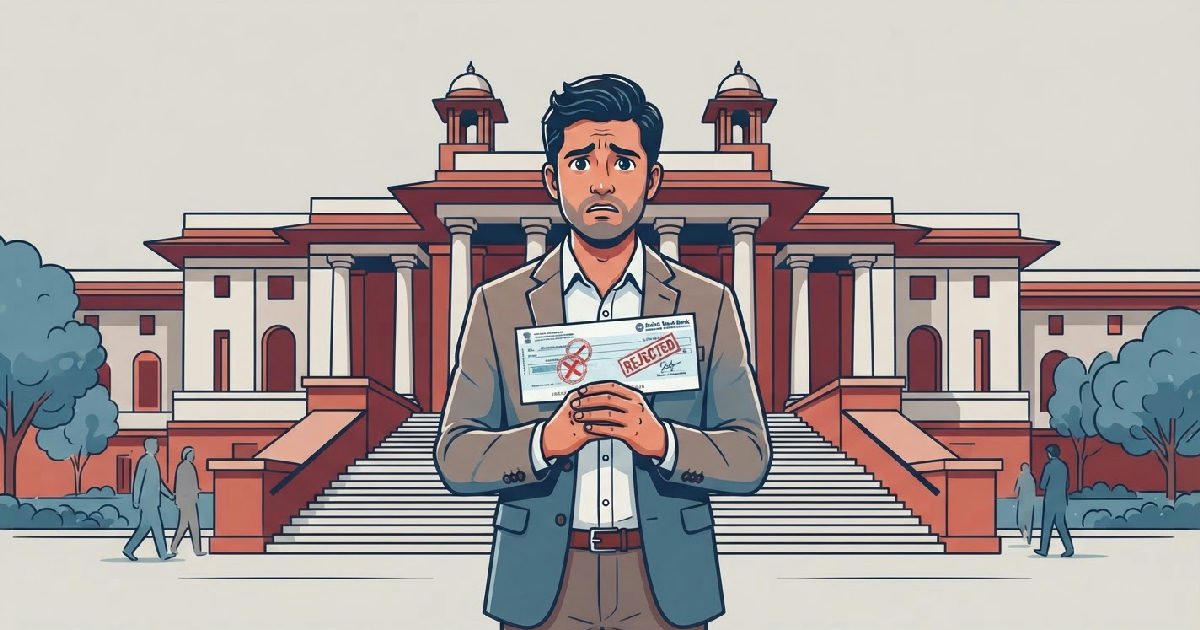
A dishonoured cheque issued by an NRI from an Indian bank account can lead to a criminal complaint under Section 138 of the Negotiable Instruments Act, 1881. This isn’t a situation that simply vanishes because of geographical distance; Indian courts retain jurisdiction, making proactive legal engagement essential.
Ignoring such summons can have severe repercussions, escalating from bailable warrants to non-bailable ones, and potentially a Look Out Circular (LOC) that could prevent future travel to or from India. Understanding the procedural nuances and available defense strategies is crucial for any NRI navigating this challenging legal landscape.
NRI drawer of a bounced cheque: India’s dishonoured cheque law
Section 138 of the NI Act specifically criminalises the dishonour of a cheque. This happens when a cheque bounces due to insufficient funds or if it exceeds the account balance, provided it was issued for a legally enforceable debt or liability. It’s a serious offense, despite its quasi-criminal nature.
The penalties for a conviction are significant, including imprisonment for up to two years, a fine that can be double the cheque amount, or both. This statute was designed to ensure the reliability of cheques as a mode of payment, particularly in commercial transactions.
Understanding Section 138 of the NI Act
The core of a Section 138 case rests on the cheque being issued for a legally enforceable debt or liability. If no such debt exists, or if the cheque was given for another purpose, like security, it could form a strong defense. The offense itself is bailable and compoundable, meaning there’s scope for settlement outside of court.
A key aspect is that Indian courts maintain jurisdiction even if the NRI drawer lives abroad. This applies if the cheque was drawn on an Indian bank or presented for collection in India, irrespective of the drawer’s current residence.
Jurisdictional Clarity for Non-Residents
For cheques payable to an account, the case must be filed in the Metropolitan Magistrate court where the payee’s bank branch is located in Delhi. This pinpoints the specific court an NRI needs to contend with. The law’s reach extends beyond India’s borders, highlighting the need for immediate legal counsel.
The judicial system is clear: if the financial transaction originates or is processed within India, the legal framework applies fully. This jurisdictional reality means NRIs cannot simply defer action in hopes the issue will dissipate.
Critical Timelines for Complainants
The complainant, usually the payee, must adhere to strict timelines to properly initiate a Section 138 case. These deadlines are equally critical for the NRI drawer to understand, as any procedural misstep by the complainant could invalidate the case. This includes proper presentation of the cheque and timely issuance of demand notices.
For example, a cheque must be presented to the bank within three months of its issue date. If the cheque is presenting cheques after three months, the opportunity to file a Section 138 case is lost. Here’s a breakdown of the key procedural steps and their associated deadlines:
| Procedural Step | Timeline Requirement | Critical Detail |
|---|---|---|
| Cheque Presentation | Within 3 months of issue or validity period (earlier of the two) | Bank issues Cheque Return Memo upon dishonor. |
| Legal Demand Notice | Within 30 days of receiving Cheque Return Memo | Must demand payment within 15 days of receipt. |
| Complaint Filing | Within 30 days after expiry of 15-day notice period | If payment not made after notice period. |
Initial Response: Avoiding Warrants from Abroad
When an NRI receives a legal demand notice or summons related to a cheque bounce, immediate action is paramount. Ignoring these communications can quickly lead to severe legal consequences in India, complicating any future interactions with the country.
A delay could result in the issuance of warrants and even a Look Out Circular (LOC), which is a serious matter. These measures are designed to compel appearance and can significantly restrict an individual’s movement or lead to arrest upon entry to India.
Responding to Legal Notices Promptly
The legal demand notice is the first critical communication. It must specify the cheque details, the amount due, the reason for dishonor, and demand payment within 15 days. Replying to this notice, especially if there’s a valid defense, can be a crucial first step.
Failure to respond or make payment within the 15-day window allows the complainant to file a criminal complaint. Ignoring summons can lead to the consequences of non-appearance, including bailable warrants, followed by non-bailable warrants, and ultimately a Look Out Circular.
Appearing Through Legal Counsel
For NRIs, physical presence in every court hearing is often impractical. The Indian legal system allows for appearance through authorized counsel. An NRI can authorize a lawyer in India to represent them by executing a Vakalatnama.
Additionally, a Power of Attorney (PoA) can be used to authorize someone in India, often a trusted family member or legal representative, to act on the NRI’s behalf. If executed abroad, the PoA must be duly notarized and apostilled or consularized to meet Indian legal standards. A Special PoA is advisable to limit its scope to the specific case.
Seeking Exemption from Personal Presence
While courts prefer personal appearance, NRIs can formally request exemption, citing residence abroad. This is permissible under Sections 205 and 317 of the Code of Criminal Procedure (CrPC). The Supreme Court has clarified that while a blanket exemption isn’t possible, magistrates can allow appearance through counsel for good reasons.
Such exemptions are often granted for routine dates, but personal appearance might still be required for pivotal stages like pleading guilty or not guilty, recording evidence, making statements under Section 313 CrPC, and the final judgment. It’s a balancing act between judicial efficiency and accommodating the accused’s circumstances.
Leveraging Virtual Hearings and Evidence
The COVID-19 pandemic accelerated the adoption of virtual hearings in Indian courts. This technological shift offers a viable pathway for NRIs to participate in legal proceedings without needing to travel to India for every single hearing.
Indian courts have largely normalized virtual hearings, making it possible for NRIs to present arguments and even record evidence remotely. This facility is a significant relief for those whose primary residence is outside India.
Video Conferencing in Delhi Courts
Delhi magistrate courts, like many others across India, have embraced video conferencing for a range of proceedings. The Supreme Court has actively encouraged lower courts to accommodate NRIs through virtual means, recognizing the logistical challenges of international travel.
However, specific critical stages of a criminal case often still mandate physical presence. This typically includes the formal framing of charges, recording of statements under Section 313 CrPC, and the pronouncement of the final judgment, particularly in serious criminal matters.
Cross-Examination via Video Link
Cross-examination, a crucial part of evidence presentation, can sometimes be conducted via video conferencing. Yet, courts often impose strict conditions to ensure fairness and veracity. This might involve appointing a Local Commissioner to oversee the process in India or requiring the testimony to be recorded at an Indian Embassy or Consulate in the NRI’s country of residence.
These conditions ensure that the integrity of the judicial process is maintained while facilitating the participation of overseas individuals. It’s a nuanced approach that seeks to balance convenience with legal rigor.
Strategic Defenses for the NRI Accused
An NRI facing a Section 138 case isn’t without recourse. Several robust legal defenses can be mounted, ranging from challenging the fundamental basis of the alleged debt to identifying procedural irregularities in the complainant’s actions. These defenses require a thorough understanding of the NI Act and diligent legal representation.
Early engagement with legal counsel can help identify the most appropriate defense strategy. It’s never advisable to assume guilt or ignore the proceedings, as legitimate defenses can often lead to a favorable outcome or a settlement.
Challenging the Legal Basis of the Debt
One of the strongest defenses is proving that the cheque was not issued for a legally enforceable debt or liability. If the underlying debt is disputed, invalid, or has already been cleared, the foundation of the Section 138 complaint weakens considerably.
Another common scenario involves cheques issued purely as a security instrument, not intended for immediate encashment. If this can be proven, the case might not stand. Similarly, if there has been part payment or a prior settlement, this can also negate the claim.
Procedural Flaws and Notice Defects
Strict procedural adherence is mandatory for the complainant. Any improper or defective demand notice, such as one not served correctly or not sent within 30 days of the cheque dishonour, can be a critical defense point. Similarly, if the complaint was filed in a court without proper territorial jurisdiction, it can be dismissed.
Moreover, if the complaint was filed beyond the stipulated limitation period — generally 30 days after the expiry of the 15-day notice period — the case becomes unsustainable. Even a valid stop payment order issued for reasons unrelated to insufficient funds can serve as a defense, distinguishing it from simply avoiding payment.
Questioning Cheque Authenticity and Intent
Defenses can also revolve around the cheque itself. If the cheque was stolen, obtained through fraud, misused, or if the signature on it is forged, the drawer cannot be held liable. Material alterations to the cheque after its issuance can also render the complaint invalid.
The intent behind issuing the cheque is often a critical factor. If the complainant cannot establish that the cheque was for a legitimate, enforceable debt, or if there is evidence of coercion, these elements can be powerful arguments in defense.
Long-Term Repercussions of Non-Compliance
The temptation to ignore a legal notice from a foreign jurisdiction is understandable but highly ill-advised. For NRIs, the consequences of non-appearance in a Delhi cheque bounce case can rapidly escalate, leading to significant personal and financial distress.
These repercussions aren’t merely theoretical; they are legally enforced mechanisms designed to ensure compliance with judicial proceedings. Understanding their severity is key to making informed decisions.
Escalation: Warrants and Look Out Circulars
The initial summons, if ignored, will likely be followed by bailable warrants. If these are also disregarded, the court will typically issue non-bailable warrants. These warrants authorize the arrest of the accused, making any visit to India a high-risk proposition.
Perhaps most concerning for an NRI is the issuance of a Look Out Circular (LOC). An LOC prevents an individual from departing India or leads to their immediate arrest upon arrival at any Indian port of entry. Furthermore, Indian courts can order the seizure or attachment of assets held by the NRI within India, causing substantial financial loss and inconvenience.
Ex-Parte Proceedings and Legal Outcomes
Should the NRI fail to appear even after warrants have been issued, the court has the power to proceed ex-parte. This means the case can be decided in the absence of the accused, potentially leading to a conviction without the defendant having presented their side of the story.
Such an outcome can have lasting damage to an NRI’s creditworthiness and reputation, both within India and potentially internationally. It underscores the critical need for timely and professional legal representation, even from afar, to protect one’s interests.
What is a cheque bounce case under Section 138 of the NI Act?
A cheque bounce case under Section 138 of the Negotiable Instruments Act, 1881, is a criminal offense where a cheque is dishonoured by the bank due to insufficient funds or if the amount exceeds the account balance, provided it was issued for a legally enforceable debt. Conviction can lead to imprisonment for up to two years or a fine up to twice the cheque amount.
Can an NRI living abroad defend a Section 138 case without physically returning to India for every hearing?
Yes, an NRI can defend a Section 138 case by appointing a lawyer in India through a Vakalatnama or Power of Attorney. They can also seek exemption from personal appearance, which courts often grant for routine hearings. For crucial stages like evidence recording, virtual hearings via video conferencing are increasingly accepted, though physical presence might be mandatory for specific key moments.
What happens if an NRI ignores a summons for a cheque bounce case in India?
Ignoring a summons can lead to severe consequences. Initially, bailable warrants may be issued, followed by non-bailable warrants. Ultimately, a Look Out Circular (LOC) could be issued, preventing the NRI from leaving or entering India without arrest. The court may also proceed ex-parte, deciding the case in the accused’s absence, leading to potential conviction and asset attachment.
138 summons received while you are outside India? Call or Whatsapp for consultation.
Related: https://arpitmarwah.com/cheque-bounce-lawyers-in-delhi/