
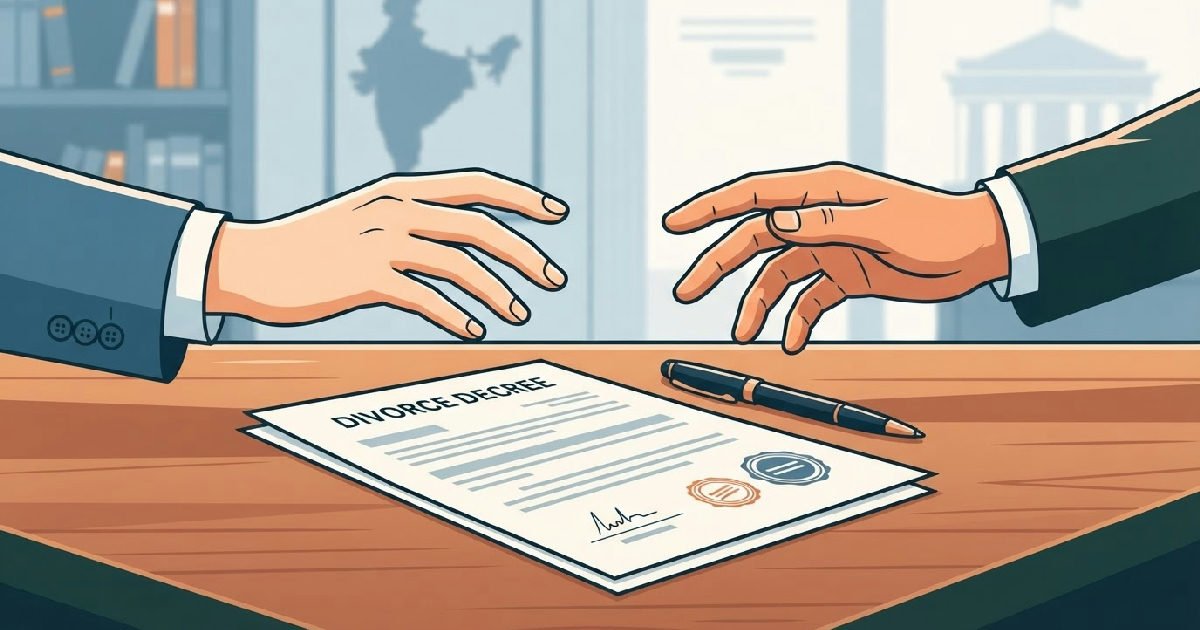
Navigating the aftermath of a mutual consent divorce in Delhi can present fresh challenges, particularly when agreed-upon terms regarding alimony, property division, or child visitation are not honored. Many individuals find themselves in a distressing situation where, despite a legally binding decree, their former spouse fails to uphold commitments made in court.
Crucially, breaching these terms after the second motion is completed and the divorce decree is issued does not necessitate a fresh divorce filing. Instead, the legal framework provides robust mechanisms for the enforcement of the original decree.
Mutual consent terms not followed: The legal pathway and its evolution
Spouses facing such non-compliance must pursue execution of the decree or initiate contempt proceedings in the Family Court, understanding that informal agreements, such as those conveyed via WhatsApp, generally hold no power to amend a formal court order.
The journey to a mutual consent divorce in India is primarily governed by Section 13B of the Hindu Marriage Act. This statute outlines a structured process designed to ensure both parties genuinely wish to dissolve their marriage and have reached a comprehensive agreement on all ancillary matters.
Eligibility hinges on the couple being married for at least one year and living separately for a minimum of one year immediately preceding the petition, even if under the same roof.
The concept of “living separately” in this context does not always imply separate residences. Spouses can legally be considered living separately even while residing under the same roof, provided they are not living as husband and wife. This nuanced interpretation acknowledges the practicalities of many Indian households, ensuring the spirit of the law is upheld.
The initial step involves filing a joint First Motion Petition in the relevant Family Court. Here, both spouses formally declare their intention to end the marriage and detail the agreed-upon terms covering alimony, child custody, and property division. The court meticulously records these statements under oath, verifying free consent and ensuring that the proposed settlement aligns with legal principles.
Traditionally, a mandatory six-month cooling-off period follows the first motion, intended to offer couples an opportunity for reconsideration or reconciliation. However, the Supreme Court, in its landmark 2017 ruling in Amardeep Singh v. Harveen Kaur, clarified that this period is directory, not mandatory.
It can be waived by a Family Court under specific conditions, such as when the one-year separation is met, all settlement terms are finalized, consent is genuine, and reconciliation is clearly impossible. Readers can find more details on waiving the cooling-off period.
Further expanding this flexibility, a Full Bench of the Delhi High Court in December 2025 held that even the one-year separation period could be waived in certain circumstances. This significant development reflects the judiciary’s evolving understanding of modern marital breakdowns, aiming to streamline the divorce process for genuinely estranged couples while preserving legal safeguards.
When settlement terms fail: Navigating post-decree breaches
A divorce decree serves as a definitive legal document, formally dissolving a marriage and incorporating all agreed-upon settlement terms. But what happens when, despite this finality, one party reneges on their promises? Common breaches include the non-payment of agreed alimony or child maintenance, refusal to transfer property as stipulated, or the wrongful denial of child visitation rights.
Common Types of Divorce Decree Breaches and Their Enforcement
| Breach Type | Common Enforcement Action | Typical Outcome |
|---|---|---|
| Non-payment of Alimony/Maintenance | Execution Petition for Arrears, Contempt of Court | Attachment of property/salary, arrest warrant, recovery of dues |
| Refusal to Transfer Property | Execution Petition for Specific Performance | Court-ordered transfer, symbolic possession, contempt proceedings |
| Denial of Child Visitation Rights | Execution Petition, Application for Contempt, Custody Modification | Court-ordered visitation schedule, penalties, temporary custody change |
| Non-compliance with Child Support | Execution Petition for Arrears, Contempt of Court | Similar to alimony, ensures child’s financial well-being |
The immediate instinct for some might be to consider fresh legal action or a new divorce petition. However, legal experts unequivocally advise against this. The existing decree is a binding court order, and the correct recourse lies in enforcing its terms, not relitigating the divorce itself. The Family Court, which initially granted the decree, retains jurisdiction to ensure its mandates are fulfilled.
Execution proceedings, typically falling under Order XXI of the Code of Civil Procedure (CPC), provide a structured legal pathway for a decree-holder to compel a judgment-debtor to comply with the terms of a decree. While divorce decrees primarily declare marital status dissolution, the financial and custody terms embedded within them are fully amenable to execution.
This can involve seizing assets, attaching salaries, or even ordering specific actions like property transfer.
Additionally, contempt proceedings offer a robust mechanism. If a spouse deliberately flouts a court order, they can be cited for civil contempt, facing potential fines, attachment of property, or, in severe cases, imprisonment.
The Delhi High Court, in Rajat Gupta v. Rupali Gupta, specifically ruled that a defaulting spouse can face contempt for breaching agreed terms, even if they later try to withdraw mutual consent.
Crucially, any informal agreements or discussions between ex-spouses after the decree, such as those made over messaging platforms, generally hold no legal weight to alter the court order. A verbal agreement or a WhatsApp chat cannot supersede a formal, judicially-sanctioned decree.
The enduring power of judicial consent: Why decrees are sacrosanct
Once a mutual consent divorce decree is granted by a Family Court, the terms embedded within it gain the full force of law, becoming sacrosanct. This legal finality is not merely procedural; it reflects a fundamental principle that judicial orders, especially those based on the free and genuine consent of parties, must be upheld to maintain the integrity of the justice system.
The Supreme Court of India, in a significant ruling in April 2026, reinforced this principle. It declared that a spouse cannot unilaterally withdraw consent for a mutual divorce after agreeing to a full and final settlement of disputes, particularly if the settlement was reached through mediation and acted upon.
This underscores that withdrawal of consent is restricted to exceptional circumstances, like fraud, coercion, undue influence, or non-compliance by the other party.
This judicial stance ensures that parties cannot use the mutual consent process to secure benefits or delays and then renege on their commitments without consequence. It provides a vital layer of security for the party whose rights are being infringed post-decree, ensuring that agreements forged in court are not easily discarded.
The Family Court has the power to direct “restoration of status quo ante” or compel the defaulting spouse to forfeit benefits gained from the settlement agreement.
Digital evidence in matrimonial cases: WhatsApp and beyond
In today’s digital age, communication often happens through messaging apps, and matrimonial disputes are no exception. WhatsApp messages, emails, and other electronic records frequently emerge as potential evidence. Under Indian law, specifically the Bharatiya Sakshya Adhiniyam, 2023 (Section 63), these digital communications are indeed recognized as admissible evidence.
However, their admissibility comes with stringent conditions. A divorce decree cannot be granted or amended solely based on WhatsApp chats or casual electronic exchanges. To be formally accepted by a court, electronic communications must meet specific certification and authentication standards, which ensures their veracity and integrity.
Section 63 of the Bharatiya Sakshya Adhiniyam, 2023, requires a certificate to prove electronic records. This certificate needs two signatures: one from the person in charge of the device that generated the record and another from a digital forensics expert.
These individuals must confirm the device was functioning properly, the record is authentic, and no tampering occurred. Courts also tend to view entire conversations rather than isolated screenshots, understanding that context is crucial for accurate interpretation.
Balancing child welfare and financial obligations
Child custody and support are often the most sensitive aspects of any divorce. In India, decisions concerning children are consistently guided by the paramount principle of the “best interest of the child.”
This means arrangements agreed upon during a mutual consent divorce, including living schedules, parenting time, financial responsibilities, and decision-making for education and healthcare, are typically approved by courts only if they align with this principle.
It’s vital to understand the distinction between alimony (spousal support) and child support, though they often intertwine. Alimony provides financial assistance to a former spouse, while child support covers the child’s direct expenses, including education, extracurricular activities, medical costs, and basic living needs. Courts factor these child-related expenses into the overall financial determinations, sometimes impacting alimony amounts.
The Hindu Marriage Act, under Section 26, specifically addresses the custody, education, and maintenance of children, underscoring that child welfare is intrinsically linked to parental financial arrangements. However, a common misconception arises when one parent unilaterally stops child visitation solely because a payment, whether alimony or child support, is late. This action is generally not advisable.
Unless the court order explicitly allows for such a linkage, the obligations of financial support and allowing visitation are usually treated as separate. Arbitrarily denying child visitation, solely due to late payments, is generally not advisable.
Courts prioritize the child’s right to a relationship with both parents and can view such actions as detrimental to the child’s best interest, potentially leading to further legal intervention or penalties for the defaulting parent.
What is an execution petition in the context of a divorce decree?
An execution petition is a formal legal application filed in court by a party seeking to enforce a court order or decree that has not been complied with by the other party. In divorce cases, it’s used to compel a former spouse to adhere to terms related to alimony, property division, child custody, or visitation.
Can informal agreements made after divorce modify the original decree?
Generally, no. Informal agreements, such as those made over messaging platforms like WhatsApp, do not hold legal weight to modify a formal court decree. Any changes to the original decree must be made through proper legal channels, usually by filing a fresh application or mutual consent petition in the court that issued the original decree.
What are the consequences of breaching a divorce decree?
Breaching a divorce decree can lead to severe legal consequences, including contempt of court proceedings. This can result in fines, attachment of property, or even imprisonment in extreme cases. The court can also order the defaulting party to comply with the decree, sometimes with additional penalties or costs.
Decree passed and the other side has stopped the agreed term? Call or Whatsapp for consultation.
Related: https://arpitmarwah.com/matrimonial-lawyers-in-delhi/