
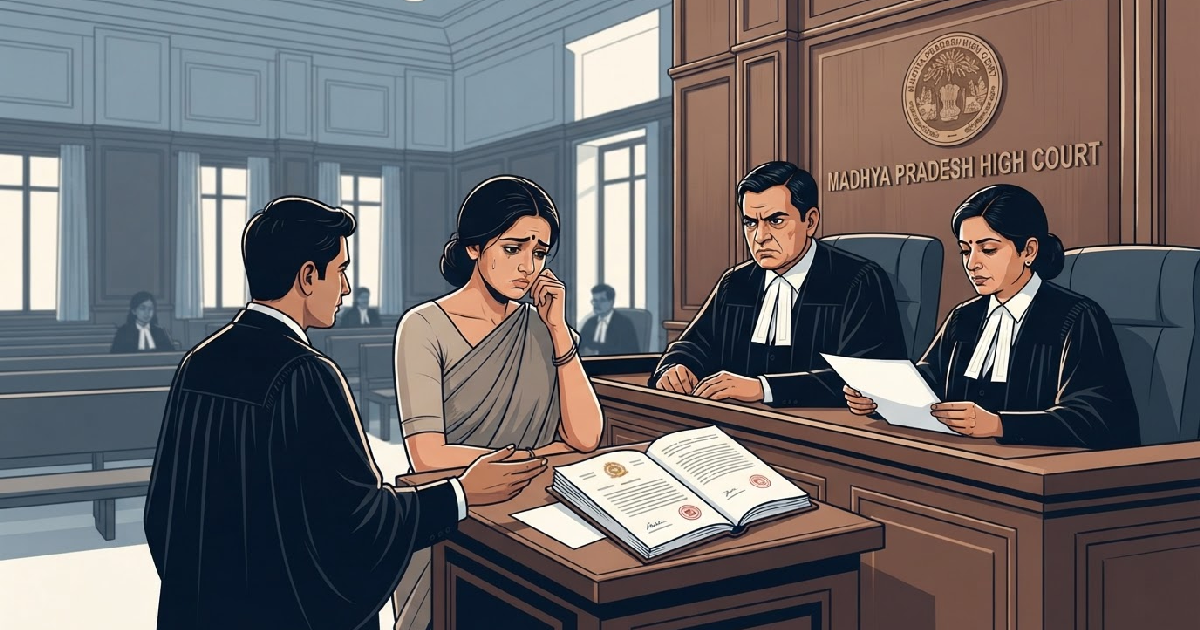
A wife cannot ordinarily claim interim maintenance from a husband she alleges to be of unsound mind, the Madhya Pradesh High Court ruled on July 30, 2026.
This legal stance is contingent on whether the husband’s mental condition truly prevents him from earning an income, a burden of proof that now rests with the wife. The ruling, delivered by a Division Bench comprising Justice G.S. Ahluwalia and Justice Anuradha Shukla, upholds a previous Family Court order from Morena.
Assessing capacity: mental health vs. earning potential
The case, identified as “BG v. VG (FA-1135-2024), 2026 LiveLaw (MP) 303,” stems from a matrimonial dispute where the wife sought financial support under Section 24 of the Hindu Marriage Act, 1955. This judgment underscores a critical distinction in family law: a diagnosis of mental illness doesn’t automatically negate a husband’s financial obligations if he retains the capacity to earn.
The Madhya Pradesh High Court’s decision draws a sharp line between a spouse’s medical condition and their functional capacity. Simply alleging that a husband is of unsound mind, while potentially a ground for divorce, does not automatically absolve him of maintenance payments. The court requires concrete evidence that the mental illness renders him genuinely incapable of generating income.
This ruling brings a practical perspective to the complex interplay of mental health and marital support. It acknowledges that not all forms of mental illness incapacitate an individual to the extent that they cannot participate in economic activity. The onus is now on the wife to demonstrate that, despite her husband’s alleged condition, he still possesses the ability to earn.
Legal landscape of spousal maintenance in India
Maintenance laws in India are multi-faceted, drawing from various statutes designed to protect spouses, children, and parents from destitution. Section 24 of the Hindu Marriage Act, 1955, under which the current case was filed, is a gender-neutral provision. It enables either spouse without independent income to seek financial support during matrimonial proceedings.
Other key provisions include Section 125 of the Code of Criminal Procedure, 1973 (CrPC), a secular law applicable across religions, which mandates support for wives, children, and parents if they are unable to maintain themselves. The Hindu Adoptions and Maintenance Act, 1956 (HAMA), further provides for a wife’s right to be maintained throughout her lifetime, even in the absence of an ongoing matrimonial dispute.
These provisions collectively aim to ensure financial security during marital discord. They reflect the legal system’s commitment to preventing economic hardship for dependent spouses. The recent High Court ruling refines these principles, adding a layer of scrutiny to claims involving mental health allegations.
The evolving definition of “unsound mind” in legal contexts
The term “unsound mind” is a recurrent, yet imprecisely defined, concept within Indian jurisprudence. It often appears in statutes without explicit clarification, leading courts to frequently equate it with “insanity.” However, “insanity” itself encompasses a broad spectrum of mental disorders, making its legal application challenging.
Legal interpretations have historically varied. For example, Section 12 of the Indian Contract Act of 1872 links a “sound mind” to the ability to understand a contract and make rational judgments. This highlights a task-specific understanding, rather than a blanket diagnosis.
The Supreme Court, in *Hari Singh Gond vs State of MP* (2008), also broadened “unsoundness of mind” to include “mental disorder,” a move that critics argued could conflate medical conditions with legal incapacity.
The Madhya Pradesh High Court’s recent judgment further contributes to this evolving definition. It emphasizes that a mere label of “unsound mind” isn’t sufficient to exempt a person from their spousal duties. Functional capacity, specifically the ability to earn, becomes the decisive factor in maintenance claims, moving beyond just a diagnosis.
A deeper look at marital disputes and the case background
The matrimonial dispute that led to this Madhya Pradesh High Court ruling began shortly after the couple’s marriage in 2008. Within a year, conflicts arose, highlighting the often-turbulent nature of marital relationships. The husband initially sought divorce in 2009, a petition he later withdrew, indicating a complex and protracted legal battle.
Attempts at reconciliation or an amicable separation were also made, with both parties filing a joint petition for divorce by mutual consent. However, this attempt ultimately failed. The agreed-upon terms for the mutual consent divorce weren’t met, prolonging the legal entanglements and leading to the wife’s subsequent plea for interim maintenance under Section 24 of the Hindu Marriage Act.
This timeline illustrates the intricate journey many couples face in the Indian legal system when marriages falter. It shows how initial allegations and attempts at resolution can evolve into further legal actions, such as maintenance claims, requiring judicial interpretation of complex personal circumstances.
Comparing recent high court rulings on mental illness and support
The Madhya Pradesh High Court’s decision isn’t an isolated one; it reflects a broader judicial trend of scrutinizing maintenance claims involving mental illness. Just prior to this ruling, on July 16, 2026, the Jharkhand High Court issued a similar pronouncement.
That court stated that a husband’s mental illness doesn’t automatically excuse him from maintenance obligations unless there’s clear proof he’s actually unable to earn or manage his affairs.
Justice Anil Kumar Choudhary of the Jharkhand High Court specifically noted that individuals with “mild, moderate or borderline mental retardation” are often capable of living and contributing socially. This indicates a consistent judicial push towards requiring proof of functional incapacity. It isn’t enough to merely present a diagnosis.
In contrast, the Delhi High Court earlier in February 2026 dealt with a related but distinct issue. It ruled that a husband who secures a divorce based on his wife’s mental illness cannot then deny her maintenance by arguing her earning potential.
Justice Swarna Kanta Sharma deemed such contradictory arguments “legally indefensible,” emphasizing fairness in post-divorce financial arrangements. These judgments collectively shape the interpretation of maintenance laws, balancing spousal rights with individual circumstances.
This evolving legal perspective means parties must now offer more than just a medical certificate. They need to present tangible evidence of how a mental condition impacts financial capability. This could involve expert testimony on vocational rehabilitation, employment history, or an assessment of daily living skills relevant to work.
The courts are increasingly focused on the practical consequences of mental health. They are less concerned with the mere presence of a diagnosis. It’s a shift towards a more pragmatic assessment of a person’s ability to contribute economically, even in challenging circumstances. This approach aims to prevent the misuse of mental illness claims to evade financial responsibilities.
Implications for litigants and legal strategy
This ruling from the Madhya Pradesh High Court sets a precedent that will likely influence how maintenance cases are argued, particularly when one spouse claims the other is of unsound mind. For wives seeking maintenance, merely asserting their husband’s mental illness is no longer sufficient grounds to guarantee support.
They’ll need to present compelling evidence demonstrating that, despite the alleged condition, the husband retains the capacity to earn an income. This might involve producing records of past employment, business dealings, or even expert assessments of his potential to hold a job.
Conversely, husbands facing such claims will need to present medical evidence that directly links their mental state to an inability to work and earn. This requires a robust defense to substantiate claims of functional incapacity. It implies a deeper evidentiary burden on both sides.
| Maintenance Provision | Applicability | Key Feature | Financial Capacity Assessment |
|---|---|---|---|
| Section 24, Hindu Marriage Act, 1955 | Hindu spouses during litigation | Interim maintenance & litigation expenses | Considers income, earning potential of both parties |
| Section 125, CrPC, 1973 | All religions (wives, children, parents) | Secular law to prevent destitution | Husband must have sufficient means; wife unable to maintain self |
| Section 18, Hindu Adoptions and Maintenance Act, 1956 | Hindu wife (lifelong right) | Maintenance even without ongoing dispute | Covers food, clothing, residence, education, medical care |
The broader societal context of mental health and disability
The legal debate surrounding “unsound mind” and maintenance is intertwined with broader societal discussions about mental health and disability. In India, like many other countries, mental health conditions have historically carried significant stigma. This stigma often translates into legal and social disadvantages for those affected.
The courts, through rulings like this one, are grappling with how to balance traditional legal frameworks with a more contemporary understanding of mental health. It’s a move away from simplistic labels towards a more nuanced recognition of an individual’s capabilities, even in the presence of a mental health condition. This reflects a growing awareness that a diagnosis doesn’t automatically equate to complete incapacitation.
For instance, a husband’s failure to pay maintenance can be construed as economic abuse, underscoring the importance of spousal support. The ongoing dialogue pushes for policies and interpretations that protect vulnerable individuals while ensuring fairness and accountability from all parties in matrimonial disputes.
Recommendations from the law commission and future outlook
The complexities of maintenance claims involving mental illness have not gone unnoticed by legal reformers. The Law Commission, in its 252nd report in 2015, proposed crucial amendments to the Hindu Adoptions and Maintenance Act, 1956. These recommendations aimed to allow a Hindu wife to claim maintenance not just from her husband, but also from his joint family members.
This provision would apply if the husband himself was unable to provide support due to physical disability, mental disorder, or other similar incapacitating reasons. Such a change would offer an additional layer of protection for wives whose husbands genuinely cannot earn, broadening the scope of responsibility. It signifies a potential future direction for family law, aiming for more comprehensive support systems.
The Madhya Pradesh High Court’s latest ruling, while focused on the husband’s earning capacity, fits into this larger narrative of refining maintenance laws. It highlights the need for a practical and evidence-based approach. This ensures that legal outcomes are fair to both parties and reflect the real-world impact of mental health conditions on financial stability.
Courts will continue to interpret these provisions, influencing future domestic legal practice.
The focus on actual earning capacity rather than just a diagnosis means legal teams must adapt their evidentiary strategies. This judicial trend emphasizes a pragmatic assessment of an individual’s economic potential, even when mental health is a factor. It moves away from broad generalizations, promoting a more detailed and individualized examination of each case’s circumstances.
Such rulings contribute to a more equitable application of maintenance laws. They acknowledge that mental health is a spectrum, and its presence does not automatically dictate an individual’s financial capabilities. The legal system seeks to ensure that support is provided when genuinely needed, without becoming an unintended loophole for avoiding marital obligations.
For instance, some court decisions have focused on cruelty and desertion as grounds for divorce, showing other complexities in family law.
Can a wife claim maintenance if her husband is diagnosed with a mental illness?
Yes, but not automatically. The Madhya Pradesh High Court has ruled that a wife can claim maintenance from a husband with a mental illness only if she can establish that his condition does not render him functionally incapable of earning an income. The mental illness itself isn’t a blanket exemption from spousal support.
What is Section 24 of the Hindu Marriage Act, 1955?
Section 24 of the Hindu Marriage Act allows either spouse, who does not have sufficient independent income to support themselves and cover litigation expenses, to apply for interim maintenance (pendente lite) during the pendency of matrimonial proceedings. It’s a gender-neutral provision ensuring financial stability during legal disputes.
How does this ruling compare to other maintenance laws in India?
This ruling refines the application of maintenance principles, specifically under the Hindu Marriage Act. While other laws like CrPC Section 125 and HAMA Section 18 also provide for spousal maintenance, the MP High Court’s decision adds a specific requirement regarding proof of earning capacity when a husband’s mental health is cited. It aligns with recent Jharkhand High Court rulings requiring functional incapacity proof.