
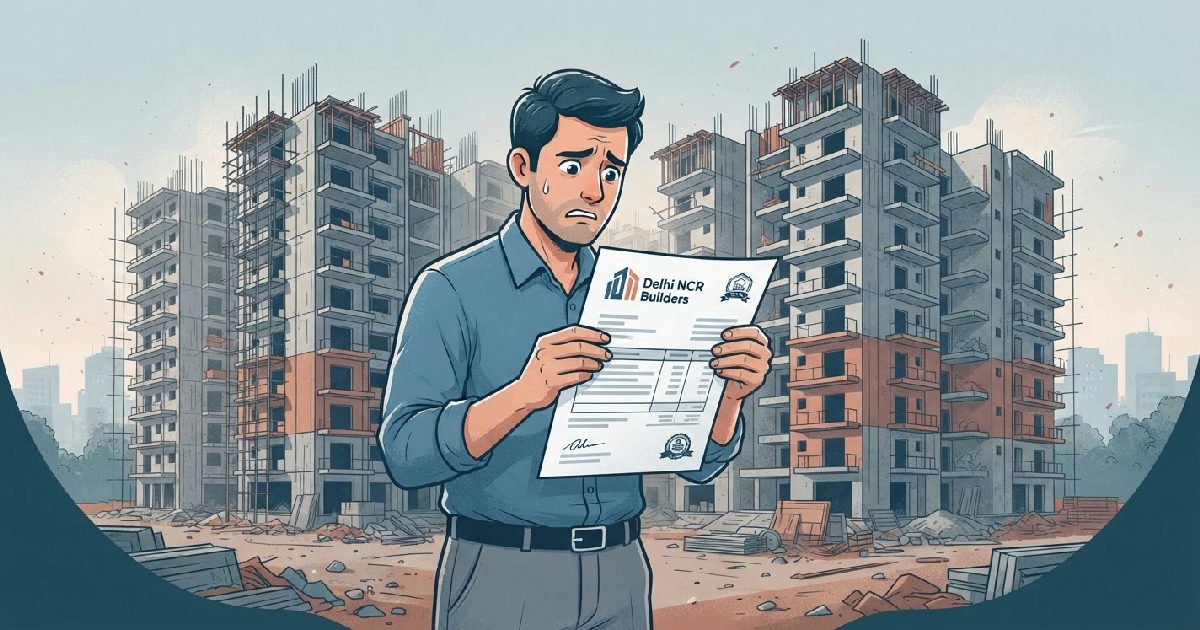
Delhi NCR builders are routinely demanding maintenance charges months before property possession or Occupancy Certificate (OC) issuance, leading to contentious battles with homebuyers. This practice, often at odds with signed builder-buyer agreements, places an unexpected financial burden on allottees.
Regulatory authorities and consumer forums are increasingly intervening, asserting that such demands made prior to a valid possession offer or OC issuance are generally unlawful. This ongoing issue, first highlighted as early as October 2015, continues to generate significant disputes in prominent areas like Gurugram, Noida, and Greater Noida.
Maintenance Charges Demanded by the Builder Before Possession by Delhi NCR builders
Developers in the Delhi NCR region have adopted a controversial strategy: invoicing homebuyers for maintenance fees well before their properties are legally ready for occupancy. This occurs despite many agreements stipulating that these charges commence only upon the handover of possession.
Such demands typically precede the crucial Occupancy Certificate, a document certifying the building’s adherence to local codes and readiness for habitation. Without this certificate, possession remains merely “paper possession,” lacking legal validity for residential use.
This early billing creates considerable financial strain for buyers, who often face substantial, unanticipated costs. It’s a classic example of an undisclosed charge, springing up just as buyers anticipate moving into their new homes.
Homebuyers are often advised to review their contracts thoroughly. Maintenance charged before possession is a common flashpoint, and understanding contractual obligations is the first line of defence.
RERA’s Stance on Builder Accountability
The Real Estate Regulatory Authority (RERA) Act, 2016, provides a clear framework aimed at protecting homebuyers from such practices. Section 11(4)(g) explicitly states that promoters are responsible for all outgoings, including maintenance charges, until physical possession transfers to the allottee or the residents’ association.
Conversely, Section 19(6) of the Act outlines the allottee’s responsibility to make timely payments as per the sale agreement. This mutual obligation, however, is contingent on the builder fulfilling their part of the contract, particularly regarding legal readiness.
The distinction between “paper possession” and legal possession, marked by the issuance of an Occupancy Certificate, is critical here. Courts and tribunals consistently rule that a building is not legally fit for use without a valid building’s occupancy certificate.
Landmark Rulings and Precedents
Several high-profile cases have reinforced the illegality of premature maintenance demands. The Supreme Court and the National Consumer Disputes Redressal Commission (NCDRC) have consistently held that builders cannot demand maintenance fees before the Occupancy Certificate is issued.
This is a fundamental principle: if a property isn’t legally ready for habitation, the buyer shouldn’t bear its running costs. These rulings provide significant legal weight to homebuyers’ arguments against unwarranted charges.
Haryana RERA Delivers Verdict
In a significant ruling in July 2026, the Haryana Real Estate Regulatory Authority (HRERA) sided firmly with a homebuyer. HRERA ordered BPTP Limited to refund ₹1,16,545 in maintenance charges collected improperly.
This refund came with an 11% annual interest payment, plus ₹1 lakh for mental agony and ₹50,000 towards litigation costs. The adjudicating officer made it clear: no promoter can collect maintenance charges in advance before possession is properly handed over.
Understanding Maintenance Costs and Structures
Maintenance charges typically cover common area upkeep, security, utilities, and facility management. These are generally computed based on the super area of a unit, or sometimes uniformly across all apartments, as outlined in the society’s approved maintenance structure.
Builders often collect advance maintenance, usually for six months to two years, but this should only happen after obtaining a valid Occupancy Certificate and Completion Certificate. This ensures that the building is officially complete and ready for its residents.
The financial implications can be substantial, particularly in prime locations. In Gurugram, for instance, monthly Common Area Maintenance (CAM) ranges from ₹3.0–₹4.5 per sq ft for mid-range housing, soaring to ₹8–₹18+ per sq ft for ultra-luxury towers as of mid-2026.
Additionally, an Interest-Free Maintenance Security (IFMS) is often required as a one-time payment upon possession, typically ranging from ₹50 to ₹150 per square foot of super area in Gurugram. Homebuyers must also be aware that an 18% Goods and Services Tax (GST) applies if monthly charges exceed ₹7,500 per flat, with societies above ₹20 lakh annual turnover required to register for GST.
| Charge Type | Description | Typical Range (Gurugram, Mid-2026) | Applicability |
|---|---|---|---|
| Common Area Maintenance (CAM) | Monthly charges for shared facilities | ₹3.0–₹4.5 per sq ft (mid-range) ₹8–₹18+ per sq ft (ultra-luxury) |
Monthly, after OC/possession |
| Interest-Free Maintenance Security (IFMS) | One-time security deposit for maintenance | ₹50–₹150 per sq ft of super area | One-time, at possession |
| GST on Maintenance | Tax on maintenance services | 18% (if >₹7,500/flat monthly) | Monthly, if threshold met |
Navigating Unjustified Demands: Homebuyer Action
Homebuyers facing premature maintenance demands have several clear steps to take. First, meticulously review the builder-buyer agreement for any clauses detailing when maintenance charges become applicable. Often, these contracts explicitly link charges to possession or OC issuance.
It’s crucial to request that the builder provide the specific clause in the agreement justifying their claim, along with the exact date from which maintenance is purportedly due. This forces transparency and often reveals inconsistencies with the legal and contractual stipulations.
Crucially, homebuyers are strongly advised against paying maintenance charges for periods before a valid possession offer or the Occupancy Certificate. Paying prematurely can be interpreted as accepting the builder’s terms, weakening any future legal challenge.
Thorough documentation is paramount. Keep precise records of the demand letter, the original builder-buyer agreement, and the date of the OC or possession offer. These documents form the backbone of any complaint or legal action.
Legal Recourse for Aggrieved Homebuyers
If a builder insists on demanding maintenance before fulfilling their legal obligations, homebuyers have robust avenues for redress. Filing a complaint with the Real Estate Regulatory Authority (RERA) in the project’s state is often the most effective first step.
RERA authorities can compel builders to refund illegally collected charges, impose penalties, and even order compensation for delays. Homebuyers can also include claims for project delays alongside their maintenance complaints, leveraging RERA’s broad powers.
Beyond RERA, the Consumer Protection Act, 2019, offers another powerful route. Buyers can file a complaint alleging “deficiency of service” and “unfair trade practices.” The National Consumer Disputes Redressal Commission (NCDRC) has a strong track record of ruling against builders who demand maintenance without an OC.
It is always prudent to seek legal advice from a professional specializing in real estate law. An experienced attorney can assess the specifics of the case, guide through the complaints process, and represent the homebuyer effectively.
The Long-Term Impact on Residential Markets
The persistent issue of premature maintenance demands erodes trust in the residential real estate sector, particularly in dynamic markets like Delhi NCR. Such practices deter potential buyers and cast a shadow over developer reputations.
RERA’s increasing assertiveness in these disputes, exemplified by rulings like the HRERA decision against BPTP Limited, signals a positive shift. Regulators are keen to ensure greater transparency and accountability from developers, fostering a healthier market environment.
As regulatory enforcement tightens, builders will likely be forced to adopt more ethical and legally compliant practices regarding maintenance charges. This ultimately benefits homebuyers by providing greater clarity and reducing unexpected financial burdens during the home-buying process.
The ongoing vigilance of homebuyers, combined with stronger regulatory oversight, is slowly reshaping the landscape of residential property transactions in Delhi NCR. It reinforces the principle that agreements must be honored and legal prerequisites met before financial obligations shift to the buyer.
When are maintenance charges legally applicable?
Maintenance charges are legally applicable only after the Occupancy Certificate (OC) has been issued and physical possession of the property has been offered to the homebuyer. Until then, the builder is responsible for all outgoings.
What should I do if a builder demands maintenance before possession?
You should review your builder-buyer agreement, demand the specific clause justifying the charge, and refrain from paying any maintenance for periods before the OC or valid possession offer. Document all correspondence and consider filing a complaint with RERA.
Can RERA help with unjustified maintenance demands?
Yes, RERA is empowered to intervene in such cases. Homebuyers can file a complaint with the relevant state RERA authority, which can order builders to refund unlawfully collected charges, impose interest, and even award compensation for mental agony and litigation costs.
Builder is billing maintenance from a date before you were offered possession? Call or Whatsapp for consultation.