
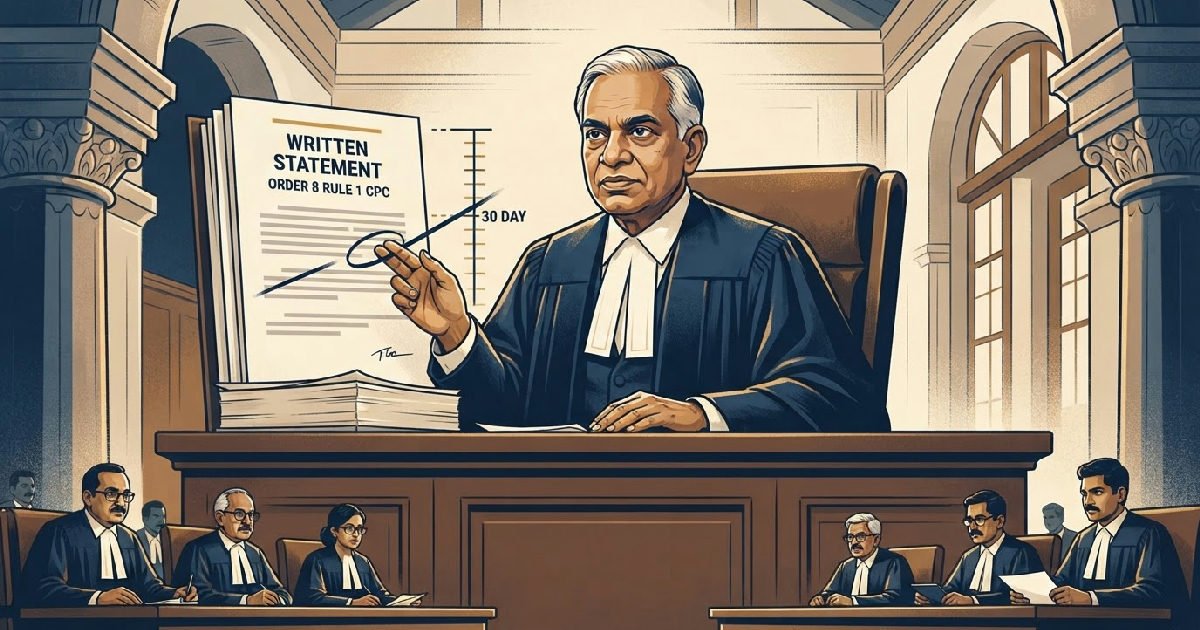
The Madurai Bench of the Madras High Court recently clarified that trial courts cannot, on their own initiative, extend the time limit for filing written statements beyond 30 days. This pivotal decision, delivered by Justice G.R.
Swaminathan, mandates that any such extension must stem from a formal, written request by the defendant, complete with valid reasons, underscoring strict adherence to Order 8 Rule 1 of the Code of Civil Procedure, 1908 (CPC).
Madras High Court restricts unilateral extensions
This ruling, which came to light through reports published in September 2024, specifically set aside an earlier order from August 2, 2023. That previous order had allowed a belated written statement without the necessary application for condonation of delay. It effectively tightens procedural discipline and aims to prevent unwarranted delays in civil litigation across the region.
In a significant move to streamline civil proceedings, the Madras High Court has unequivocally stated that trial courts lack the authority to unilaterally grant extensions for filing written statements once the initial 30-day period expires. This means judges can no longer simply overlook missed deadlines without a proper application from the defendant.
Justice G.R. Swaminathan emphasized that any request for extended time must be submitted in writing and clearly articulate the reasons for the delay. An oral request is simply insufficient, according to the court. This directive aims to bring greater transparency and accountability to the extension process, reflecting the judicial push for procedural rigor.
The court’s rationale for strict adherence
The court explicitly stated that granting an extension on its own accord would directly contravene Order 8 Rule 1 of the CPC. Justice Swaminathan noted that while courts should avoid harming parties through their own errors, no party should benefit from a court’s procedural lapse that goes against statutory provisions.
He underscored that orders condoning delay must include recorded reasons and should not be passed mechanically. The court suggested that trial courts might consider awarding costs when condoning delays, further deterring casual applications for extensions. This approach balances judicial discretion with procedural fairness.
The Ramesh Flowers case: a catalyst for clarity
The ruling originated from a civil revision petition involving Ramesh Flowers Private Limited v. Mr. Sumit Srimal. Ramesh Flowers, a plaintiff, had filed suit against its former employee, Mr. Sumit Srimal, alleging actions detrimental to the company after his termination on April 8, 2022.
Initially, the trial court had issued a notice but denied an ex-parte interim injunction. After the interim injunction was granted on appeal, Mr. Srimal filed a written statement which the trial court accepted. The petitioner (plaintiff) then challenged this acceptance, leading to the Madras High Court’s current pronouncement. This case exemplifies the practical application of procedural rules.
Understanding Order 8 Rule 1 CPC timelines
Order 8 Rule 1 of the Code of Civil Procedure is fundamental to civil litigation in India, outlining the framework for defendants to file their responses. The provision dictates that a defendant must submit a written statement within 30 days of receiving a summons. This initial period is critical for setting the pace of legal proceedings.
Should a defendant fail to meet this initial deadline, courts may grant an extension for recorded reasons. However, this extended period “shall not be later than ninety days from the date of service of summons”. The ruling reinforces that this power to extend time isn’t an automatic privilege for the court to exercise.
Mandatory reasons for extended filing periods
When seeking an extension beyond the initial 30 days, the defendant must provide good reasons in writing. This requirement ensures that any deviation from the standard timeline is justified and documented. It prevents arbitrary delays that could prejudice the plaintiff or prolong litigation unnecessarily.
Condonation of delay, while discretionary for the court, mandates the recording of reasons. This accountability measure means judges can’t just rubber-stamp requests. Instead, they must carefully weigh the justification presented, potentially awarding costs to compensate the opposing party.
Differentiating civil suits and commercial disputes
The interpretation of these timelines varies significantly between ordinary civil suits and commercial disputes. For general civil cases, the 90-day extension limit from the date of summons is typically considered directory, allowing courts some discretion in “exceptionally hard cases” as established by previous Supreme Court judgments. Courts, however, still require a formal application and valid reasons.
However, for commercial suits with a specified value of ₹3 lakhs or more, the Commercial Courts Act, 2015, imposes a stricter, mandatory 120-day limit from the date of summons. Exceeding this 120-day period results in the defendant forfeiting their right to file, with no further judicial discretion for extension.
This distinction highlights a tiered approach to procedural enforcement based on the nature of the dispute, aimed at speeding up economic litigation. The Karnataka High Court has further clarified these strict limits.
| Type of Suit | Initial Filing Period | Maximum Extension Period (after initial 30 days) | Total Maximum Period (from summons) | Nature of Limit |
|---|---|---|---|---|
| Ordinary Civil Suits | 30 days | Up to 60 days | 90 days (with discretion) | Directory |
| Commercial Disputes | 30 days | Up to 90 days | 120 days | Mandatory |
| Commercial Suits (Post-120 days) | N/A | 0 days | 120 days | Strictly Mandatory |
Supreme Court’s evolving interpretation of CPC timelines
The Madras High Court’s current ruling isn’t isolated; it stands on a long line of judicial interpretations from the Supreme Court concerning procedural deadlines. These past judgments have shaped how courts understand and apply Order 8 Rule 1 of the CPC. They’ve worked to balance flexibility with the need for timely justice.
Over the years, the Supreme Court has had to distinguish between procedural provisions that are “directory” versus those that are “mandatory.” This distinction dictates how strictly courts must adhere to specified timelines, particularly for filing critical documents like written statements. The evolving legal landscape reflects an ongoing effort to refine the efficiency of the justice system.
Key Supreme Court precedents on extensions
Landmark Supreme Court cases like Kailash v. Nankhu (2005) established that the 90-day total period for written statements in ordinary civil suits is directory. This means courts retain some discretion to allow late filings in truly exceptional circumstances, provided there is a sufficient cause demonstrated for the delay. However, this discretion isn’t unfettered and requires strong justification.
Similarly, Salem Advocate Bar Association, T.N. v. Union of India (2005) reiterated the directory nature for non-commercial cases. It emphasized that extensions should be rare and for recorded reasons. These rulings highlight the delicate balance between procedural rules and the pursuit of justice, often leading to costs being imposed on defaulting parties.
The broader impact on judicial efficiency
The Code of Civil Procedure underwent crucial amendments in 1999 and 2002, largely based on recommendations from the Malimath Committee. These changes were designed to speed up civil litigation, aiming to prevent tactics that cause delays, such as prolonged extensions for filing written statements. The legislative intent was clearly to establish a more expeditious judicial process.
The subsequent Commercial Courts Act of 2015 further solidified this intent for commercial disputes. By setting a hard 120-day cap for written statements, it eliminated judicial discretion that could lead to endless delays. These legislative efforts collectively signify a push towards greater efficiency and tighter procedural control in Indian courts. Strict filing deadlines are also common in other specialized courts.
Expert views on procedural discipline
Legal experts and judicial pronouncements consistently highlight that the primary purpose of the time schedule under Order VIII Rule 1 CPC is to expedite hearings and not to impede them. The rules of procedure are often considered the “hand-maid of justice,” meaning they should facilitate the resolution of disputes rather than obstruct it.
This ruling from the Madras High Court reinforces that judicial discretion isn’t a blank cheque. It must be exercised judiciously, based on formal requests, and with recorded reasons. This aligns with a broader push for transparent and accountable judicial processes, ensuring fairness for all parties involved.
What is a written statement?
A written statement is the defendant’s formal response to the claims made by the plaintiff in a civil lawsuit. It outlines the defendant’s defense and any counterclaims they may have, forming a critical part of the legal proceedings.
Can a court extend the time for filing a written statement?
Yes, but only under specific conditions. For ordinary civil suits, courts can extend the time, with a maximum total of 90 days from the summons date, but only if the defendant applies with valid reasons. For commercial disputes, the extension is strictly limited to a total of 120 days from summons, after which filing is generally not permitted.
What is the difference between directory and mandatory provisions in law?
A directory provision is one where courts have some flexibility in its application, often allowing for exceptions if there’s a good reason and no significant prejudice. A mandatory provision, conversely, must be strictly followed, leaving no room for judicial discretion or non-compliance.