
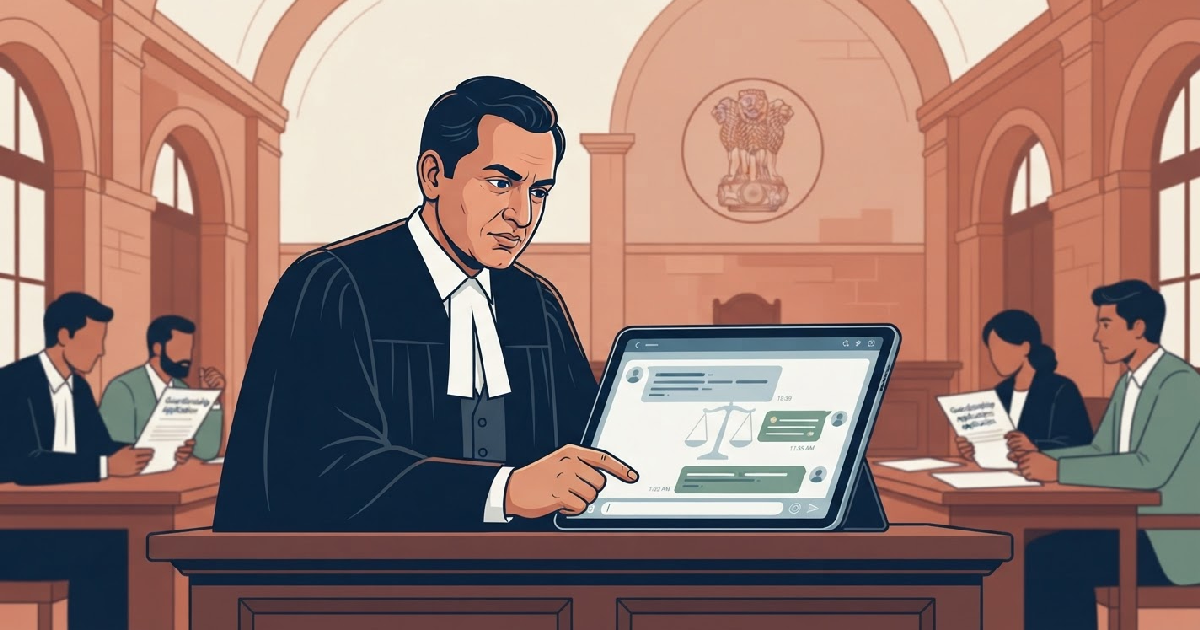
The Madras High Court ruled this week that private communications like WhatsApp chats and screenshots are relevant to child guardianship suitability, especially concerning alleged drug use.
This decision, handed down on July 17, 2026, firmly states that such evidence cannot be excluded on the grounds of privacy when a child’s welfare is at stake.
balancing child welfare and individual privacy rights
The court clarified that while these specific types of private communications are admissible, not every private conversation a parent has will automatically become relevant just because child custody is in dispute. This nuanced approach aims to protect children while upholding a degree of personal privacy.
This latest ruling from the Madras High Court underscores an ongoing tension in family law: the balance between an individual’s right to privacy and the paramount consideration of a child’s well-being. Indian courts consistently prioritize the welfare of the minor when making decisions about guardianship and custody.
The Guardians and Wards Act, 1890 (GWA), which governs child custody and guardianship across India, explicitly states that the child’s welfare is the primary factor. Section 7 of the GWA empowers courts to appoint a guardian if it serves the minor’s best interests. This legal framework provides the foundation for decisions like the one recently made.
the paramount importance of a child’s welfare
Judicial precedent in India has long established the principle that a child’s future and safety supersede many other considerations. When a parent’s lifestyle choices, particularly those involving illegal activities like drug use, directly impinge on their ability to provide a safe and nurturing environment, courts are compelled to intervene.
The court’s decision reflects a growing recognition that a parent’s hidden behaviours can have profound effects on a child. Protecting minors from potentially harmful environments often necessitates a closer look into aspects of a parent’s life that might otherwise remain private.
evolving interpretation of privacy rights
India’s legal landscape around privacy has seen considerable evolution, particularly since the Supreme Court’s 2017 ruling in Justice K. S. Puttaswamy (Retd.) v. Union of India. This landmark case affirmed privacy as a fundamental right under Article 21 of the Constitution.
However, this fundamental right isn’t absolute. Courts have repeatedly held that privacy can be curtailed when it clashes with other compelling rights or public interest, such as the right to a fair trial or, critically, the welfare of a child.
digital evidence: a shifting landscape in family disputes
The proliferation of digital communication platforms means electronic evidence has become an indispensable tool in family law cases. WhatsApp chats, text messages, social media posts, and even call recordings are now routinely presented in divorce and child custody cases across India.
This digital footprint offers courts a clearer picture of parental behaviour, financial activities, caregiving consistency, and potential risks to a child. The current ruling adds another layer to this expanding domain of admissible digital evidence.
| Court/Jurisdiction | Case Type | Evidence Admissibility | Key Ruling Principle |
|---|---|---|---|
| Madras High Court | Child Custody | WhatsApp Chats, Screenshots | Child welfare paramount over privacy in specific cases |
| Supreme Court of India | Matrimonial Dispute | Secretly Recorded Conversations | Admissible for fair trial, no absolute privacy breach |
| Chhattisgarh High Court | General Civil/Family | Private Calls/Chats | Privacy not absolute in judicial proceedings |
| UK Family Courts | Child Arrangements | Social Media Posts, Messages | Irresponsible conduct can influence custody decisions |
WhatsApp messages and other electronic records
In the case before the Madras High Court, WhatsApp chats and screenshots were central to the guardianship application. These digital records allegedly detailed the parent’s drug use and association with individuals involved in such activities, providing concrete evidence of behaviour that could impact a child.
The court acknowledged that these specific communications were directly relevant to assessing parental fitness. It reflects a pragmatic approach to modern evidence, understanding that significant portions of personal interaction now occur digitally.
admissibility under current and proposed laws
The admissibility of electronic records in Indian courts has been a complex area, traditionally governed by Section 65B of the Indian Evidence Act, 1872. This section required specific certification for digital evidence to be used in court.
However, the proposed Bharatiya Sakshya Bill, 2023 (BSA 2023) aims to streamline this process. It grants electronic records the same weight as paper documents and makes electronically stored or transmitted information admissible, though it still emphasizes certification by a qualified digital forensic expert.
precedent and comparisons: courts’ stance on digital privacy
The Madras High Court’s decision isn’t an isolated one. It aligns with a broader trend in Indian judiciary where courts are increasingly willing to admit digital evidence, even if privately obtained, when it pertains to matrimonial or child welfare matters. This move indicates a judicial recognition of modern communication realities.
For instance, the Chhattisgarh High Court ruled in February 2026 that the right to privacy isn’t absolute in judicial proceedings. They confirmed that private calls and chats can be considered evidence when directly relevant to the case at hand. This shows a unified stance emerging across various High Courts.
spousal privacy versus evidence needs
There have been instances where the line between spousal privacy and evidentiary needs has been debated. The Madras High Court itself had previously ruled in November 2024 that evidence obtained by invading spousal privacy, such as secretly acquired call data records, could be inadmissible. This previous ruling highlighted the importance of privacy within spousal relationships.
However, the Supreme Court of India offered a different perspective in July 2025. They held that secretly recorded private conversations between spouses could be admissible in matrimonial disputes, arguing it doesn’t breach the right to privacy, especially when crucial for a fair trial. This nuance is key; the nature of the dispute and the impact on dependents heavily influence admissibility.
international perspectives on digital evidence in family courts
This trend isn’t unique to India. Family courts in the United Kingdom and the United States also heavily scrutinize digital footprints. Social media posts, messages, and online behaviour are increasingly influencing decisions on child arrangements.
Evidence revealing irresponsible conduct, substance abuse, or attempts to alienate a child is often permissible. In some jurisdictions, mobile phone data extraction, with stringent checks, can even occur without explicit parental consent if relevant to child protection.
This international consistency highlights a global legal recognition that while privacy is valued, the welfare of children remains paramount. The digital age has blurred many traditional boundaries, and courts are adapting to ensure that justice is served, particularly for the most vulnerable.
implications for parents and legal professionals
This ruling from the Madras High Court sends a clear message to parents and legal practitioners alike: behaviour documented in private digital spaces can and will be scrutinized in child custody cases if it pertains to parental fitness. It means parents must be aware that their digital lives aren’t entirely insulated when a child’s future is on the line.
For legal professionals, it reinforces the necessity of exploring all avenues of digital evidence, while also ensuring proper authentication. The emphasis now shifts further towards what truly serves the child’s best interests.
the fine line of ‘relevance’
The court made a crucial distinction by noting that not every private communication becomes relevant simply because custody is an issue. This highlights the importance of the
Why is privacy not considered absolute in child custody cases?
While privacy is a fundamental right, courts consistently prioritize the welfare and best interests of a child, especially in guardianship and custody matters. If private communications, such as drug-related chats, directly impact a parent’s ability to provide a safe and nurturing environment for their child, the court may admit such evidence.
The right to privacy can be curtailed when it clashes with a compelling public interest, like child protection.
What types of digital evidence are typically admissible in family disputes?
A wide range of digital evidence can be admissible, provided it is relevant to the case and properly authenticated. This includes WhatsApp chats, text messages, social media posts, emails, and even call recordings. The Madras High Court’s ruling specifically highlighted private communications related to substance abuse as highly relevant to assessing parental fitness.
How does the proposed Bharatiya Sakshya Bill, 2023, affect the admissibility of digital evidence?
The Bharatiya Sakshya Bill, 2023 (BSA 2023), aims to simplify the admissibility of electronic records by granting them the same legal weight as physical documents. It intends to streamline the process for introducing digital evidence in court, though it still emphasizes the need for certification, often by a qualified digital forensic expert, to ensure authenticity and integrity.