
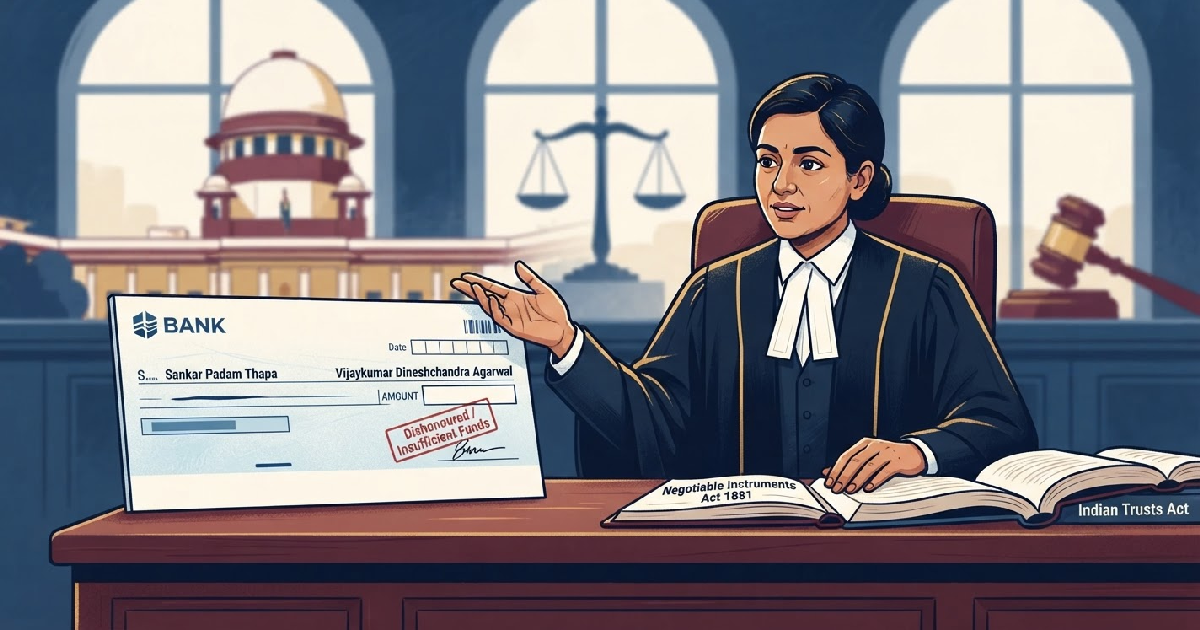
In a significant clarification, the Supreme Court of India recently affirmed that the liability of trust members in cheque bounce cases primarily rests with the individual trustee or trustees who signed the dishonoured cheque. These individuals are held accountable as they are responsible for the trust’s financial management.
This ruling, stemming from the landmark 2025 case of *Sankar Padam Thapa v. Vijaykumar Dineshchandra Agarwal*, clarifies that a trust itself is not a “juristic person” or a “company” under Indian law. Therefore, it cannot be prosecuted directly for cheque dishonour, shifting the focus of legal action squarely onto the trustees.
Understanding Trust Liability in Cheque Dishonour Cases
A trust, as defined by the Indian Trusts Act, 1882, is an obligation linked to property ownership, arising from confidence placed in an owner for a beneficiary’s benefit. It isn’t a separate legal entity that can sue or be sued in its own name, unlike a registered company.
Trustees are individuals who accept this confidence, holding trust property for beneficiaries. They’re legally responsible for managing investments, safeguarding assets, record-keeping, and making distributions. Beneficiaries are the intended recipients of the trust’s benefits.
Key Legal Definitions for Cheque Bounce Cases
A cheque bounce, or dishonoured cheque, happens when a bank refuses to process a cheque presented for payment. Common reasons include insufficient funds, signature mismatches, or an expired validity period.
The bank issues a “Cheque Return Memo” detailing the reason for non-payment. India’s Negotiable Instruments Act, 1881 (NI Act), governs such transactions, with Section 138 specifically criminalizing cheque dishonour under certain conditions.
Section 141 of the NI Act typically extends liability for offences to individuals associated with a “company” or “other association of individuals.” However, the Supreme Court has explicitly stated that a trust does not fall within this definition. “Plenary Control” signifies comprehensive authority over financial transactions, which can establish criminal liability for authorized signatories, particularly in corporate settings.
| Feature | Trust | Company |
|---|---|---|
| Legal Entity Status | Not a juristic person | Juristic person |
| Prosecution for Cheque Dishonour | Individual Trustee(s) | Company (and liable individuals) |
| Applicability of NI Act Section 141 | No (per Supreme Court) | Yes |
| Primary Liability for Cheque | Trustee with financial management responsibility | Director/Officer with plenary control |
| Governing Law (Formation) | Indian Trusts Act, 1882 | Companies Act, 2013 (India) |
Supreme Court’s Landmark Ruling on Trustee Accountability
The Supreme Court of India delivered a definitive verdict in *Sankar Padam Thapa v. Vijaykumar Dineshchandra Agarwal* (2025 SCC OnLine SC 2194). This crucial judgment brought much-needed clarity to how Section 141 of the NI Act applies to trusts.
The Court unequivocally declared that a trust does not qualify as a “company” or “other association of individuals” under Section 141. This means criminal complaints for cheque dishonour cannot be filed against the trust entity itself. Instead, legal action must target the specific trustee or trustees.
These individuals must be the ones who signed the dishonoured cheque and held responsibility for the trust’s financial management. This ruling effectively resolved prior conflicting interpretations among various High Courts, setting a uniform legal precedent across India.
Navigating the Cheque Bounce Legal Process in India
Initiating legal action for a cheque bounce involving a trust under Section 138 of the NI Act follows a specific sequence. First, a trustee must have issued the cheque on the trust’s behalf to settle an existing and legally enforceable debt.
The payee then presents this cheque to their bank within its three-month validity period. If the cheque is returned unpaid, usually due to insufficient funds, the bank provides a “Cheque Return Memo” explaining the reason.
Following this, the payee must send a written legal demand notice to the trustee(s) who signed the cheque within 30 days of receiving the return memo. This notice demands payment of the bounced amount. Trustees then have 15 days from receiving this notice to clear the outstanding payment. Understanding India’s strict notice period for cheque dishonour cases is crucial for pursuing such actions effectively.
If payment isn’t made within that 15-day window, the offence under Section 138 is considered complete. The payee can then file a criminal complaint against the individual trustee(s) in a court of law. This complaint must be lodged within 30 days following the expiry of that 15-day payment period.
For more details on the legal framework, you can refer to Section 138 NI Act cheque dishonour case ngo treasurer explained.
Implications for Trust Management and Financial Oversight
This Supreme Court clarification profoundly impacts how trusts operate and are managed, reinforcing the personal accountability of trustees. It underscores the vital need for meticulous financial record-keeping and robust internal controls within trust structures.
Trustees with “plenary control” over a trust’s finances must now be acutely aware of their individual legal exposure in cheque bounce incidents. For beneficiaries and creditors alike, the ruling offers a clearer path for recourse. They now know legal action will focus on the specific individuals responsible for the trust’s financial operations.
The decision reinforces that while trusts serve essential societal and financial purposes, they do not shield individuals from personal liability for financial mismanagement. This maintains the integrity of cheque-based transactions. It ensures accountability remains with those directly involved in the trust’s financial dealings.
Who is liable when a trust’s cheque bounces?
When a trust’s cheque bounces, the individual trustee or trustees who signed the cheque and were responsible for the trust’s financial management are held liable. The trust itself, not being a juristic person, cannot be prosecuted directly under Indian law.
Can a trust be prosecuted under the Negotiable Instruments Act?
No, a trust cannot be prosecuted as an accused under the Negotiable Instruments Act, 1881. The Supreme Court of India has clarified that trusts do not fall under the definition of a ‘company’ or ‘other association of individuals’ as per Section 141 of the Act.
What is the role of Section 138 of the NI Act in these cases?
Section 138 of the Negotiable Instruments Act makes cheque dishonour a criminal offence under specific conditions. For trusts, while the trust entity isn’t prosecuted, the individual trustee(s) responsible for issuing the bounced cheque can face criminal charges under this section.