
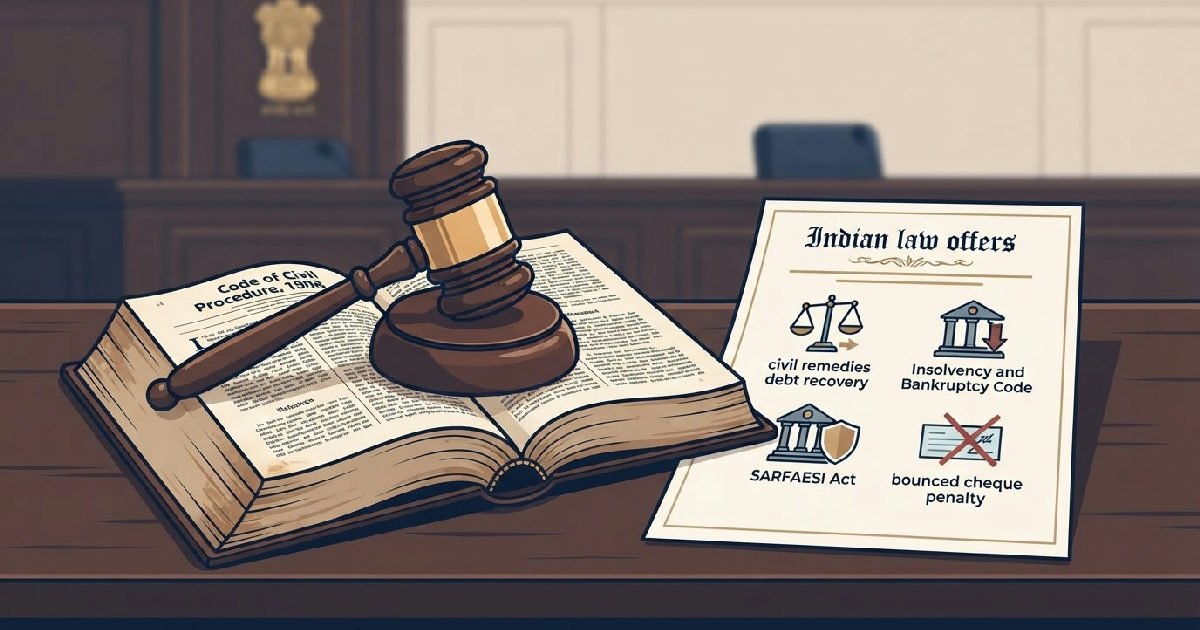
Navigating the recovery of dues under Indian law offers a complex web of legal avenues for creditors, from straightforward civil suits to potent criminal actions and specialized tribunals. For businesses and individuals alike, understanding these pathways is critical to reclaiming outstanding payments in a system governed by statutes like the Code of Civil Procedure, 1908, and the Negotiable Instruments Act, 1881.
The legal framework offers a multi-pronged approach, tailored to the nature of the debt and the parties involved. While a simple unpaid invoice might lead to a civil court, a bounced cheque can trigger criminal proceedings. For large-scale corporate debt, especially involving banks, powerful tools like the Insolvency and Bankruptcy Code (IBC) have reshaped the entire recovery landscape.
What Indian law offers for primary civil remedies
For most creditors, the civil justice system is the first port of call. The foundational method is a standard civil suit for the recovery of money, a process governed by the Code of Civil Procedure, 1908 (CPC). This involves filing a formal plaint, which leads to a sequence of summons, written statements, evidence presentation, and finally, a court decree.
However, the traditional civil suit can be a lengthy affair. Recognizing the need for a faster alternative in clear-cut debt cases, the law provides for an expedited process. This ensures that undisputed claims don’t get bogged down in procedural delays, offering a more efficient route to justice for many creditors.
The expedited path: Summary suits under Order 37
Order 37 of the CPC allows for the filing of a “summary suit.” This mechanism is designed for cases based on written contracts, bills of exchange, or promissory notes where the debt is a specific, liquidated amount. Its primary advantage is speed. Once a suit is filed and summons are issued, the defendant has only 10 days to enter an appearance.
If the defendant fails to appear or cannot present a substantial defence, the court can grant an immediate judgment in the plaintiff’s favour. Should the defendant successfully argue their right to defend, the case converts into a regular civil suit, and they are typically required to file a CPC written statement within 30 days.
This process places the initial burden on the debtor to prove they have a valid case to argue.
Leveraging the Negotiable Instruments Act for bounced cheques
One of the most common tools for debt recovery is Section 138 of the Negotiable Instruments Act, 1881. This provision specifically deals with dishonoured or “bounced” cheques. When a cheque is returned unpaid, the payee must send a legal notice to the issuer within 30 days, demanding payment.
The issuer then has 15 days to settle the amount. If they fail to pay, the payee has the right to file a criminal complaint in a magistrate’s court within one month.
The consequences for the issuer, if found guilty, are significant: a potential prison sentence of up to two years, a fine of up to double the cheque’s value, or both. This quasi-criminal nature makes it a powerful deterrent and an effective recovery tool.
When non-payment becomes a criminal matter
While most debt is a civil issue, certain actions can cross the line into criminal territory under the Indian Penal Code, 1860 (IPC). These provisions are not for simple defaults but are reserved for cases involving dishonest intent, deception, or fraud from the outset. Pursuing a criminal remedy is a serious step and requires a higher burden of proof.
Creditors may invoke these sections when they believe they were deliberately cheated or that funds entrusted to someone were dishonestly used for personal gain. Unlike a civil suit that aims to recover money, a criminal case aims to punish the wrongdoing. However, a successful conviction can often compel the accused to return the misappropriated funds to seek leniency.
Distinguishing criminal breach of trust from cheating
Two key provisions in the IPC are often considered. Section 405 defines “Criminal Breach of Trust,” which applies when a person is entrusted with property and dishonestly misappropriates it. This carries a penalty of imprisonment for up to three years, a fine, or both. The key element is the pre-existing relationship of trust.
Section 415 defines “Cheating,” where a person fraudulently induces another to deliver property. This offence, punishable under sections like 417 and 420, hinges on proving deception was used from the beginning of the transaction. The maximum penalty can vary, with imprisonment reaching up to seven years for more severe forms of cheating.
The courts have recently become stricter, and in some cases, mandates para-wise reply to plaints have been enforced to streamline proceedings.
Specialized recovery laws for banks and financial institutions
Recognizing the systemic risk posed by non-performing assets (NPAs), India has enacted powerful laws specifically for banks and financial institutions. These statutes provide a faster and more potent recovery mechanism than traditional civil courts, empowering lenders to act decisively against large-scale defaulters.
These laws were born out of the necessity to clean up bank balance sheets and prevent capital from being locked in endless litigation. The creation of specialized tribunals and the granting of powers to seize assets without court intervention marked a significant shift in the balance of power between institutional lenders and corporate borrowers.
The role of Debt Recovery Tribunals (DRTs)
The Recovery of Debts Due to Banks and Financial Institutions Act, 1993 (RDDBFI Act) was a landmark piece of legislation. It established Debt Recovery Tribunals (DRTs) across the country. These are quasi-judicial bodies designed exclusively to hear and adjudicate debt recovery cases filed by banks and financial institutions.
The primary purpose of the DRTs is to provide speedy justice. They have the authority to order the attachment and sale of a defaulting borrower’s assets, including property, and can even garnish salaries to recover the outstanding dues. This focused jurisdiction helps lenders bypass the clogged regular court system.
Seizing assets under the SARFAESI Act
Perhaps the most powerful tool in a bank’s arsenal is the Securitisation and Reconstruction of Financial Assets and Enforcement of Security Interest Act, 2002 (SARFAESI Act). This law allows banks and financial institutions to take possession of and sell secured assets—like property mortgaged for a loan—without any court intervention.
Under SARFAESI, if a borrower defaults, the bank can issue a demand notice. If the dues are not cleared within 60 days, the bank can take possession of the security, sell it, or appoint a manager to run the business. This ability to enforce security interests directly has dramatically improved recovery rates for secured loans.
This process is distinct from older methods of streamlines decree execution, which required more court oversight.
The Insolvency and Bankruptcy Code (IBC): A modern paradigm shift
Enacted in 2016, the Insolvency and Bankruptcy Code (IBC) has revolutionized debt resolution in India. It provides a consolidated, time-bound framework for resolving insolvency for companies, partnerships, and individuals. The IBC’s primary focus is on revival of the corporate debtor, but if that’s not possible, it ensures an orderly and timely liquidation to maximize value for all stakeholders.
Financial creditors, operational creditors, and even the corporate debtor itself can initiate the Corporate Insolvency Resolution Process (CIRP). A key feature is the moratorium period, which freezes all other legal actions against the company, allowing a resolution professional to take control and work towards a viable plan. The entire process is overseen by the National Company Law Tribunal (NCLT).
The IBC isn’t just for banks. In a significant move to protect workers, the code allows employees to file an application with the NCLT if their unpaid salaries exceed one lakh rupees (₹1,00,000). The system is designed for speed; within 24 days of filing a demand notice, the applicant will know if their petition has been accepted or rejected, offering a swift path to resolution.
Key timelines and limitation periods in debt recovery
Successfully navigating debt recovery requires strict adherence to statutory timelines. Missing a deadline can result in a case being time-barred, rendering the claim legally unenforceable. The Limitation Act, 1963, sets the overarching deadline, but specific acts have their own critical timeframes that creditors must respect.
The most fundamental is the three-year limitation period for filing a standard civil suit for money recovery, which starts from the date the cause of action arises. However, for procedures like summary suits or actions under the Negotiable Instruments Act, the timelines are much shorter and more rigid, demanding swift action from the creditor.
| Legal Provision | Action Required | Prescribed Time Limit |
|---|---|---|
| Civil Suit (Limitation Act) | Filing a suit for recovery of money | 3 years from the date the debt becomes due |
| Summary Suit (Order 37, CPC) | Defendant to enter an appearance | 10 days from service of summons |
| Summary Suit (Converted to Civil) | Defendant to file written statement | 30 days |
| Bounced Cheque (NI Act, S138) | Send legal notice to the issuer | 30 days from receipt of cheque return memo |
| Bounced Cheque (NI Act, S138) | Issuer to make payment after notice | 15 days from receipt of notice |
| Bounced Cheque (NI Act, S138) | File criminal complaint in court | 1 month after the 15-day notice period expires |
| Insolvency & Bankruptcy Code (IBC) | Receive NCLT decision on petition acceptance | Within 24 days of filing a demand notice |
What is the first step to recover money from a debtor?
The first formal step is usually sending a legal notice through an advocate. This notice outlines the debt, cites the basis for the claim, and demands payment within a specified period, serving as a final warning before legal proceedings are initiated.
Can I go to jail for not paying a debt in India?
Generally, no. Failure to repay a standard loan is a civil liability, not a criminal one. However, criminal liability, including imprisonment, can arise if there’s clear evidence of fraud, cheating, or criminal breach of trust, or in the specific case of a bounced cheque under Section 138.
How long do I have to file a lawsuit for debt recovery?
The Limitation Act of 1963 specifies a period of three years for filing a standard civil suit to recover outstanding money or dues. This period is calculated from the date the debt first became legally due and payable.