
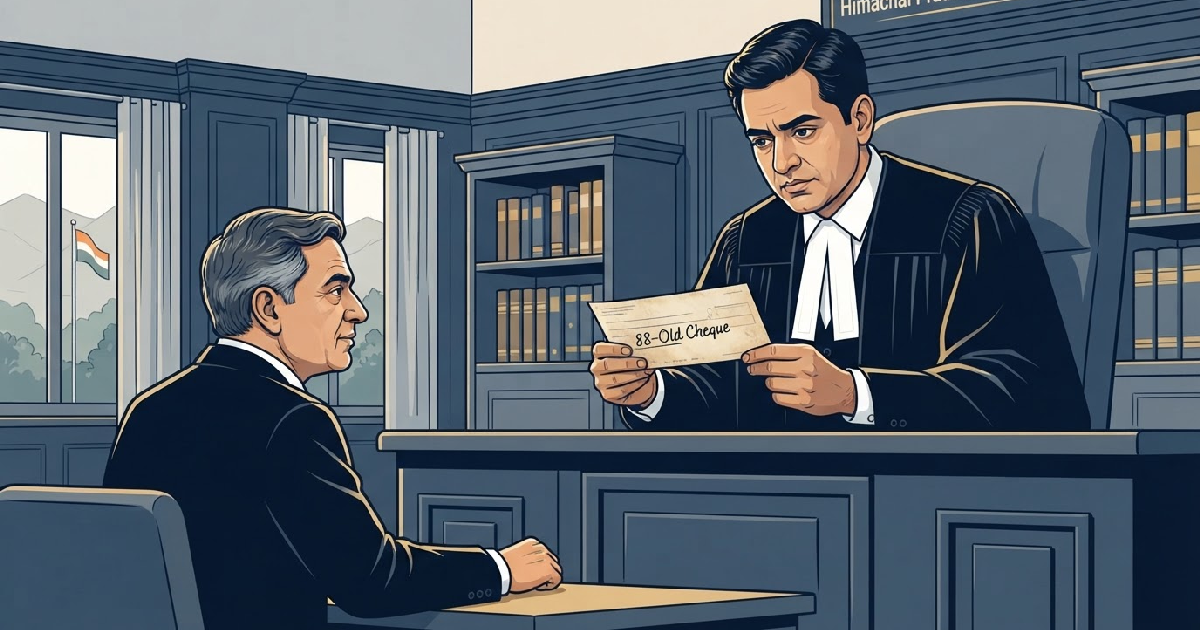
The Himachal Pradesh High Court considered a criminal petition on July 3, 2026, regarding cheque dishonour laws under Section 138 of the Negotiable Instruments Act, 1881. Justice Sandeep Sharma, issued an order on July 3, 2026, documenting its consideration of a criminal petition filed by Jasmer Singh. This order details the arguments presented by both sides concerning the interpretation of cheque dishonour India laws, specifically Section 138 of the Negotiable Instruments Act, 1881.
The core legal question before the court is whether a cheque returned with the remark “88-Old Cheque” falls within the scope of “insufficient funds” for the purpose of initiating criminal proceedings. Crucially, the provided document outlining this order concludes before stating the final decision or ruling of the High Court on Jasmer Singh’s petition to quash the complaint.
Petitioner seeks to quash “old cheque” complaint
Jasmer Singh, referred to as the petitioner or accused, filed a petition (Cr.MMO No.971 of 2024) under Section 528 of the Bharatiya Nagrik Suraksha Sanhita, 2023. He sought to quash criminal proceedings (Case No.465 of 2022) initiated by Smt. Sunita, the respondent or complainant, before the Additional Chief Judicial Magistrate, Court No.1, Paonta Sahib.
Mr. Karan Singh Kanwar, counsel for Jasmer Singh, argued that the complaint under Section 138 of the Negotiable Instruments Act was not maintainable. His primary contention was that the cheque wasn’t dishonoured due to “insufficient funds” but rather because it was an “old cheque.”
Arguments for a narrow interpretation of Section 138
Mr. Kanwar highlighted that Section 138 explicitly states proceedings can be initiated only when a cheque is dishonoured due to “insufficient funds.” Since the return memo, dated June 10, 2022, clearly stated “88-Old Cheque,” he argued the statutory condition for a Section 138 offence had not been met.
He contended that continuing the trial would amount to an abuse of the legal process, as the complaint was likely to fail. This argument suggests a strict, literal interpretation of the grounds for cheque dishonour that can trigger criminal action.
The Rs. 1,30,000 debt and its origins
The dispute originated from Smt. Sunita advancing a loan of Rs. 1,30,000 to Jasmer Singh at his request. To discharge this lawful liability, Jasmer Singh issued a cheque for the same amount, drawn on the Oriental Bank of Commerce, Branch at Nahan Road, Paonta Sahib.
When Smt. Sunita presented the cheque to the bank, it was returned unpaid with the specific remark “88-Old Cheque.” Following this, Smt. Sunita served a legal notice to Jasmer Singh, demanding payment, and subsequently initiated the criminal proceedings when payment was not made.
Complainant argues for broader Section 138 scope
Mr. Rahul Singh Verma, counsel for Smt. Sunita, countered the petition, arguing it was an attempt to delay the trial. He asserted that once the cheque’s issuance and dishonour were admitted, the “88-Old Cheque” remark shouldn’t prevent the proceedings.
He proposed that the court could presume the cheque’s return, even for being “old,” indicated a failure to honour payment. Mr. Verma also suggested the question of whether sufficient funds existed at the time of the return memo should be decided by the trial court based on all evidence.
Applying the Laxmi Dyechem precedent
Mr. Verma drew heavily on the Supreme Court’s landmark judgment in M/s Laxmi Dyechem v. State of Gujarat and Ors. (2012) 13 SCC 375. He argued that the phrase “insufficient funds” in Section 138 acts as a broad “genus.” Various other reasons for dishonour, like “account closed” or “payment stopped,” are merely “species” within that genus.
He contended that an “Old cheque” remark should similarly be considered a species of “insufficient funds.” This perspective implies that if the drawer knew the cheque was outdated due to a bank merger, its issuance could be deemed a deliberate act to avoid payment, thus falling under Section 138.
| Cheque Dishonour Reason | Supreme Court Stance (per Laxmi Dyechem) | Relevance to Jasmer Singh’s petition |
|---|---|---|
| Insufficient Funds | Directly applicable (genus) | Petitioner argues “88-Old Cheque” is not this. |
| Account Closed | Species of “insufficient funds” | Cited by respondent for broader interpretation. |
| Payment Stopped by Drawer | Species of “insufficient funds” | Cited by respondent for broader interpretation. |
| Signature Mismatch | Species of “insufficient funds” | Cited by respondent for broader interpretation. |
| “88-Old Cheque” | Under High Court examination | Whether this remark constitutes a species of “insufficient funds” is the core legal question the Himachal Pradesh High Court is currently examining. |
Bank merger complicates the matter
A significant detail in the case involves the merger of Oriental Bank of Commerce, where Jasmer Singh initially held his account, with Punjab National Bank. Mr. Verma submitted that Jasmer Singh was aware of this merger.
Despite this knowledge, he allegedly issued a cheque from the old bank. Mr. Verma argued that the Punjab National Bank should have honoured the cheque if sufficient funds were available, as the account itself remained the same. He asserted that issuing an “old cheque” after a merger was a deliberate move to evade the complainant’s claim.
High Court’s role in quashing criminal proceedings
Justice Sandeep Sharma is considering the petition within the framework of the High Court’s inherent powers. These powers, now codified under Section 528 of the Bharatiya Nagrik Suraksha Sanhita, 2023 (formerly Section 482 of the Criminal Procedure Code), allow a High Court to quash criminal proceedings.
Such powers are exercised when no prima facie offence is made out, or when continuing the proceedings would constitute an abuse of the legal process. The court seeks to prevent prolonged trials that are ultimately destined to fail, upholding the integrity of the judicial system.
Supreme Court guidance on inherent powers
The High Court’s document cites several Supreme Court judgments that guide the exercise of these inherent powers. Cases like State of Karnataka v. L. Muniswamy and others (1977) 2 SCC 699 establish that High Courts can quash proceedings if their continuation would abuse the court’s process or if justice demands it.
Further principles were laid down in State of Haryana and others v. Bhajan Lal and others (1992 Supp (1) SCC 335), detailing the scope of these powers. More recently, Vineet Kumar and Ors. v. State of U.P. and Anr. (Criminal Appeal No.577 of 2017) affirmed that these powers serve to ensure court proceedings don’t become tools for harassment.
The Laxmi Dyechem principle and statutory interpretation
The High Court’s document extensively discusses the Supreme Court’s ruling in M/s Laxmi Dyechem v. State of Gujarat and Ors. (2012) 13 SCC 375. This judgment underscored that the “insufficient funds” clause in Section 138 should not be interpreted narrowly or literally.
The Supreme Court clarified that deliberate acts, such as closing an account, stopping payment, or signature mismatches, effectively prevent a cheque from being honoured. These actions are viewed as creating a state of insufficient funds for all practical purposes, thus attracting Section 138.
The ruling also noted that Laxmi Dyechem effectively differed from the earlier, more restrictive view in Vinod Tanna & Anr. Vs. Zaher Siddiqui & Ors. (2002) 7 SCC 541.
The underlying purpose of Sections 138 to 142 of the Negotiable Instruments Act is to penalize those who knowingly issue cheques without sufficient backing, which is considered a form of cheating. The focus is on dishonest intent, not punishing those with bona fide reasons for non-payment.
Current status of the petition
The Himachal Pradesh High Court, after hearing counsel and reviewing the records, noted that there was no dispute regarding the issuance of the cheque or the signatures on it. The central argument for quashing was precisely that the cheque was not returned for “insufficient funds,” but as an “88-Old Cheque.”
The court document ends while reiterating the arguments regarding the bank merger and the accused’s knowledge, without providing the final disposition of Jasmer Singh’s petition to quash the criminal complaint. The decision on whether “88-Old Cheque” falls under Section 138 in this specific instance remains pending in the provided record.
What is the core issue before the Himachal Pradesh High Court?
The central question being considered by the High Court is whether a cheque dishonoured with the remark “88-Old Cheque” can be treated as falling under “insufficient funds” for the purpose of Section 138 of the Negotiable Instruments Act, 1881.
What was the petitioner’s main argument?
Jasmer Singh, the petitioner, argued that proceedings under Section 138 are only applicable when a cheque is dishonoured due to “insufficient funds.” He contended that an “88-Old Cheque” remark does not meet this specific criterion, making the complaint against him not maintainable.
How do bank mergers relate to cheque dishonour cases?
In this case, the complainant argued that Jasmer Singh’s former bank, Oriental Bank of Commerce, had merged with Punjab National Bank. The argument suggests that if the drawer knowingly issued an old cheque post-merger, it could be seen as an intentional act to prevent payment, potentially bringing it under the wider interpretation of Section 138.