
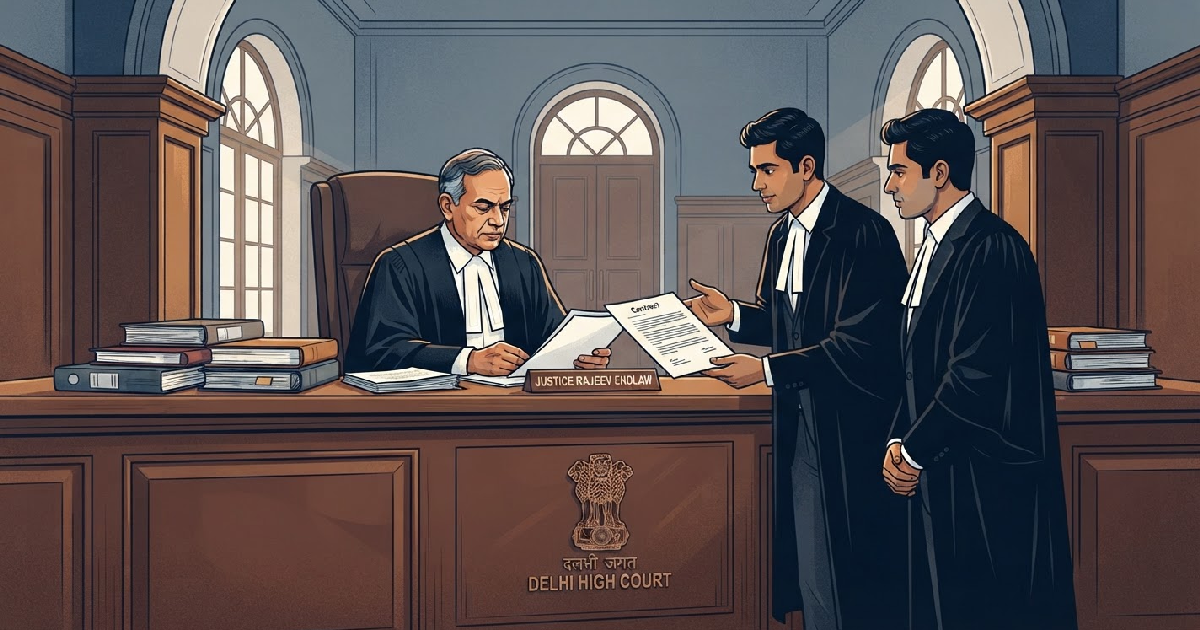
The Delhi High Court ruled that relief in a summary suit cannot be claimed against individuals not privy to foundational documents like a “Settlement of Deal” and dishonoured cheques.
This decision by Justice Rajeev Endlaw, issued on a Wednesday, affirms that parties not directly involved in the core agreements cannot be impleaded in these expedited legal proceedings under Order XXXVII of the Code of Civil Procedure (CPC).
Understanding India’s summary suit framework
The judgment specifically addresses a case involving Satya Prakash & Bros (P) Ltd. against Qutab Realcon Pvt. Ltd., where attempts were made to extend liability to directors beyond the primary contracting parties. This ruling reinforces the stringent conditions governing summary suits, highlighting the enduring importance of the doctrine of privity of contract in India’s commercial legal landscape.
Order XXXVII of the Code of Civil Procedure, 1908, provides a specialised, fast-track mechanism for recovering money in particular kinds of cases. It aims to accelerate the resolution of disputes where a defendant may lack a substantial defence, thereby preventing undue delays in commercial matters.
The primary goal is to ensure quick disposal of cases involving liquidated debts, offering a streamlined remedy for specific commercial claims. Many businesses rely on this provision for faster debt recovery when there is clear, documentary evidence supporting the claim.
Expedited process under Order XXXVII CPC
Summary suits are designed for efficiency, significantly reducing the typical timelines associated with civil litigation. Unlike standard civil suits, defendants must actively seek and obtain the court’s explicit permission, known as “Leave to Defend,” before they can present their case.
If the court deems a proposed defence frivolous or without merit, a decree can be issued immediately. This stringent requirement for a leave to defend requirement streamlines the judicial process. It ensures that only genuinely contested matters proceed to a full trial.
Scope and applicability of summary proceedings
Summary suits are applicable for claims seeking liquidated amounts arising from specific types of documents or agreements. These include written contracts, negotiable instruments such as bills of exchange, hundies, and promissory notes, as well as guarantees.
The sum claimed must be a fixed amount or a statutory debt, explicitly excluding penalties. Courts with jurisdiction for these matters include High Courts, City Civil Courts, and other courts specifically notified by the respective High Court.
The Delhi High Court, established in October 1966, exercises original jurisdiction over civil suits with pecuniary values exceeding ₹2 crore, making it a key venue for significant commercial disputes.
The doctrine of privity: a contractual cornerstone
The Delhi High Court’s recent judgment in the Satya Prakash case strongly reasserts the fundamental legal principle known as the “doctrine of privity of contract.” This doctrine is a bedrock of contract law, dictating who can enforce or be bound by the terms of an agreement.
It means that generally, only parties directly involved in forming a contract can acquire rights or incur obligations under it. Consequently, a third party, even if somehow connected to the transaction, typically cannot sue or be sued on that contract if they weren’t a signatory.
Defining contractual privity
Privity of contract establishes a direct contractual relationship between parties. Without this direct link, a person is considered a “stranger” to the contract, lacking the legal standing to enforce its terms or have its terms enforced against them. This principle is crucial for defining the scope of liability in commercial arrangements.
It ensures that obligations and rights are clearly delineated among the individuals or entities who assented to the agreement. So, if your name isn’t on the dotted line, you’re generally not part of the deal in a legal sense.
Privity in Indian contract law
While the doctrine has English common law roots, the Indian Contract Act, 1872, largely upholds the principle that a “stranger to a contract cannot sue.” However, Indian law exhibits some flexibility regarding “privity of consideration,” meaning that the consideration for a contract doesn’t strictly have to move only from the promisee.
Despite this nuanced difference concerning consideration, the core tenet of privity of contract regarding parties to the suit remains robust in India. It prevents an arbitrary extension of contractual liability to unconnected third parties.
Delhi High Court’s ruling on non-privy parties
In the specific case of Satya Prakash & Bros (P) Ltd. v. Qutab Realcon Pvt. Ltd. (CS (Os) 51/2019), the Delhi High Court meticulously examined the boundaries of a summary suit filed under Order XXXVII CPC. The plaintiff, Satya Prakash & Bros (P) Ltd., initiated the suit based on a “Settlement of Deal” document and subsequently dishonoured cheques.
The suit targeted Qutab Realcon Pvt. Ltd. and Piyoosh Goel, who allegedly signed the settlement on behalf of the company. However, the plaintiff also impleaded Abhishek Saraf, Hanuman Singh, and Ravi Kumar, who were directors of Qutab Realcon Pvt. Ltd.
Case background: Satya Prakash & Bros v. Qutab Realcon
The crux of the matter involved allegations of dishonoured cheques issued by Qutab Realcon Pvt. Ltd., stemming from a settlement agreement. The plaintiff sought to recover funds, leveraging the summary suit procedure for its expedited nature. The inclusion of the company’s directors as additional defendants broadened the scope of the original claim significantly.
This move tested the limits of who could be held accountable in such swift proceedings. The court had to determine if the directors, by virtue of their position, could be made parties to a suit rooted in documents they weren’t direct signatories to.
Justice Endlaw’s pronouncements on director liability
Justice Rajeev Endlaw keenly questioned the senior counsel for the plaintiffs regarding the inclusion of these additional defendants. He specifically queried how the suit against parties not privy to the foundational documents (the Receipt/Settlement of Deal and the cheques) had been instituted under Order XXXVII CPC.
Justice Endlaw unequivocally stated, “A suit under Order XXXVII of the CPC is maintainable only if a claim within the ambit of Order XXXVII is made thereunder.
The plaintiffs having claimed reliefs in the suit against persons other than those privy to documents on the basis of which suit under Order XXXVII of the CPC has been filed, notwithstanding the suit having been entertained without noticing the said aspect by the learned Joint Registrar, the suit cannot be permitted to be treated as under Order XXXVII of the CPC.”
He added that even if the directors (defendants no. 3 to 5) had signed any cheques, it wouldn’t automatically make them personally liable in a summary suit.
Implications for corporate liability and debt recovery
This ruling carries substantial implications for how businesses structure their commercial agreements and pursue debt recovery actions. It reinforces that simply being a director of a company does not inherently make one personally liable for corporate debts in a summary proceeding, unless that director was a direct party to the foundational agreement.
Creditors must now be more meticulous in identifying the specific parties to a contract and ensuring direct privity for all individuals or entities they wish to pursue through a summary suit. This means robust documentation and clear contractual obligations are more important than ever.
Rethinking director liability
The judgment means that for a director to be held personally liable in a summary suit under Order XXXVII CPC, they must have explicitly signed or been a party to the underlying documents. Merely signing cheques on behalf of the company is insufficient to establish personal liability in this specific type of expedited proceeding.
This distinction prevents the automatic expansion of corporate liability to individual directors, protecting them from summary judgments unless they have a direct contractual link. Businesses, therefore, need to understand the nuances of this personal guarantee versus corporate representative role.
Strategic considerations for creditors
For creditors seeking to recover debts, this ruling necessitates a careful review of their contractual agreements and the parties involved. If a creditor intends to hold directors personally liable, they must ensure these directors are explicitly made parties to the primary contractual documents or guarantees.
Failing to establish this direct privity can result in the summary suit being deemed inadmissible against the non-privy director, potentially leading to delays and additional legal costs as the plaintiff might need to pursue a regular civil suit. This puts the onus on diligent contract drafting and clear identification of all liable parties from the outset.
Here’s a comparison of summary suit characteristics:
| Characteristic | Summary Suit (Order XXXVII CPC) | Regular Civil Suit |
|---|---|---|
| Purpose | Expedited recovery of liquidated debts | Resolution of various civil disputes |
| Defendant’s Right to Defend | Requires ‘Leave to Defend’ from court | Automatic right to file defence |
| Timeline | Significantly reduced | Can be lengthy (years, depending on complexity) |
| Applicability | Written contracts, negotiable instruments, guarantees | Broad range of legal and equitable claims |
Navigating the complexities of commercial litigation
The Delhi High Court’s clarification underscores the increasingly nuanced nature of commercial litigation in India. It serves as a reminder that while summary suits offer an attractive pathway for swift debt recovery, their application is strictly governed by procedural rules and foundational legal doctrines like privity of contract.
Businesses engaged in commercial transactions must proactively ensure their agreements are meticulously drafted, clearly identifying all parties and their respective liabilities. This foresight can prevent costly legal challenges down the line and ensure the enforceability of claims.
Due diligence in commercial agreements
For entities entering into commercial contracts, thorough due diligence regarding the parties involved is paramount. It’s not enough to simply identify the principal company; one must also determine if personal guarantees or direct contractual obligations from directors are necessary and properly documented. Specific property worth standards and clear agreements are crucial.
This includes ensuring that all intended liable parties are direct signatories or explicitly bound by the core documents forming the basis of any potential summary suit. Legal counsel plays a critical role in advising on these precise requirements to safeguard commercial interests effectively.
Evolving landscape of summary proceedings
This Delhi High Court ruling reflects a continuing judicial effort to refine the application of summary proceedings. Courts aim to balance the need for expedited justice with the fundamental rights of defendants, ensuring that swift judgments are only delivered when the foundational legal requirements are unequivocally met.
This ongoing judicial scrutiny means that legal practitioners and commercial entities must stay abreast of evolving interpretations. Adapting contractual strategies and litigation approaches to align with these clarifications will be key for successful commercial dealings moving forward. The Jammu & Kashmir and Ladakh High Court’s bolstering of summary suit deposit rules illustrates this trend of judicial refinement.
What is a summary suit under Order XXXVII CPC?
A summary suit is an accelerated legal procedure designed to facilitate the rapid recovery of liquidated debts or specific contractual claims in India. Governed by Order XXXVII of the Code of Civil Procedure, it seeks to circumvent delays by defendants lacking a genuine or substantial defense.
Can I sue a director personally in a summary suit for company debts?
No, not automatically. The Delhi High Court has clarified that a director cannot be held personally liable in a summary suit under Order XXXVII CPC for company debts unless they were directly privy to the foundational documents of the agreement. Merely signing cheques on behalf of the company is typically not enough.
What is the doctrine of privity of contract?
The doctrine of privity of contract is a legal principle stating that a contract cannot confer rights or impose obligations upon any person who is not a party to the contract. Only the direct parties to an agreement can generally sue or be sued on its terms.