
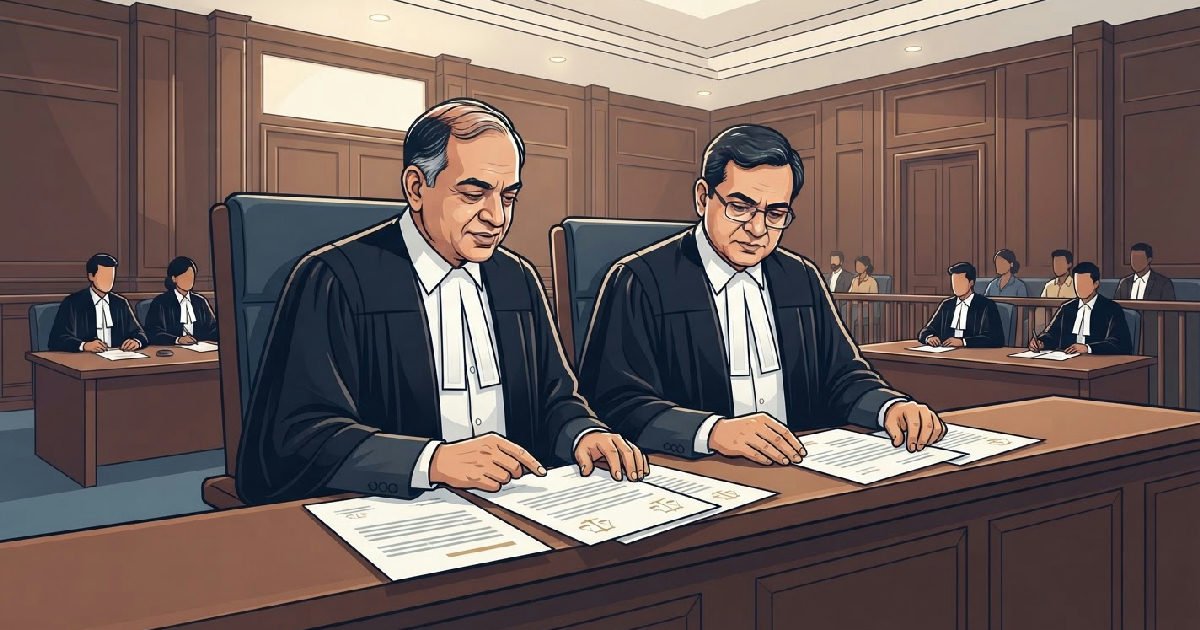
The Delhi High Court has reinforced the high bar for issuing summary judgments in commercial disputes, ruling that the power is “exceptional in nature” and must be used with significant prudence.
In a decision on February 5, 2026, a division bench comprising Justices Anil Kshetarpal and Amit Mahajan set aside a summary decree, sending a clear message that contested factual issues deserve a full trial, even when contractual documents are not in dispute.
Summary judgment commercial cases: judicial shortcuts
The ruling came in a case involving tenant Cottage Industries Exposition Ltd. and its landlord over rent and consultancy fees for a commercial property on Barakhamba Road. The court found that simply having agreements in place does not automatically warrant a summary judgment if the underlying liability is seriously challenged, restoring the suit for a complete trial.
The High Court’s judgment delved into the specifics of the dispute, where a Commercial Court had previously issued a summary decree against the tenant. The lower court reasoned that since the existence of the lease and consultancy agreements was admitted, a trial was unnecessary. However, the High Court disagreed, focusing on the tenant’s substantive defense.
Cottage Industries Exposition Ltd. argued that its liability was not straightforward. It claimed the agreements had expired, consultancy services were not actually utilized, and rent could not be claimed after an offer to hand over possession had been made. The division bench concluded these were not flimsy arguments but genuine factual disputes requiring evidence.
The Commercial Courts Act was designed for efficiency, but not to bypass due process.
In its observation, the bench stated, “The mere fact that contractual documents exist does not, by itself, justify a summary decree when the liability flowing therefrom is seriously contested.” This statement underscores a critical principle: the purpose of a summary judgment is not to conduct a mini-trial on paper but to weed out cases with no realistic chance of success.
The court determined that issues like the subsistence of consultancy obligations and the correct method for calculating interest could not be decided without a trial. By restoring the suit, the court has ensured that both parties will have the opportunity to present oral evidence and cross-examine witnesses to substantiate their claims.
The legal framework for summary judgment: order XIII-A
The legal basis for this judicial tool is Order XIII-A of the Code of Civil Procedure (CPC), 1908. This provision was not part of the original code but was inserted by the Commercial Courts Act, 2015. Its primary goal was to accelerate the resolution of business disputes and improve India’s position on the World Bank’s Ease of Doing Business index.
Order XIII-A empowers a court to decide a claim or a part of a claim without recording oral evidence. It is a powerful mechanism designed to save judicial time and resources by disposing of meritless cases at an early stage. However, it comes with strict conditions to prevent its misuse and protect the fundamental right to a fair trial.
A court can grant a summary judgment only if it finds that the claimant or defendant has “no real prospect” of succeeding in or defending the claim. Additionally, there must be “no other compelling reason” why the case should proceed to a full trial. This dual test ensures that the power is reserved for the clearest of cases.
Application and limitations
Timing is also a critical factor. An application for summary judgment cannot be made at any time. The rules specify that it must be filed after the summons has been served on the defendant but before the court has framed the issues for trial.
Crucially, a court cannot issue a summary judgment of its own accord (suo motu); a formal application by one of the parties is mandatory.
Balancing act: a history of judicial interpretation
The Delhi High Court’s latest ruling does not exist in a vacuum. It builds on a series of judgments from both the High Courts and the Supreme Court that have sought to define the contours of this “exceptional” power. The judiciary has been engaged in a careful balancing act, weighing the need for speedy justice against the risk of premature decisions.
A landmark ruling from the Supreme Court of India in April 2026, in *Reliance Eminent Trading and Commercial Private Limited v. Delhi Development Authority*, provided significant clarification. In that case, Justices J.K. Maheshwari and Atul S. Chandurkar encouraged courts not to shy away from granting summary judgment when a defense is merely “fanciful” and lacks a real prospect of success.
The Supreme Court stated that Order XIII-A empowers courts to “arrest such proceedings at the threshold,” but this is predicated on the defense being weak on a prima facie basis.
The Delhi High Court’s recent decision complements this by highlighting the inverse: when a defense appears substantive and raises triable questions of fact, caution is paramount. This creates a nuanced standard for lower courts to apply. Other courts have also weighed in, with the Bombay High Court clarifying appealability of certain orders.
Early interpretations from the Delhi high court
The Delhi High Court itself has a history of carefully interpreting this provision. In one of the earliest cases, *Bright Enterprises Private Ltd. & Anr. v. MJ Bizcraft LLP & Anr.* (2016), a division bench first labeled the power as exceptional. This set the tone for future jurisprudence. Later, in *Su-kam Power Systems Ltd. v.
Mr. Kunwer Sachdev* (2019), the court noted that with the advent of the Commercial Courts Act, a full “trial is no longer the default procedure/norm,” but only when a dispute can be resolved summarily.
When is summary judgment appropriate?
This evolving jurisprudence helps litigants understand when a case might be ripe for summary disposal versus when a court is likely to insist on a full trial. The key distinction always comes down to whether there are genuine, triable issues of fact or only questions of law based on admitted facts.
The following table illustrates scenarios where a court might lean one way or the other, based on the principles laid down in recent judgments.
| Scenario | Suitable for Summary Judgment? | Rationale |
|---|---|---|
| An undisputed debt supported by invoices and clear acknowledgment of liability. | Yes | The defendant has no real prospect of defending the claim as the core facts and liability are admitted. |
| A contract’s existence is admitted, but one party alleges breach of a key condition or misrepresentation. | No | This raises a triable issue of fact that requires evidence to prove or disprove the alleged breach. |
| A dispute revolves entirely around the interpretation of a specific clause in a contract with no factual disagreement. | Potentially Yes | If the matter is purely a question of law, the court may be able to decide it without oral evidence. |
| The defendant raises a defense that is vague, unsupported by any documentation, or contradictory. | Yes | This would likely be considered a “fanciful” defense with no real prospect of success. |
| A case requires technical or expert evidence to determine facts, such as the cause of a product failure. | No | Such complex factual questions cannot be resolved without expert testimony and cross-examination. |
Broader implications for commercial litigation in India
The Delhi High Court’s judgment serves as a vital course correction, ensuring that the push for efficiency in commercial courts doesn’t trample the principles of natural justice.
For businesses engaged in litigation, it means that simply being on the right side of a written contract isn’t enough if the opposing party can raise a credible, fact-based defense. It signals that courts will look beyond the paperwork to the substance of the dispute.
The Commercial Courts Act, 2015, was a legislative overhaul intended to make India a more attractive destination for investment by promising faster dispute resolution. Historically, commercial suits could languish in the court system for anywhere from 3 to 10 years. While mechanisms like summary judgment are crucial to trimming these timelines, this ruling ensures the tool is used as a scalpel, not a sledgehammer.
It reinforces the idea that while some disputes are clear-cut, many are not. Business relationships can be complex, and issues like contract expiration, non-performance of services, or mitigation of damages often require a deep factual inquiry that is only possible in a full trial. This is different from matters like employment disputes not being commercial suits, which are excluded on a subject-matter basis.
What happens next
For the parties in the immediate case, the path forward is clear. The suit is now restored to the file of the Commercial Court for a full trial. The court has directed the parties to appear on February 17, 2026, to proceed with framing issues and leading evidence.
The landlord’s attempt to secure a quick victory has been thwarted, and they must now prove their claim through the traditional trial process.
For the wider business community, this ruling provides valuable guidance. Plaintiffs seeking summary judgment must be prepared to demonstrate that the defendant’s case is truly without merit and has no real prospect of success. Conversely, defendants can be more confident that if they have a legitimate, fact-based defense, they will get their day in court.
The judgment ultimately strengthens the integrity of the commercial justice system. It affirms that while efficiency is a goal, the ultimate objective is to deliver a just and fair outcome based on a thorough examination of the evidence, especially when the facts themselves are the heart of the disagreement.
What is a summary judgment in a commercial case?
A summary judgment is a procedure under Order XIII-A of the Civil Procedure Code that allows a court to decide a commercial dispute without a full trial. It can be granted if one party can show that the other has no real prospect of winning and there’s no other compelling reason for the case to go to trial.
Why did the Delhi High Court overturn the lower court’s decision?
The High Court found that the lower court had wrongly granted a summary judgment. The tenant had raised several serious, fact-based disputes about its liability concerning rent and consultancy fees. The High Court ruled that such contested factual issues could not be decided summarily and required a full trial with evidence.
Can a court issue a summary judgment on its own?
No, a court cannot issue a summary judgment on its own initiative (suo motu). One of the parties involved in the commercial suit must file a formal application requesting it. The application must be made after summons are served but before trial issues are framed.
Call or Whatsapp for free consultation.
Related Service: https://arpitmarwah.com/commercial-lawyers-in-delhi/