
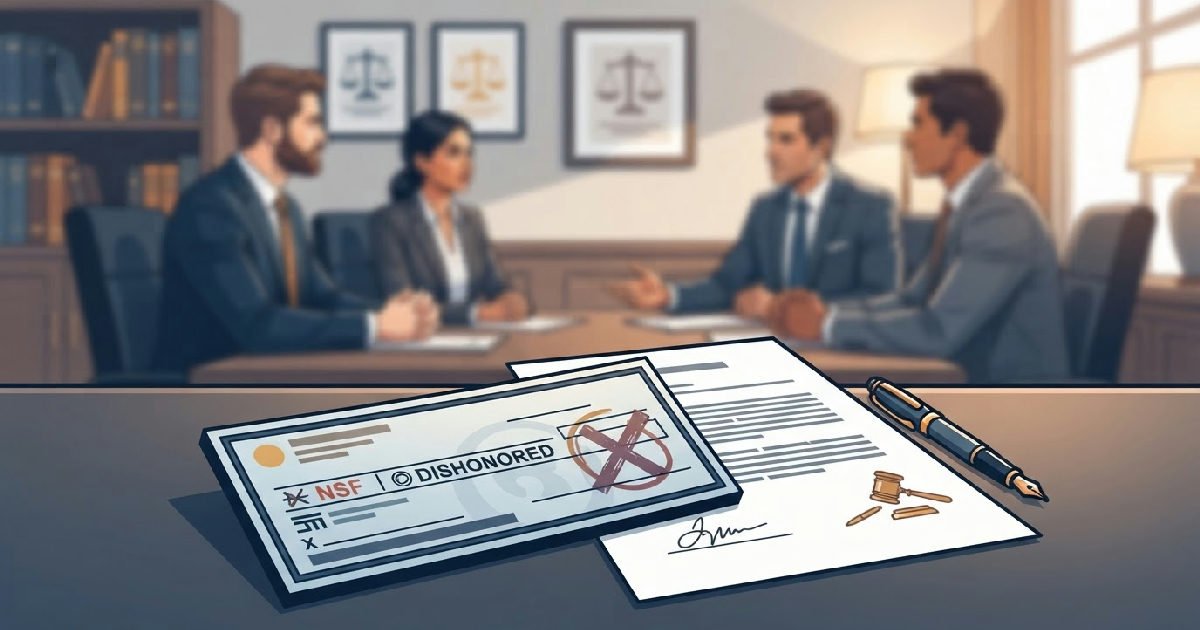
A bounced cheque lawyer offers vital legal counsel and representation when individuals or entities encounter dishonored checks, a situation that can trigger substantial financial and legal repercussions. For both the check writer, known as the drawer, and the recipient, the payee, understanding when to seek professional legal guidance is crucial.
Typically, legal intervention becomes necessary once informal attempts to resolve the issue prove futile, particularly when significant sums of money are at stake or when fraudulent activity is suspected.
Understanding Dishonored Checks and Their Causes
Moreover, facing potential civil litigation or criminal charges associated with a dishonored check unequivocally warrants legal assistance. Navigating the legalities surrounding non-sufficient funds (NSF) or fraudulent checks requires a deep understanding of state-specific statutes and the broader Uniform Commercial Code (UCC).
A “bounced check,” often referred to as a “dishonored check” or “Non-Sufficient Funds (NSF) check,” is a payment instrument that a bank cannot successfully process and pay to the designated recipient. This issue most commonly arises because the account from which the check is drawn lacks adequate funds to cover the specified amount. But there are other reasons too.
However, insufficient funds aren’t the sole reason for a check being returned unpaid. Various other technical or procedural problems can lead to a check bouncing, creating headaches for all parties involved. Banks will typically return these checks, often imposing fees on both the drawer and the payee.
Primary causes of bounced checks
Several factors can cause a check to bounce, moving beyond the simple issue of an empty account. These reasons highlight the complexities of check processing and the potential pitfalls for both individuals and businesses. Understanding these common pitfalls helps in preventing them.
- Insufficient Funds (NSF): This remains the most prevalent cause, occurring when the drawer’s bank account holds less money than the check demands. It’s a common issue for many check writers.
- Incorrect Details: Simple human errors, such as a wrong date, miswritten numerical figures, or illegible handwriting, can prevent a check from being processed. Such errors often lead to immediate rejection by the banking system.
- Outdated or Stale Checks: Financial institutions often reject checks not presented for payment within a specific timeframe, commonly 180 days (six months) after issuance. Payees must deposit checks promptly to avoid this.
- Closed Account: If the account used to write the check has been closed prior to its presentation, the bank will return it unpaid. This can happen if a person switches banks or closes an unused account.
- Stop Payment Order: A drawer might instruct their bank to halt payment on a check, sometimes without a legally valid reason, leading to its dishonor. This action can have legal implications depending on the circumstances.
- Fraudulent Checks: Checks that are discovered to be forged or counterfeit represent a serious criminal offense and will immediately be rejected by banks. Identifying and reporting fraudulent checks quickly is crucial.
Key Players in a Bounced Check Scenario
Understanding the roles of the different parties involved in a check transaction is essential, especially when a check bounces. Each entity has distinct responsibilities and potential liabilities when things go wrong. The system relies on clear identification of who initiates the payment, who receives it, and which financial institution facilitates the transfer.
| Role | Description | Primary Responsibility/Action |
|---|---|---|
| Drawer | The person or entity writing the check. | Ensures sufficient funds in their account; issues payment instruction. |
| Payee | The person or entity receiving the check. | Entitled to receive the specified payment; deposits or cashes the check. |
| Drawee/Payor Bank | The bank on which the check is drawn. | Verifies check details; transfers funds from drawer’s account (if available). |
The Legal Framework Governing Checks
The legalities surrounding bounced checks are primarily dictated by individual state laws across the United States. However, these state regulations frequently integrate foundational principles derived from the Uniform Commercial Code (UCC). The UCC provides a standardized approach to commercial transactions, ensuring some consistency.
Specifically, UCC Article 3 lays out the rules for negotiable instruments like checks, establishing their fundamental characteristics and transferability. UCC Article 4, on the other hand, provides the framework for bank deposits and collections, outlining the operational aspects between banks and their customers. These articles form the backbone of check law.
While the UCC offers a consistent baseline, each state maintains its own specific statutes concerning bad checks. These state-level laws can determine thresholds for what constitutes a criminal offense and the range of civil remedies available to aggrieved parties. This variability means what’s permissible in one state might carry different consequences elsewhere. Understanding these nuances is critical for navigating bad cheque laws effectively.
When Payees Need Legal Counsel for Recovery
For the payee, receiving a bounced check can be a frustrating and financially damaging experience. While initial attempts at informal resolution are common, there are clear indicators when the situation demands the expertise of a bounced check lawyer.
Acting swiftly and appropriately can often mean the difference between recovering lost funds and facing a prolonged, unrewarding battle. Consulting legal counsel ensures that all steps taken are compliant with state-specific regulations.
- Informal Resolution Fails: If direct communication with the check writer doesn’t lead to prompt payment, further legal steps become necessary. A lawyer can escalate the matter formally, often through official demand letters.
- Significant Amount Involved: When a bounced check is for a substantial sum, the financial repercussions can be significant enough to justify the cost of professional legal assistance. Protecting larger financial interests often requires expert intervention to maximize recovery chances.
- Suspected Fraud: If there’s any indication the check was written with no genuine intent to pay, or if it appears forged, a lawyer can help pursue both criminal charges and civil remedies. Fraudulent checks are serious offenses with potential legal action.
- Need to Understand State-Specific Remedies: State laws widely differ on the precise procedures for collection, including specific demand letter requirements and potential statutory damages. A legal professional ensures compliance, avoiding procedural missteps and protecting the payee’s rights.
Pursuing civil litigation for recovery
When informal methods and demand letters fail to yield results, a payee may need to pursue civil litigation to recover funds. This process can be complex and requires adherence to specific legal protocols to be successful.
A bounced check lawyer becomes an invaluable asset during this phase, guiding the payee through each step of the recovery process. Their expertise helps in maximizing the chances of a favorable outcome and securing the funds owed.
- Demand Letter: A lawyer can draft a formal demand letter, which is often a mandatory precursor to further legal action. This letter typically requests payment within a specified timeframe, such as 10 to 30 days, serving as official notice.
- Small Claims Court: For amounts falling below state-specific thresholds, small claims court offers a streamlined, less formal avenue for recovery. Legal representation can still be highly beneficial here, ensuring proper presentation of the case and adherence to local rules.
When Drawers Need Legal Advice
While often seen as the party at fault, check writers, or drawers, also face potential risks when a check bounces. The research indicates that seeking legal advice from a bounced check lawyer can be beneficial for drawers in various circumstances. This general guidance acknowledges the complexities they might encounter.
Drawers may find legal counsel helpful if they are facing potential civil litigation from a payee, or if there is any suspicion of criminal charges, especially when fraud is involved. A lawyer can clarify their legal position and potential next steps. This proactive approach can help navigate complex situations.
Financial and Legal Ramifications of Dishonored Checks
The repercussions of a bounced check extend far beyond the immediate inconvenience. Both drawers and payees can face a cascade of financial penalties and legal challenges. Understanding these potential outcomes is critical for appreciating the importance of legal intervention. Bounced cheques can lead to monetary losses and significant stress, making timely legal advice invaluable.
For the drawer, the immediate impact typically involves fees from their bank for the returned item, plus fees from the payee’s bank. These charges add up, increasing the financial burden. If fraud is suspected, and it meets state-defined thresholds, this can lead to potential criminal charges.
Payees, on the other hand, face the immediate loss of expected funds and the frustration of dealing with recovery. They may also incur fees from their bank for the returned item. If they fail to recover the money, it represents a direct financial hit, potentially impacting their own financial obligations.
When should I consult a bounced check lawyer?
You should consider contacting a bounced check lawyer if informal attempts to resolve the issue have failed, if a significant amount of money is involved, or if you suspect fraud. Additionally, legal counsel is advisable if you are facing potential civil litigation or criminal charges related to a dishonored check, whether you are the drawer or the payee.
What are the legal implications of writing a bounced check?
Writing a bounced check can lead to significant legal implications, including civil lawsuits for the recovery of funds and potential statutory damages. In cases where fraud is suspected, and it meets state-specific thresholds, potential criminal charges may also arise. State laws vary significantly regarding these legal responses and available civil remedies.
Can a lawyer help me recover money from a bounced check?
Yes, a bounced check lawyer can significantly assist in recovering funds for a payee. They can draft formal demand letters, advise on state-specific collection procedures, and represent you in small claims court if necessary. Their expertise guides payees through the legal process to pursue payment effectively.