
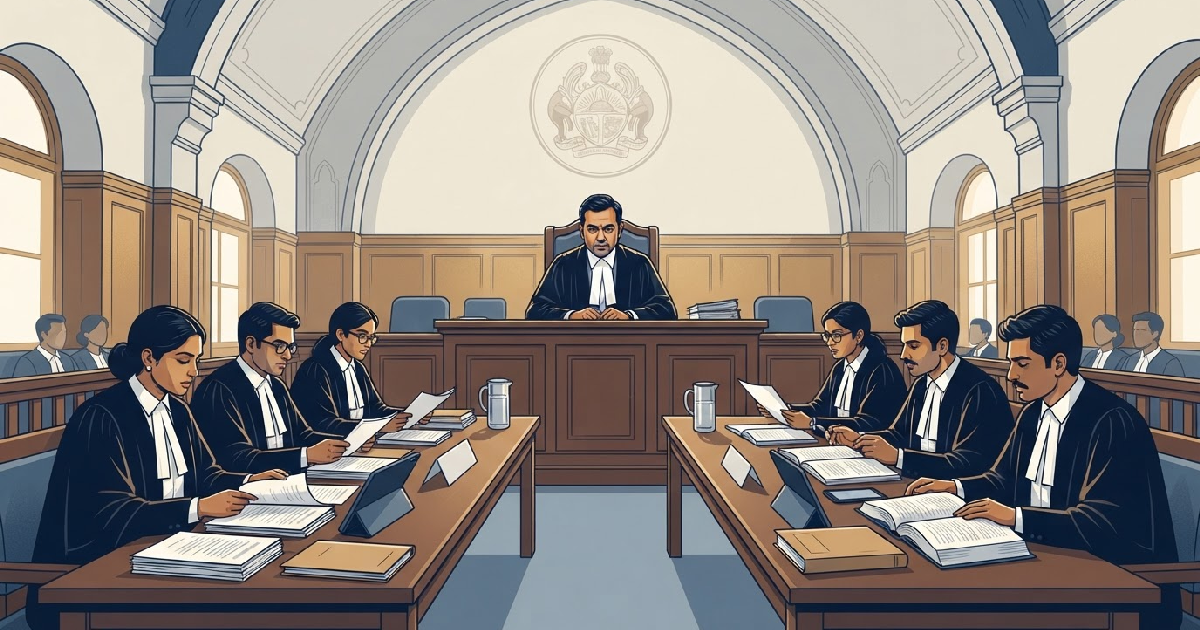
The Bombay High Court ruled that a singular debt assignment transaction is not a commercial dispute under the Commercial Courts Act, 2015.
Justice Abhay Ahuja presided over the case of Rolta Private Limited and Anr. vs. Varanium Cloud Limited and Anr., and importantly, imposed a substantial cost of ₹5,00,000 on the defendant, Varanium Cloud Limited, for attempts to delay the judicial process.
Court’s decisive ruling on commercial dispute
This decision, pronounced on November 11, 2024, has drawn a clear line on what types of financial disagreements qualify for the specialized fast-track procedures of commercial courts. It underlines the judiciary’s commitment to preventing the misuse of these specialized forums, ensuring they remain focused on their intended purpose of resolving genuine commercial matters efficiently.
The core issue revolved around an Interim Application (L) No. 6341 of 2024 filed by Varanium Cloud Limited, seeking the return of a plaint in Summary Suit No. 18 of 2023. The defendant argued that the suit, initiated by Rolta Private Limited and Anr., was a commercial dispute.
Therefore, it contended, the matter should have been lodged before the Commercial Division of the High Court, invoking the provisions of the Commercial Courts Act, 2015.
Justice Abhay Ahuja, however, unequivocally rejected this contention. The court highlighted that a dispute stemming from a one-off debt assignment transaction does not inherently qualify as an “ordinary transaction of a merchant, financier, or trader.” It clarified that such a transaction doesn’t fall under the specific categories outlined in Section 2(1)(c)(ii) to (xiii) of the Commercial Courts Act, 2015.
Background of the case: Rolta vs Varanium
The underlying dispute originated from Summary Suit No. 18 of 2023, where Rolta Private Limited and Anr. sought to recover ₹800 Crores, alongside accrued interest. This claim was based on a debt assignment agreement dated July 7, 2023. Varanium Cloud Limited and Anr., as defendants, then moved the interim application challenging the jurisdiction.
Their plea was based on the premise that the dispute was commercial. They sought to have the plaint returned under Order VII, Rule 10 of the Code of Civil Procedure, 1908 (CPC). This procedural maneuver aimed to redirect the case to the Commercial Division of the Court.
The court’s reasoning
Justice Ahuja stressed that even if the overarching purpose of the transaction was commercial, it would not automatically grant jurisdiction to the Commercial Division. The critical determinant is whether the dispute itself aligns with the precise definition of a “commercial dispute” as per Section 2(1)(c)(i) of the Commercial Courts Act. The court found it did not.
This interpretation underscores that the nature of the transaction—whether it’s a singular, isolated event versus a regular course of business—is paramount. It emphasizes that a mere financial transaction isn’t sufficient to trigger the specialized commercial court framework.
Unpacking the commercial courts act, 2015
The Commercial Courts Act, 2015, was a legislative initiative to streamline the resolution of high-value business disputes in India. This move was primarily aimed at enhancing the country’s “Ease of Doing Business” ranking and attracting further foreign investment. The Act established specialized courts and divisions to handle complex commercial cases with greater efficiency.
Its implementation introduced specific procedural innovations designed for faster adjudication. These include mandatory pre-institution mediation and strict timelines for pleadings, aiming to reduce litigation delays. The Act also sought to provide a clear framework for what constitutes a commercial dispute, guiding legal practitioners and businesses.
Purpose and scope of the act
The primary goal of the Commercial Courts Act was to create a dedicated judicial ecosystem for commercial matters. It led to the establishment of Commercial Courts at the district level. Additionally, it facilitated the creation of Commercial Divisions and Commercial Appellate Divisions within the High Courts, providing specialized expertise.
These specialized forums were designed to address the unique complexities of commercial law. They also sought to reduce the burden on the general civil judicial system, thereby accelerating the resolution of business-related conflicts. This legislative intent focused on fostering a more predictable and efficient legal environment for commerce.
Evolution of specified value thresholds
Initially, the Commercial Courts Act applied to disputes with a “specified value” of ₹1 crore or more. This threshold was designed to focus on high-stakes commercial litigation. However, an amendment in 2018 significantly lowered this value to ₹3 lakh or more.
This reduction broadened the categories of cases that could be heard by these specialized courts. It allowed a wider range of commercial disputes to benefit from the Act’s fast-track procedures. The change reflected an effort to make commercial justice more accessible while still maintaining the efficiency of the specialized courts.
Broader implications for financial litigation
This ruling from the Bombay High Court provides critical clarity for businesses and legal professionals navigating financial disagreements in India. It signals a judicial reluctance to expand the definition of “commercial dispute” beyond the clear legislative intent. The decision suggests courts will scrutinize the nature of transactions more closely.
Lawyers representing companies involved in debt recovery or assignment transactions will need to re-evaluate their litigation strategies. They will have to consider whether a dispute truly fits the commercial court framework. This could lead to a more nuanced approach to forum selection in future cases.
Strict interpretation sets precedent
The Bombay High Court’s strict interpretation aligns with previous rulings by the Supreme Court and other High Courts. These judgments have consistently emphasized that the definition of a commercial dispute should be applied restrictively. This ensures that the specialized courts remain focused on genuine commercial matters and avoid being overwhelmed by general civil disputes.
It sets a precedent that an isolated transaction, even if it involves substantial sums, does not automatically transform into a commercial dispute. Parties must demonstrate that the transaction is part of their ordinary course of business. This distinction is crucial for maintaining the integrity and efficiency of the commercial court system.
Impact on summary suits
The case specifically involved a Summary Suit filed under Order 37 of the Code of Civil Procedure, 1908 (CPC). These suits are designed for the swift recovery of money for liquidated demands, often arising from written contracts. They allow for judgment without a full trial unless the defendant obtains “leave to defend” by proving a legitimate defense.
The ruling clarifies that even in summary suits concerning financial matters, the fundamental nature of the underlying transaction determines jurisdiction under the Commercial Courts Act. This means defendants can’t simply claim a summary suit is a commercial dispute to shift forums. It reinforces the need for careful legal assessment at the outset of any debt recovery proceeding.
Legal precedents shaping the definition
The Bombay High Court’s decision didn’t arise in a vacuum; it echoes a consistent line of judicial interpretation from India’s higher courts. Understanding these precedents helps illuminate the judiciary’s deliberate approach to defining “commercial dispute” under the Act. This has been a developing area of law since the Act’s inception.
Courts have been careful to prevent the Commercial Courts Act from becoming a catch-all for any dispute involving money. They aim to preserve its effectiveness for truly commercial matters. This judicial restraint ensures the specialized courts can fulfill their mandate for speedy dispute resolution.
Supreme Court’s stance on ‘ordinary transactions’
The Supreme Court, in cases like Ambalal Sarabhai Enterprises Ltd. v. K. S. Infraspace LLP & Anr., has previously highlighted the importance of a dispute being tied to a party’s regular business activities. For a matter to qualify as commercial, it must emanate from an “ordinary transaction of merchants, bankers, financiers, and traders.”
This implies a pattern of regular business conduct, not an isolated incident.
This principle forms the bedrock of the current ruling. It prevents parties from classifying an ad-hoc financial arrangement as a commercial dispute. The transaction must be integral to the habitual dealings of the entities involved, reflecting their core commercial functions.
Calcutta High Court’s similar rulings
The Calcutta High Court has also contributed to this interpretive framework. In Ladymoon Towers Pvt. Ltd. v. Mahendra Investment Advisors Pvt. Ltd., it ruled that a singular loan transaction doesn’t automatically qualify as an “ordinary transaction of a financier.” This echoes the Bombay High Court’s recent stance on debt assignment.
Furthermore, the Calcutta High Court clarified in August 2021 that a commercial dispute under Section 2(1)(c)(i) requires two elements. First, it must be between specified types of persons (merchants, bankers, financiers, traders), and second, it must be formalized by a mercantile document.
A “hand-loan” based on an oral understanding, not part of regular business, wouldn’t meet this criterion. This further solidifies the need for leave to defend in these kinds of cases.
The penalty for delaying tactics
A notable aspect of Justice Ahuja’s ruling was the imposition of exemplary costs totaling ₹5,00,000 (Five Lakhs Indian Rupees) on the defendants, Varanium Cloud Limited. This substantial penalty wasn’t merely a judicial slap on the wrist; it was a clear signal against procedural abuses.
The court explicitly stated that Varanium Cloud Limited’s application was viewed as a tactic to delay the progress of the original Summary Suit. The application for returning the plaint came after another interim application seeking dismissal of the suit. This pattern of filings suggested a deliberate strategy to prolong proceedings.
Costs imposed and their destination
The ₹5 lakh costs are not going into general court funds or to the plaintiffs. Instead, Justice Ahuja directed that the amount be paid to the High Court Non Gazetted Ministerial Staff Association, Mumbai. This specific directive ensures the penalty benefits those who support the judicial system directly.
Varanium Cloud Limited has been given a period of two weeks from the date of the order to make this payment. This swift deadline emphasizes the court’s seriousness in deterring dilatory practices. It underscores a commitment to efficient judicial administration.
Future outlook for commercial disputes
This Bombay High Court judgment marks a pivotal moment in the interpretation of the Commercial Courts Act, 2015. It reinforces the Act’s original intent to handle complex, high-value commercial matters, rather than becoming an avenue for all financial disputes. Businesses must now exercise greater precision in classifying their disputes.
Legal teams will need to conduct more thorough due diligence when initiating or defending cases they wish to bring under the Commercial Courts Act. The focus will undoubtedly shift further towards demonstrating that a transaction is part of the “ordinary course of business” for all parties involved, moving beyond superficial financial characteristics.
The ruling also serves as a stark warning against filing applications primarily designed to delay proceedings. The imposition of significant costs signals a lower tolerance for procedural tactics that impede timely justice. This could lead to a more streamlined litigation process in commercial matters, benefiting all stakeholders seeking swift resolution.
Table: Overview of commercial dispute criteria
| Criterion | Description | Implication for Single Debt Assignment |
|---|---|---|
| Nature of Transaction | Must arise from “ordinary transactions of merchants, bankers, financiers, and traders.” | A singular, one-off assignment often doesn’t meet this continuous business activity requirement. |
| Parties Involved | Dispute typically between commercial entities or individuals in their commercial capacity. | While parties may be commercial, the transaction’s nature is key. |
| Mercantile Document | Often involves formalized documents like bills of exchange, contracts, or promissory notes. | A debt assignment agreement exists, but its singular nature is the point of contention. |
| Specified Value | Dispute value must meet the statutory threshold (currently ₹3 lakh or more). | The value can be met (₹800 Crore in this case), but it’s not the sole determinant of “commerciality.” |
What did the Bombay High Court rule regarding debt assignment?
The Bombay High Court ruled that a dispute arising from a single transaction involving the assignment of debt does not qualify as a “commercial dispute” under Section 2(1)(c) of the Commercial Courts Act, 2015. This means such cases might not be heard in specialized commercial courts.
Why did the court impose a fine of ₹5 lakh?
Justice Abhay Ahuja imposed a cost of ₹5,00,000 on the defendants, Varanium Cloud Limited, because their application seeking to return the plaint was deemed a tactic to delay the summary suit. The court viewed it as an abuse of the judicial process.
What is the Commercial Courts Act, 2015, and its purpose?
The Commercial Courts Act, 2015, was enacted to create specialized courts and divisions for the faster and more efficient resolution of high-value commercial disputes in India. Its goal is to improve the ease of doing business and attract investment by providing a streamlined legal framework for commercial matters.