
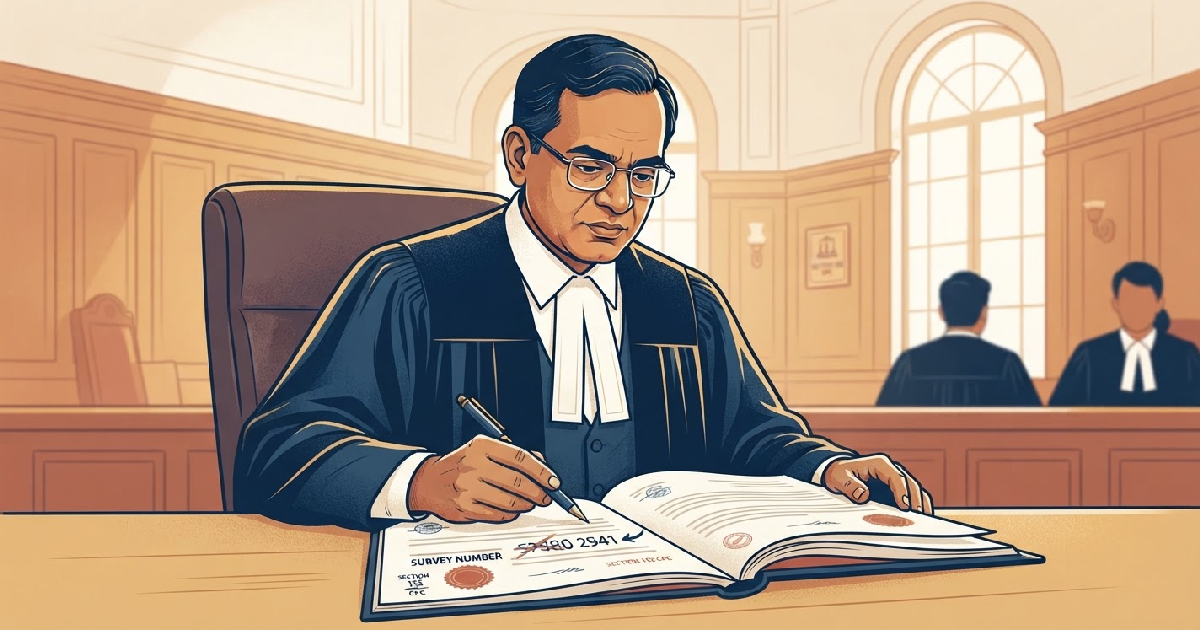
Courts can rectify incorrect survey numbers in judicial decrees, allowing for survey number correction of accidental errors, the Andhra Pradesh High Court ruled on July 30, 2026.
Justice Subba Reddy Satti, presiding over the case, clarified that such corrections fall under Section 152 of the Code of Civil Procedure (CPC), provided the error was an accidental slip and the property’s identity remains unequivocally undisputed. This decision dismissed a Civil Revision Petition, reinforcing a crucial mechanism for ensuring justice in property-related matters.
Ensuring Accuracy in Judicial Records
This judicial stance underscores a fundamental principle: technical inaccuracies shouldn’t impede the execution of justice when the underlying facts are clear. The ruling offers much-needed clarity for litigants and legal practitioners grappling with clerical errors in property descriptions, particularly where older records might contain minor discrepancies.
Judicial decrees serve as the final word in legal disputes, but clerical or arithmetical errors can sometimes creep into these documents. Section 152 CPC provides a vital avenue for correcting such mistakes. It allows courts to amend judgments, decrees, or orders to rectify accidental slips or omissions, ensuring that the written record accurately reflects the court’s true intention and the facts presented during the proceedings.
The power isn’t meant for revisiting the merits of a case or introducing substantive changes. Instead, it’s a procedural safeguard designed to prevent parties from suffering due to inadvertent errors. This is especially critical in property law, where precise identification is paramount for ownership and transactional clarity.
The Importance of Property Identification and Survey Numbers
In India, a survey number is a unique identification code assigned to each parcel of land during official land surveys. It’s a cornerstone for legal identification, taxation, and dispute resolution. Accurate survey numbers are essential in deeds, sale agreements, and judicial pronouncements to avoid future disputes over ownership or boundaries.
However, older records or administrative oversights can sometimes lead to discrepancies. When a decree contains an erroneous survey number, it can create significant practical challenges for the decree-holder in enforcing their legal rights, potentially leading to further litigation and delays. This is where the court’s power under Section 152 CPC becomes indispensable.
When Boundaries Trump Survey Numbers
A key aspect of the Andhra Pradesh High Court’s ruling is the emphasis on property boundaries. Justice Satti explicitly stated that the boundaries of an immovable property prevail over its survey numbers and recorded extent when it comes to identifying the property. This pragmatic approach acknowledges that physical demarcations often provide a more reliable and undisputed means of identification than a potentially erroneous number.
This principle is particularly relevant in rural areas or older properties where survey records might be less precise or subject to historical changes. By prioritizing clear boundaries, the court ensures that the substance of the property identification takes precedence over formalistic errors. It means that if everyone agrees on the physical plot of land, a mistake in the number won’t invalidate the entire legal outcome.
The court’s decision in this case stemmed from a Civil Revision Petition where the initial error was confined solely to the survey number (e.g., recorded as 175/5) within a decree for specific performance. The crucial detail was that the property’s boundaries remained consistent and undisputed throughout the proceedings. This distinction was central to allowing the correction.
Judicial Precedents: A History of Rectification
The Andhra Pradesh High Court’s recent pronouncement isn’t an isolated event; it builds upon a rich tapestry of judicial precedents across Indian courts. These prior rulings have consistently upheld the judiciary’s inherent power and statutory right to correct clerical errors, particularly those related to property descriptions, to ensure the effective administration of justice.
Landmark High Court Rulings
One of the foundational cases cited is the Andhra Pradesh High Court’s own ruling in Kalkonda Pandu Rangaiah v. Kalkonda Krishnaiah And Others from March 8, 1973.
This case established that clerical or arithmetical errors in survey numbers and land extents, even if present in the plaint schedules and decrees, can be corrected under Section 152 CPC.
It affirmed that this power could be exercised even after a considerable lapse of time, provided the errors were purely clerical and didn’t alter the fundamental nature or ownership of the properties involved. This precedent has guided courts for decades.
Another Andhra Pradesh High Court decision, Vallabhaneni Vimalamba v. Ghanta Ratnamma (AIR 1966 AP 26), further clarified that Section 152 CPC could be invoked to remedy defects in a decree that originated from an incorrect plaint. This highlights the broad application of the section to ensure decrees accurately reflect the intended judicial outcome, even if the error began at an earlier stage of litigation.
The Madras High Court has also contributed significantly to this jurisprudence. In Krishna Poduval v. Lekshmi Nathiar (AIR 1950 Mad. 751), the court permitted the amendment of a survey number in both plaint and decree schedules. The deciding factor was the absence of any dispute regarding the property’s identity or boundaries, aligning perfectly with the latest AP High Court ruling.
More recently, in C.K. Philips v. T.A. Shanmugam (2003)2 MLJ 722, the Madras High Court explicitly ruled that Section 152 CPC can be used to correct survey numbers and isn’t limited to clerical errors in judgments and decrees alone.
It also clarified that corrections aren’t restricted to the pre-decree stage, allowing for adjustments even after a final judgment has been passed. This is a critical point for litigants who discover errors only during the execution of a decree.
Similarly, the Madras High Court in Swaminathan And Another v. Duraisami And 7 Others (November 27, 1997) held that bona fide mistakes in survey numbers within plaints and decrees could be rectified under Sections 152 and 153 CPC, especially when property identity was not in question.
These decisions collectively demonstrate a consistent judicial approach to prioritizing the true intent and undisputed facts over mere clerical anomalies.
Supreme Court’s Consistent View
The Supreme Court of India has consistently affirmed the principles underpinning Section 152 CPC. In Pratibha Singh And Anr. vs Shanti Devi Prasad And Anr. (November 29, 2002), the apex court stated that if immovable property isn’t definitively identified in a decree, the defect can be cured under Section 152 CPC.
This ensures a successful plaintiff isn’t deprived of their rightful benefits due to an accidental slip or omission, reinforcing the idea that justice should not be thwarted by technicalities.
Another important Supreme Court case, K. Rajamouli vs A.V.K.N. Swamy (2001), reiterated that clerical or arithmetical mistakes or accidental slips in judgments, decrees, or orders can be corrected at any time. These pronouncements from the highest court provide a strong legal foundation for lower courts to exercise their powers under Section 152 CPC, ensuring uniformity and fairness across the judicial system.
The Supreme Court also highlighted this principle again very recently, on July 29, 2026. It allowed an appeal to correct erroneous observations in a High Court judgment under Section 152 CPC.
This action was taken to prevent prejudice in pending civil proceedings, where the High Court had mischaracterized claims and misstated the effect of a prior order regarding property identity. This shows the ongoing relevance and application of this procedural tool.
The Fine Line: Accidental Slip vs. Disputed Identity
While the court’s power to correct errors is broad, it’s not without its limits. The Andhra Pradesh High Court, like many before it, explicitly cautioned against the misuse of this jurisdiction. The key differentiator is whether the error is a genuine accidental slip or omission, as opposed to a fundamental dispute about the property’s actual identity or ownership.
If the identity of the property itself is disputed, or if correcting the survey number would effectively alter the substance of the original judgment, then Section 152 CPC would not apply.
Such scenarios would typically require a fresh suit, an appeal, or a review, as they delve into the merits of the case rather than mere clerical rectifications. The principle is that the power of correction exists to align the record with the truth, not to rewrite the truth.
Litigants must present clear evidence that the property’s physical boundaries and other identifying features were consistently understood by all parties, and that the wrong survey number was simply an administrative oversight. This burden of proof ensures that the corrective power isn’t abused to gain an unfair advantage or re-litigate settled matters.
Implications for Litigants and Legal Practice
This ruling from the Andhra Pradesh High Court has significant implications for both current and future property disputes. For individuals who have obtained a favorable decree but face challenges due to minor errors in property descriptions, the path to correction is now clearer. It reduces the likelihood of protracted legal battles solely over technicalities, saving time, resources, and emotional strain.
It also serves as a reminder for legal professionals to meticulously verify all property details in pleadings and decrees. While the courts are equipped to correct accidental errors, proactive diligence can prevent them from occurring in the first place. This ruling reinforces the idea that the legal system is designed to provide substantive justice, not to trap parties in a web of procedural minutiae.
The emphasis on undisputed identity and prevailing boundaries promotes a more practical approach to property law. It means courts are increasingly looking beyond mere numbers to the physical reality of what was intended to be decreed. This could lead to faster execution of decrees and a reduction in post-judgment litigation arising from clerical imperfections.
The Broader Impact on Indian Judiciary
The consistent application of Section 152 CPC, as reaffirmed by the Andhra Pradesh High Court and numerous Supreme Court precedents, reflects a broader judicial philosophy. It demonstrates the judiciary’s commitment to preventing injustice stemming from inadvertent human error while maintaining the sanctity of final judgments.
This approach helps to maintain public trust in the judicial system, assuring citizens that their rights won’t be undermined by administrative mistakes. It also contributes to judicial efficiency by providing a streamlined process for minor corrections, thus allowing courts to focus on more complex substantive disputes. This balance between formality and flexibility is crucial for a robust legal framework.
The principle that boundaries prevail over survey numbers is a practical interpretation that benefits property owners. It aligns legal descriptions with physical reality, making property rights more tangible and less vulnerable to errors in record-keeping. This pragmatic stance reinforces the objective of the legal system: to resolve disputes fairly and effectively.
Key Judicial Directives on Correction of Errors
The various court rulings establish clear guidelines for when and how corrections under Section 152 CPC can be made. Here’s a summary of the conditions and their impact:
| Condition for Correction | Impact / Principle | Relevant Case Law Example |
|---|---|---|
| Accidental slip or omission | Error must be inadvertent, not substantive | Kalkonda Pandu Rangaiah v. Kalkonda Krishnaiah |
| Identity of property undisputed | All parties agree on the physical property | Krishna Poduval v. Lekshmi Nathiar |
| Boundaries prevail over numbers | Physical demarcation is primary identifier | Andhra Pradesh High Court (current ruling) |
| Correction after decree passed | Amendments permissible post-judgment | C.K. Philips v. T.A. Shanmugam |
| Error in plaint or original document | Scope extends beyond drafting of decree | Vallabhaneni Vimalamba v. Ghanta Ratnamma |
This table illustrates the consistent judicial approach across various instances and courts, underlining the core tenets of Section 152 CPC. It shows that while procedural rectifications are encouraged, they must always uphold the integrity of the original judicial decision and the undisputed facts of the case.
What is Section 152 CPC?
Section 152 of the Code of Civil Procedure, 1908, is a legal provision that empowers courts to correct clerical or arithmetical mistakes, or errors arising from any accidental slip or omission in judgments, decrees, or orders. Its purpose is to ensure the accuracy of judicial records so that they truly reflect what the court intended.
Can a wrong survey number in a decree always be corrected?
No, not always. The Andhra Pradesh High Court has specified that such corrections are permissible only if the error in the survey number is due to an accidental slip or omission, and crucially, if the identity of the property in question remains undisputed by all parties involved. If there’s a dispute over the actual property, then a mere correction isn’t sufficient.
Do property boundaries or survey numbers take precedence in identification?
According to the Andhra Pradesh High Court’s ruling, the boundaries of an immovable property generally prevail over its survey numbers and recorded extent when identifying the property. This means that if the physical demarcation and agreed-upon boundaries are clear and undisputed, a clerical error in the survey number can be corrected to match the actual property.