
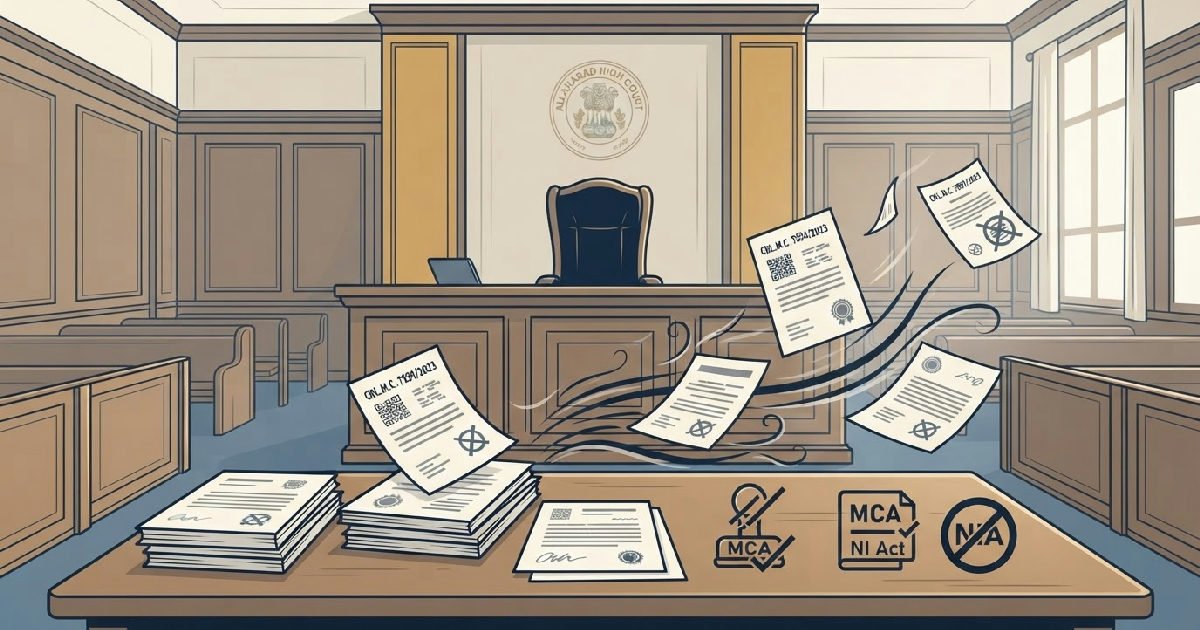
The Allahabad High Court ruled that criminal proceedings for cheque dishonour under Section 138 of the Negotiable Instruments Act, 1881, cannot proceed if the company is dissolved.
This decision, handed down by Justice Arun Monga on October 8, 2025, significantly impacts how cheque bounce cases are handled in the capital, particularly for entities no longer legally in existence.
Allahabad High Court rules against cheque issued by a company that has been struck off
The court’s pronouncement effectively quashed two criminal complaints, CRL.M.C. 7534/2023 and CRL.M.C. 7559/2023, underscoring that a dissolved company lacks the juristic personality to either initiate or face such proceedings. This legal clarity is vital for both creditors seeking to recover dues and former directors of defunct companies facing litigation.
The recent Delhi High Court judgment solidifies the principle that a company, once struck off and dissolved from the Register of Companies, ceases to exist as a legal entity. This absence of juristic personality renders any action taken on its behalf, or against it, void from the outset unless the company is later restored under Section 252 of the Companies Act.
Justice Arun Monga’s ruling specifically highlighted that a cheque issued by or presented on behalf of such a dissolved entity cannot be considered a legally enforceable instrument. Essentially, without a valid drawer or account-holder in the eyes of the law, the foundational elements for a Section 138 complaint are missing.
The cases that led to this significant ruling involved underlying transactions from 2011-2014. The complainant company, Raghav Aditya Chits Pvt Ltd., had been struck off the Register of Companies by the Registrar of Companies (ROC), Delhi & Haryana, on August 8, 2018.
Crucially, the cheques and subsequent complaints were filed after the company’s dissolution, leading the court to conclude that the company was legally non-existent at the time of these critical actions.
This principle extends to both sides of a cheque bounce dispute. Whether the struck-off company is the drawer of the cheque or the entity presenting it as a complainant, criminal prosecution cannot be maintained. This alignment with rulings from other High Courts, including those in Madras and Bombay, suggests a growing judicial consensus across India on this complex issue.
| Scenario | Company’s Legal Standing | Section 138 Case Against Company | Director Liability (Section 141) |
|---|---|---|---|
| Active Company | Exists | Maintainable | Possible |
| Struck-off & Dissolved Company | Non-existent | Not Maintainable | Possible (if offense during operation) |
| Company under IBC Resolution | Exists (under process) | Maintainable (with caveats) | Possible |
| Company Dissolved under IBC | Non-existent | Not Maintainable | Possible (for pre-dissolution acts) |
Director liability persists despite company dissolution
While the dissolution of a company may halt direct criminal proceedings against the entity itself, it does not automatically absolve its directors of all liability. The law distinctly separates the corporate entity from the individuals responsible for its conduct, especially when offenses were committed during the company’s operational period.
Directors can still face prosecution under Section 141 of the Negotiable Instruments Act, 1881, which addresses offenses by companies. This section stipulates that every person who, at the time the offense was committed, was in charge of and responsible to the company for the conduct of its business, shall also be deemed guilty of the offense, alongside the company.
However, establishing this liability requires more than just a directorship title. A criminal complaint must contain a specific, detailed statement outlining precisely how and in what manner the director was responsible for the company’s business operations at the time the cheque was dishonoured. Merely being named as a director or attending board meetings is typically insufficient grounds for conviction.
This critical distinction means complainants must meticulously detail the director’s role. For directors, the defense often hinges on proving they were not in charge of the company’s day-to-day financial operations or decision-making concerning the cheque in question at the material time.
Liability nuances for former and non-executive directors
The legal landscape further refines director liability based on their specific roles and tenure within a company. Former directors, those who have resigned, generally cannot be held responsible for cheque dishonour if the cheque was issued after their resignation date.
The Supreme Court affirmed this in Rajesh Viren Shah v. Redington (India) Limited on February 14, 2024, holding that a director who has resigned cannot be held liable for post-resignation acts. However, if a director signed the cheque and then resigned, their liability generally remains if that cheque is later dishonoured.
Proper filing of Form DIR-12 (formerly Form 32) with the Registrar of Companies after resignation is crucial for directors to establish their non-involvement in subsequent acts.
Non-executive and independent directors also receive specific consideration. They typically cannot be held vicariously liable under Section 141 of the NI Act unless the complaint explicitly demonstrates their direct involvement in the company’s financial decision-making or daily business conduct at the time of the offense.
The Supreme Court, in K.S. Mehta v. Morgan Securities and Credits Pvt. Ltd. in March 2025, clarified that mere directorship is insufficient for Section 138 liability for these categories of directors.
Understanding these distinctions is vital for both parties. For detailed advice on navigating such complex situations, particularly when a resigned director is still named in a Delhi cheque case, legal counsel is essential. Complainants need to ensure their pleadings are robust, while directors must actively manage their corporate records, especially resignation filings.
Insolvency proceedings and director criminal liability
The intersection of cheque bounce cases with insolvency proceedings under the Insolvency and Bankruptcy Code (IBC) adds another layer of complexity. A key clarification from the Supreme Court is that the approval of a resolution plan under the IBC, or even the dissolution of the company under IBC, does not extinguish the criminal liability of erstwhile directors under Section 138 of the NI Act.
This means that despite a company undergoing insolvency proceedings or even dissolution under the IBC, the criminal liability of its directors for cheque dishonour remains a distinct legal matter.
Can a cheque bounce case be filed against a company that has been struck off?
No, the Delhi High Court has clarified that criminal proceedings for cheque dishonour under Section 138 of the Negotiable Instruments Act cannot be sustained against a company that has been officially struck off and dissolved, as it lacks juristic personality to either initiate or face such proceedings.
Do directors remain liable for cheque bounce cases if their company is dissolved?
Yes, while the company itself may not face direct criminal proceedings if dissolved, directors can still be prosecuted under Section 141 of the NI Act if they were in charge of and responsible for the company’s business at the time the offense was committed. Their liability is distinct from that of the corporate entity.
What is the significance of a company being “struck off”?
When a company is officially “struck off” from the Register of Companies, it ceases to exist as a legal entity. This means it loses its juristic personality and can no longer legally operate, initiate legal actions, or be sued, including in matters related to cheque dishonour, unless it is subsequently restored under Section 252 of the Companies Act.
Company cheque bounced and the company has now been struck off? Call or Whatsapp for consultation.
Related: https://arpitmarwah.com/cheque-bounce-lawyers-in-delhi/