
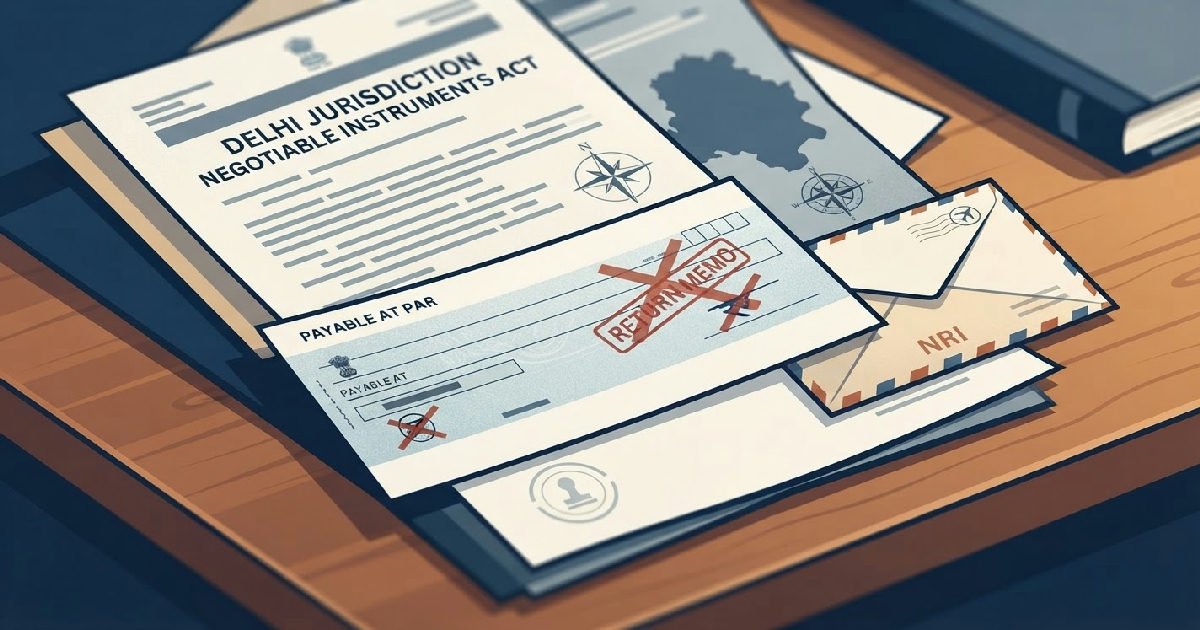
Non-Resident Indians (NRIs) holding a bounced cheque from an Indian company face specific legal challenges, particularly concerning where to file a complaint in Delhi. The Negotiable Instruments (Amendment) Act, 2015, which took effect on June 15, 2015, significantly clarified the jurisdictional landscape, moving away from previous ambiguities.
This pivotal amendment establishes that such cases should typically be filed in the court governing the local jurisdiction of the payee’s bank branch where the cheque was presented. For an NRI, even if residing overseas, the physical location of the bank in India, specifically in Delhi in this scenario, dictates the appropriate legal forum.
Navigating the 2015 Amendment for NRI holding a Bounced Cheque
The 2015 amendment to the Negotiable Instruments Act, 1881, reshaped the rules for filing bounced cheque complaints. Before this change, a Supreme Court judgment in Dashrath Rupsingh Rathod versus State of Maharashtra on August 1, 2014, restricted territorial jurisdiction to the court where the cheque was dishonoured by the drawee bank. This created considerable difficulties for payees.
But the new law, enacted retrospectively from June 15, 2015, permits payees to initiate proceedings in the jurisdiction of their own bank branch. This ensures that an NRI with a bounced cheque deposited in a Delhi bank can pursue legal action directly within Delhi’s judicial system, simplifying a previously complex process for overseas residents.
The “Payee’s Home Branch” Rule
Under the revised provisions, the offence under Section 138 of the Negotiable Instruments Act, 1881, must be tried by a court within whose local jurisdiction the payee’s bank branch is situated. This is the branch where the payee presented the cheque for payment.
Should the cheque have been delivered for collection through an account, the jurisdiction similarly lies with the court governing the location of the payee’s bank branch where that account is maintained. This precise clarification streamlines the process for many filing a cheque bounce case.
The Supreme Court has explicitly reinforced this as the “payee’s home branch” rule. It definitively states that jurisdiction rests with the court overseeing the payee’s bank branch where the account is maintained, not necessarily the site of physical presentation.
For NRIs, this often points to the Indian bank branch associated with their subsidiary or the specific branch where their account is held and the cheque deposited.
Delhi’s Court Landscape
In Delhi, cases related to cheque dishonour are adjudicated across several local court complexes. These include Tis Hazari, Saket, Karkardooma, Dwarka, Rohini, and Rouse Avenue Courts. The specific court depends on the precise jurisdictional area of the payee’s bank branch.
Indian courts maintain jurisdiction over “foreign cheques” that are deposited for encashment within India. The authority to adjudicate such complaints rests with the court located in the jurisdiction where the cheque was deposited, regardless of its origin.
Crucial Steps for Filing a Complaint
For an NRI seeking redress for a bounced cheque, adhering to strict procedural timelines is paramount. Missing these deadlines can lead to the dismissal of the case, irrespective of its merits. Diligence and prompt action are key to a successful complaint under Section 138 of the NI Act.
The process begins with the initial presentation of the cheque and follows a defined sequence of steps. Each stage has its own critical time window, demanding careful management. Proper documentation and timely submission are essential components of this legal journey.
Strict Timelines for Action
Firstly, the cheque must be presented to the bank within three months from its date of issue, or within its validity period, whichever comes first. This initial step is non-negotiable for any subsequent legal action.
Following a cheque’s dishonour, the payee must obtain a written memo from the bank detailing the reason for non-clearance. Common reasons cited include insufficient funds, signature discrepancies, or an account closure. This memo serves as vital evidence.
Within 30 days of receiving this cheque return memo, the payee is legally obligated to dispatch a formal written demand notice to the drawer. This notice must meticulously detail the cheque information, explain the reason for its dishonour, and demand full payment within 15 days, explicitly warning of Section 138 legal action if payment is not met.
If the drawer fails to render payment within that 15-day grace period after receiving the notice, the complainant must then file a criminal complaint under Section 138. This filing must occur before a Metropolitan Magistrate or Judicial Magistrate First Class within the subsequent 30 days. Crucially, any delay in sending the notice or filing the complaint can result in the case being dismissed.
Essential Documentation
To support a cheque bounce complaint effectively, specific documents are indispensable. The original bounced cheque is central to the case, providing direct evidence of the transaction and its dishonour.
Additionally, the Cheque Return Memo from the bank, clearly stating the reason for non-clearance, forms a critical piece of evidence. A copy of the legal notice sent to the drawer, along with definitive proof of its delivery, further substantiates the complaint. An affidavit and other supporting documents are also typically required for submission.
The Role of a Power of Attorney
For NRIs unable to attend court proceedings in person, a Power of Attorney (POA) can play a crucial role. A POA is authorized to appear on behalf of the complainant for the initial dates of the court hearings, provided the court grants permission.
This provision offers significant flexibility for overseas residents, mitigating the necessity of frequent international travel during the preliminary stages of a legal battle. It allows the legal process to proceed without undue delay for the NRI complainant.
| Action | Timeline | Details |
|---|---|---|
| Cheque Presentation | Within 3 months of issue / validity period | Must be done at payee’s bank branch |
| Legal Demand Notice | Within 30 days of Cheque Return Memo | Demand payment within 15 days |
| Filing Criminal Complaint | Within 30 days after 15-day notice period expires | Filed before Magistrate in jurisdictional court |
Severe Repercussions for Dishonouring Cheques
The implications of a bounced cheque are far-reaching, especially for Non-Resident Indians who may underestimate the severity of Indian law. Section 138 of the Negotiable Instruments Act classifies cheque dishonour as a criminal offence, carrying substantial penalties that extend beyond mere financial compensation.
These consequences can severely impact an individual’s freedom, financial standing, and ability to travel. It’s a potent reminder that Indian legal provisions are designed to be both compensatory and deterrent, ensuring accountability in financial transactions.
Legal Penalties and Travel Restrictions
A conviction for cheque dishonour under Section 138 can lead to imprisonment for a term extending up to two years. Additionally, a fine of up to twice the cheque amount can be levied, or both penalties may be imposed concurrently. These are not minor sanctions.
For NRIs, a particularly grave consequence is the potential for arrest upon arrival in India. Courts can issue a Look Out Circular (LOC) against an accused NRI, which actively prevents them from departing India once they enter the country. Accused not appearing in court risk increasingly severe warrants.
Indian courts have the authority to issue summons, bailable warrants, and even non-bailable warrants if an NRI fails to appear in court as required. This legal framework ensures that even those residing abroad are held accountable for financial obligations in India.
Reputation and Financial Impact
Beyond direct legal penalties, a cheque bounce case can inflict significant damage on an individual’s creditworthiness and reputation within India. This can have long-term implications for future financial dealings or investments in the country.
Furthermore, courts possess the power to order the seizure or attachment of assets held by the accused in India. This adds another layer of financial risk for NRIs who default on their cheque obligations.
Interim Compensation and Case Resolution
Recognizing the prolonged nature of some cheque bounce cases, recent legislative changes have introduced mechanisms to provide quicker relief to complainants. These measures aim to ease the financial burden on payees while the legal process unfolds, ensuring a fairer system.
The introduction of interim compensation is a significant step towards balancing the scales. It acknowledges that delays in resolution can cause considerable hardship, especially for those reliant on timely payments.
New Avenues for Relief
The Negotiable Instruments (Amendment) Act, 2018, brought in Section 143A, a crucial provision that allows courts to mandate interim compensation. This directs the drawer of the bounced cheque to pay up to 20% of the cheque amount to the complainant during the trial proceedings.
This interim payment provides immediate financial succour to the payee, mitigating some of the losses incurred due to the cheque’s dishonour. However, it comes with a condition: if the accused is ultimately acquitted, this interim compensation must be refunded to the drawer, along with applicable interest.
Addressing Backlogs in Indian Courts
Cheque bounce cases are notorious for contributing to the backlog in Indian judicial systems, often taking between 1.5 to 2 years for full resolution, though courts ideally aim for 12 months. The Supreme Court has actively sought to address these delays.
In September 2025, the Supreme Court issued significant guidelines in the case of Sanjabij Tari v. Kishore S. Borcar. These guidelines encourage and facilitate settlement at any stage of the proceedings, including post-conviction, aiming to expedite case closures and reduce the burden on the courts.
Historical Context and Legislative Intent
Understanding the evolution of the law surrounding cheque dishonour provides valuable insight into the current framework. The 2015 amendment was not an isolated change but a deliberate legislative response to judicial interpretations that had inadvertently complicated the enforcement of financial contracts.
The legislative intent behind these amendments has consistently been to bolster the credibility of negotiable instruments and to ensure that financial commitments made through cheques are honored. This helps maintain trust within the economy.
Pre-Amendment Challenges
Prior to the 2015 amendment, the legal landscape for cheque dishonour cases was marked by uncertainty, largely due to the August 1, 2014, Supreme Court judgment in Dashrath Rupsingh Rathod versus State of Maharashtra. This ruling stipulated that territorial jurisdiction was confined to the court where the cheque was dishonoured by the drawee bank.
This narrow interpretation meant that a payee might have to file a complaint in a distant city, far from their own place of business or residence, causing significant logistical and financial hardship. The government recognized this bottleneck and sought to rectify it.
The initial response came through the Negotiable Instruments (Amendment) Ordinance, 2015, promulgated on June 15, 2015. This ordinance laid the groundwork for the subsequent Act, which received presidential assent on December 26, 2015, and importantly, was given retrospective effect from the ordinance date.
Strengthening Financial Accountability
Section 138 of the Negotiable Instruments Act, 1881, fundamentally designates the dishonour of a cheque as a criminal offence. This provision is designed to be both compensatory for the victim and a deterrent against such financial misconduct.
It is not merely a punitive measure. The offence is categorized as cognizable and non-bailable, meaning an First Information Report (FIR) can lead to arrest without a warrant, and bail is not granted as a matter of right. This underscores the seriousness with which Indian law views cheque dishonour.
Practical Advice for Non-Resident Indians
For NRIs navigating the complexities of a bounced cheque case in Delhi, proactive and informed action is crucial. The unique position of being a non-resident adds layers of procedural and logistical considerations that must be addressed swiftly to prevent adverse outcomes.
Ignoring a bounced cheque issue or delaying action can lead to far more severe consequences than many anticipate. Therefore, understanding the immediate steps and securing appropriate legal guidance becomes paramount.
Avoiding Common Pitfalls
One critical mistake an NRI can make is delaying the initial steps, such as sending the legal demand notice. The tight 30-day window after receiving the cheque return memo is non-negotiable. Waiting until a planned visit to India could mean missing this crucial deadline, leading to the case’s dismissal.
It’s also vital to retain all original documents, including the bounced cheque, the bank’s return memo, and proof of dispatch and delivery of the legal notice. These form the evidentiary backbone of the complaint. Even if a cheque bounce notice returned unclaimed, proper records are essential.
Seeking Specialized Legal Support
Given the legal complexities and the geographical distance, securing specialized legal assistance in India is highly recommended for NRIs. Many legal firms offer services tailored to managing Indian cheque dishonour cases, often minimizing the need for the NRI’s physical presence.
These services can encompass arranging bail, seeking exemption from personal court appearances, devising a robust defense strategy, facilitating settlements, and handling appeals. Such expert guidance ensures that the NRI’s interests are protected throughout the legal process.
Can an NRI living abroad file a cheque bounce case in India?
Yes, an NRI can absolutely file a cheque bounce case in India. The 2015 amendment clarifies that jurisdiction lies with the court where the payee’s bank branch, which handled the cheque, is located. A Power of Attorney can represent the NRI for initial court appearances if permitted.
What happens if an NRI accused in a cheque bounce case doesn’t appear in court?
If an NRI accused in a cheque bounce case fails to appear, Indian courts can issue summons, bailable warrants, and eventually non-bailable warrants. This can lead to arrest upon arrival in India, the issuance of a Look Out Circular (LOC), preventing departure, and potential seizure of assets.
Is a cheque bounce a civil or criminal matter in India?
In India, the dishonour of a cheque under Section 138 of the Negotiable Instruments Act, 1881, is considered a criminal offence. While it involves financial aspects, the law treats it with criminal severity, allowing for penalties like imprisonment and fines, making it distinct from purely civil disputes.
Cheque bounced and you are not in India to file? Call or Whatsapp for consultation.
Related: https://arpitmarwah.com/cheque-bounce-lawyers-in-delhi/