
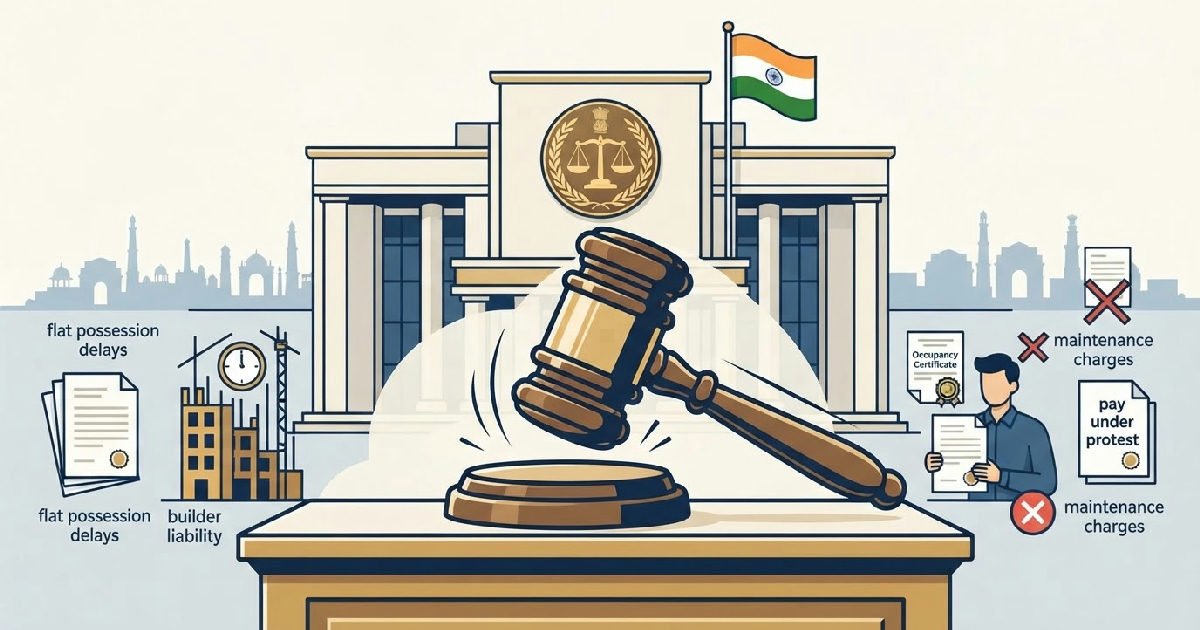
Homebuyers in Delhi NCR frequently face demands for maintenance charges on their flats even when the properties remain unfinished or lack proper legal possession. This contentious practice, where builders raise charges despite agreements tying maintenance to actual possession, was decisively addressed by the National Consumer Disputes Redressal Commission (NCDRC) on January 31, 2022.
This critical NCDRC ruling clarifies that builders cannot compel payment for extra charges at possession or maintenance until a valid Occupancy Certificate (OC) has been obtained from the civic authority. The decision provides much-needed clarity and recourse for thousands of affected homebuyers across the region.
Maintenance charged before possession ruling empowers homebuyers
The National Consumer Disputes Redressal Commission (NCDRC) delivered a significant verdict on January 31, 2022, asserting that homebuyers are only liable for maintenance charges once a builder secures the Occupancy Certificate (OC) for their flat. This ruling directly challenges the common builder practice of demanding fees for properties that are not yet legally complete or habitable.
The NCDRC reasoned that a builder’s failure to obtain an OC indicates the project is not fully complete, meaning all promised services might not be in place. In such scenarios, any handover is considered merely “paper possession,” not a lawful transfer that triggers maintenance liabilities for the buyer.
The Bengaluru Precedent
This landmark decision by the NCDRC stemmed from a plea filed by 15 homebuyers in Bengaluru, led by Harinder Singh. They had been compelled by VDB Whitefield Development Private Ltd. to pay two years of advance maintenance, despite a six-year project delay and the absence of an Occupancy Certificate.
The Bengaluru case underscored the arbitrary nature of pre-OC maintenance demands. It highlighted how developers often bypass contractual terms that link maintenance payments to actual, lawful possession. The NCDRC’s ruling affirmed the homebuyers’ stance, solidifying the legal requirement that true possession hinges on complete regulatory adherence.
Understanding the Occupancy Certificate Imperative
An Occupancy Certificate (OC) is more than a mere formality; it’s a crucial legal document confirming a building’s compliance with local codes and its fitness for habitation. Without an OC, a property may lack essential utilities, and residents could face legal repercussions or difficulties with services like water and electricity.
The NCDRC’s stance reinforces the OC as a prerequisite for lawful possession. It acts as a clear benchmark, preventing builders from transferring maintenance burdens onto buyers for properties not yet officially deemed complete or ready for use. This clarity helps mitigate common disputes and protects homebuyers from premature financial liabilities.
What an OC Signifies for Possession
The issuance of an Occupancy Certificate confirms that a developer has completed the project in line with approved plans and local regulations. It certifies the building is ready for occupancy and that all promised essential services are functional. Without this certificate, the property remains legally under construction, regardless of its physical appearance.
Therefore, any demand for full society-style maintenance before an OC is issued is fundamentally flawed. It asks homebuyers to bear costs for services that might not be fully operational, or for a property that lacks official clearance. This is why the NCDRC ruling is so vital for consumers.
RERA’s Role in Protecting Homebuyer Interests
The Real Estate (Regulation and Development) Act, 2016 (RERA), plays a pivotal role in ensuring transparency and accountability in the real estate sector. RERA mandates that developers clearly disclose all maintenance-related charges in the Agreement for Sale before a property is sold.
RERA authorities and various consumer forums actively intervene against arbitrary demands for maintenance made before an Occupancy Certificate is issued. This proactive stance helps safeguard homebuyers from unfair practices, complementing rulings like that of the NCDRC.
Transparency in Maintenance Charges
Beyond the OC requirement, RERA significantly boosts transparency by requiring builders to detail all maintenance charges upfront. This means buyers should have a clear understanding of what they are expected to pay and when, before finalising the purchase.
This provision aims to prevent hidden costs and last-minute financial surprises. It empowers buyers to scrutinize their agreements for any clauses that might contradict the spirit of RERA and the NCDRC’s pro-consumer rulings.
Your Rights and Recourse Against Unjust Demands
If you’re a homebuyer in Delhi NCR facing demands for maintenance before possession or without an Occupancy Certificate, you’re generally not required to pay. Your liability typically begins only after you take physical possession of the apartment or the OC is issued, whichever occurs first.
It’s crucial not to ignore such demands. Instead, respond in writing, clearly stating that possession is incomplete, and retain a copy of this correspondence. This formal communication can be vital evidence if further disputes arise.
The “Pay Under Protest” Mechanism
In situations where a builder threatens to block a deed or handover if maintenance isn’t paid, buyers have an option: “pay under protest.” This involves making the payment while explicitly stating, in writing, that the amount is disputed and may be challenged later. This protest must be recorded in the receipt or any related email communication.
Paying under protest allows buyers to secure their property without conceding the validity of the charges. It creates a legal record that preserves their right to dispute the payment and seek redress through appropriate channels.
Navigating Legal Channels
Homebuyers have several avenues for legal recourse against builders making illegitimate maintenance demands. The RERA authority overseeing the project is often the most appropriate forum for complaints concerning builder lapses.
Additionally, buyers can approach a consumer forum under the Consumer Protection Act, 2019, to address alleged deficiencies in services. While withholding payments unilaterally can lead to penalties like late fees (up to 21% interest) or restricted amenities, essential services like water and electricity generally cannot be cut off arbitrarily. If delayed possession becomes a persistent issue, buyers have additional recourse options.
Deconstructing Maintenance Charges: What You Need to Know
Understanding the various components of maintenance charges is crucial for homebuyers. These fees cover the upkeep of common areas and services, but their calculation methods and applicable taxes can vary significantly.
For instance, developers are themselves liable to pay maintenance charges for unsold flats until those units are either sold or possessed by new owners. This prevents the burden of unowned units from falling unfairly on early residents.
Builder Liability for Unsold Units
It’s often overlooked, but developers bear the financial responsibility for maintaining any unsold flats within a project. This obligation continues until each unit is officially sold or transferred to a buyer’s possession. This ensures that the costs of managing the entire complex aren’t disproportionately passed on to early occupants.
This rule underscores that maintenance is not a universal charge to be levied indiscriminately. It highlights the builder’s ongoing commitment to the project’s financial health until all units are accounted for. This legal provision helps ensure that buyers aren’t burdened with costs associated with a developer’s unsold inventory.
Understanding Tax Implications and Other Fees
Maintenance charges are commonly calculated based on the carpet area or super built-up area of a flat, though some projects might impose a uniform rate. In Gurugram and Noida, typical rates for high-rises range from Rs 2 to Rs 6 per square foot per month, with luxury projects commanding Rs 8 to Rs 12 per square foot per month.
An 18% Goods and Services Tax (GST) applies to maintenance bills if the charge exceeds Rs 7,500 per unit per month, and this tax applies to the entire amount, not just the excess. This GST liability also depends on the Resident Welfare Association’s (RWA) annual turnover exceeding Rs 20 lakh.
Furthermore, an Interest-Free Maintenance Security (IFMS), a one-time refundable deposit for major repairs, is often collected at possession, typically ranging from Rs 50 to Rs 200 per square foot in the NCR.
| Maintenance Component | Description | Typical Rate (NCR) |
|---|---|---|
| Normal Monthly Maintenance | Upkeep of common areas, services | Rs 2-6 per sq ft/month (high-rises) |
| Luxury Monthly Maintenance | Enhanced amenities, premium services | Rs 8-12 per sq ft/month (luxury projects) |
| GST (if applicable) | Tax on charges over Rs 7,500/month | 18% on total bill |
| Interest-Free Maintenance Security (IFMS) | One-time refundable deposit for repairs | Rs 50-200 per sq ft |
Buyers need to scrutinize their agreements for these various charges and ensure they are transparently disclosed and legally permissible. Awareness of these financial details helps in challenging any unjust or opaque demands.
The NCDRC ruling provides a strong legal foundation for homebuyers to assert their rights. It reinforces the principle that full financial liability for maintenance only begins when a property is genuinely ready and legally certified for occupation. Armed with this knowledge, buyers are better equipped to navigate the complexities of property transactions in Delhi NCR.
For those needing to take formal action, knowing how to file a RERA complaint correctly can be an invaluable step. This legal pathway ensures that disputes are addressed by the appropriate regulatory body.
What is an Occupancy Certificate (OC)?
An Occupancy Certificate (OC) is a vital legal document issued by local civic authorities. It certifies that a building has been constructed according to approved plans and local building codes, and is safe and fit for habitation. Without an OC, a property is not considered legally complete or habitable.
Can a builder demand maintenance charges before providing physical possession?
No, a builder generally cannot demand maintenance before actual physical possession or the issuance of an Occupancy Certificate (OC), whichever happens earlier. The NCDRC ruling on January 31, 2022, explicitly states that buyers are only liable after the OC is obtained.
What should I do if my builder demands maintenance without an OC?
If your builder demands maintenance without an OC, you should formally dispute the demand in writing, keeping a copy for your records. If forced to pay to secure possession, do so “under protest” and clearly record this dispute on the receipt. You can then approach the RERA authority or a consumer forum for redressal.
Maintenance bill before you have the flat? Call or Whatsapp for consultation.