
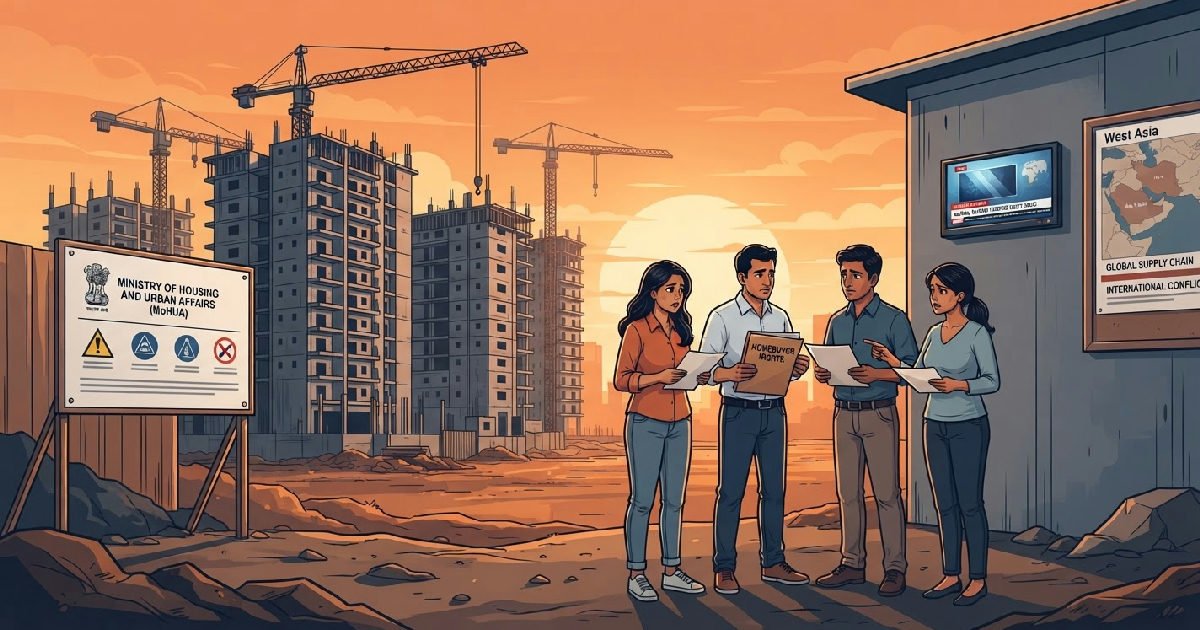
Homebuyers across Delhi National Capital Region (NCR) are once again grappling with significant project delays. Real estate developers invoke “force majeure” clauses, citing disruptions from the ongoing West Asia conflict. This follows a July 31, 2026 advisory from the Ministry of Housing and Urban Affairs (MoHUA), recommending a four-month deadline extension for eligible housing projects.
The situation puts a renewed spotlight on the delicate balance between developer protections and consumer rights under the Real Estate (Regulation and Development) Act, 2016 (RERA). Homebuyers now face the critical task of discerning legitimate force majeure claims from those that might mask underlying operational inefficiencies. Many wonder if their delayed possession is genuinely linked to global turmoil or merely an excuse.
Builder blames force majeure
The latest wave of project delays stems from the West Asia conflict, which has prompted Indian authorities to act. On April 29, 2026, the Department of Expenditure, under the Ministry of Finance, formally classified the West Asia situation as “war.” This crucial classification allows for the invocation of force majeure clauses in contracts across various sectors, including real estate.
This official recognition provided the legal basis for the MoHUA’s July 31, 2026, advisory. The advisory suggests state RERA authorities grant a four-month extension to housing projects impacted by supply chain disruptions. These disruptions are directly attributed to the conflict, which has squeezed the availability of vital construction materials.
Industry leaders have welcomed the move, underscoring the severity of the supply chain challenges. Pradeep Aggarwal, Founder and Chairman of Signature Global (India) Ltd., stated that the geopolitical situation severely disrupted global supply chains. He noted this led to acute shortages of vital construction materials, justifying the force majeure recognition.
Haryana RERA Implements Automatic Extensions
Following the central advisory, the Haryana RERA, Gurugram bench, moved quickly to implement the recommended extensions. It granted an automatic four-month extension to the completion timelines for eligible registered real estate projects. This extension applies to projects with completion dates falling on or after February 28, 2026.
The benefit is specifically confined to projects registered on or before July 31, 2026. It also covers those where an extension or continuation was granted on or before July 31, 2026. Critically, promoters do not need to file a separate application to avail this extension in Haryana. This streamlines the process, though it places the onus on homebuyers to understand the implications.
Rishabh Periwal, Senior Vice President at Pioneer Urban Land and Infrastructure Ltd., highlighted the significance of this advisory. He remarked that it provides a crucial legal and financial lifeline for developers. This lifeline removes the threat of unfair penalties and litigation for delays outside their control.
Understanding Force Majeure Under RERA
“Force majeure,” a French term meaning “superior force,” refers to extraordinary events beyond a party’s control that prevent them from fulfilling contractual obligations. The Real Estate (Regulation and Development) Act, 2016 (RERA), specifically defines what constitutes force majeure in the real estate sector. This includes natural calamities, war, government actions like lockdowns, and health emergencies such as pandemics.
For an event to genuinely qualify under RERA, it must be unforeseeable at the time of contract signing. It must also be beyond the control of both parties, making contract execution impossible. Importantly, such a clause must be explicitly included in the contract itself.
RERA provides a robust legal framework that acknowledges genuine delays while actively discouraging misuse of these clauses. The burden of proof always rests squarely with the builder to demonstrate the exact nature of the force majeure event. They must also show precisely how it impacted the project timeline and prove no alternative remedy was feasible.
Navigating these complex regulations often requires the insights of experienced commercial lawyers.
Extensions granted under RERA due to force majeure are strictly capped. Even for events as widespread as the COVID-19 pandemic, the aggregate extension period was limited to one year. This means builders cannot perpetually cite a single event for years of delay. Financial constraints, raw material shortages, or workforce unavailability do not qualify as force majeure. These are considered standard occupational risks for developers.
RERA’s Scrutiny of Force Majeure Claims
RERA authorities and courts diligently examine each claim, ensuring the event genuinely qualifies and caused the delay. Builders cannot simply label any project delay as force majeure and expect automatic approval. For instance, an automatic extension of six months was provided during the COVID-19 pandemic. However, further extensions were granted only on a case-by-case basis, requiring detailed justification.
The Delhi High Court, in M/s Halliburton Offshore Services Inc v Vedanta Ltd (April 2020), acknowledged the nationwide lockdown as a force majeure event. Yet, subsequent rulings have been increasingly stringent. Courts emphasize that builders must explain COVID-related delays within the permissible extension period. Unexplained or prolonged delays beyond statutory limits are consistently deemed deficiencies in service.
This stricter interpretation means that builders cannot use a force majeure plea to excuse contractual obligations breached before the event. If a project was already delayed before, for example, March 2020, the COVID-19 related force majeure claim for that specific period is invalid. This protects homebuyers from developers retrospectively justifying pre-existing issues, emphasizing that one-sided agreements cannot circumvent statutory rights.
Homebuyer Vigilance: Navigating Delay Excuses
Homebuyers are entitled to timely possession of their properties; failure to deliver constitutes a deficiency of services under RERA. Section 18(1) of the RERA Act provides clear avenues for recourse. If a promoter fails to deliver possession as per the agreed date, the allottee has two primary options.
They can either withdraw from the project and claim a full refund with interest and compensation, or continue with the project and claim interest for every month of delay.
It’s crucial for buyers to thoroughly read the force majeure clause in their builder-buyer agreement before signing. An overly broad clause can disproportionately favor the builder, making it harder for homebuyers to challenge delays. Buyers should assess if the claimed event genuinely qualifies as force majeure and if it actually caused the project delay. Simply invoking a general clause isn’t enough.
If misuse of the force majeure clause is suspected, buyers have the right to file a complaint with state RERA authorities for grievance redressal. The Haryana RERA has consistently ruled against unjustified delays, clarifying that routine approval delays, financial constraints, or internal management issues do not qualify as valid force majeure grounds.
A breach of a supply agreement for construction materials, not tied to a genuine force majeure event, would also fall outside these exemptions.
Practical Steps for Affected Homebuyers
Buyers should demand the specific reasons for delays, along with any supporting legal documentation, if a developer invokes force majeure. Developers often recycle old excuses; COVID-era letters re-issued in 2026 are frequently considered “too thin” as justification. Always ensure communication regarding new possession dates is formal, not merely via WhatsApp or informal channels.
Maintaining detailed records is vital. Keep all payment receipts, email exchanges, and any written promises from the developer. If delays extend beyond 24 months, buyers are strongly advised to approach RERA with comprehensive documentation. Consulting a real estate expert knowledgeable in contract law and RERA provisions is highly recommended to navigate these complex situations effectively.
Legal Precedents and Protections for Homebuyers
The judiciary has consistently reinforced homebuyer protections against one-sided builder agreements. The Supreme Court, in Pioneer Urban Land & Infrastructure Ltd. v. Govindan Raghavan (2019), firmly held that such agreements cannot defeat the statutory rights of homebuyers. This landmark ruling empowers buyers to challenge unfair terms and claims.
RERA authorities have also set clear boundaries. The Rajasthan Tribunal refused to exclude periods of stop-work notices where delays were due to the promoter’s negligence, even while accepting the COVID-19 moratorium. Similarly, the Haryana Tribunal rejected a promoter’s attempt to broaden the statutory meaning of force majeure to include construction bans and the pandemic.
They also stated that an offer of “fit-out possession” without an Occupation Certificate is not valid. Seeking legal counsel for money recovery can be beneficial if disputes escalate.
A notable case in Delhi-NCR saw a buyer receive ₹65 lakh in compensation after a 9-year delay. RERA authorities dismissed the developer’s claims of COVID-19, a chairman’s death, and water issues as legitimate force majeure events. This precedent underscores that RERA courts will scrutinize claims rigorously and will not hesitate to penalize developers for unjustified delays.
Outlook: Heightened Scrutiny in 2026
The year 2026 presents a heightened level of scrutiny for developers invoking force majeure. The compliance picture under RERA increasingly emphasizes construction quality, contractual fairness, and the enforceability of delivery commitments. Developers are also accountable for structural defects for five years after possession, demonstrating a commitment to long-term quality and responsibility.
While the recent MoHUA advisory acknowledges genuine geopolitical impacts, it doesn’t provide a blank cheque for perpetual delays. Homebuyers in Delhi NCR must remain informed and proactive. They should continue to monitor project statuses on RERA portals and challenge any claims that appear to be convenient excuses rather than legitimate force majeure events.
The legal framework is in place to protect them, provided they utilize it effectively.
What exactly is force majeure under RERA?
Force majeure, under RERA, refers to exceptional events beyond a developer’s control that prevent project completion. This includes natural disasters, war, government actions like lockdowns, and pandemics. It protects developers from penalties for delays truly outside their influence, but only under specific, verifiable conditions.
Can builders claim force majeure for financial problems or material shortages?
No, RERA explicitly states that financial constraints, typical raw material shortages (unless directly caused by a genuine force majeure event like war), or workforce unavailability do not qualify as force majeure. These are considered normal business risks that developers must manage.
What should a homebuyer do if their builder claims force majeure for delays?
Homebuyers should request detailed documentation proving the force majeure event and its direct impact on the project. They should also monitor the RERA portal for project status and consult a legal expert if they suspect the claim is unfounded. If the delay is unjustified, buyers can claim interest or a full refund under RERA Section 18(1).
Call or Whatsapp for free consultation.
Related Service: https://arpitmarwah.com/rera-lawyers-in-delhi/