
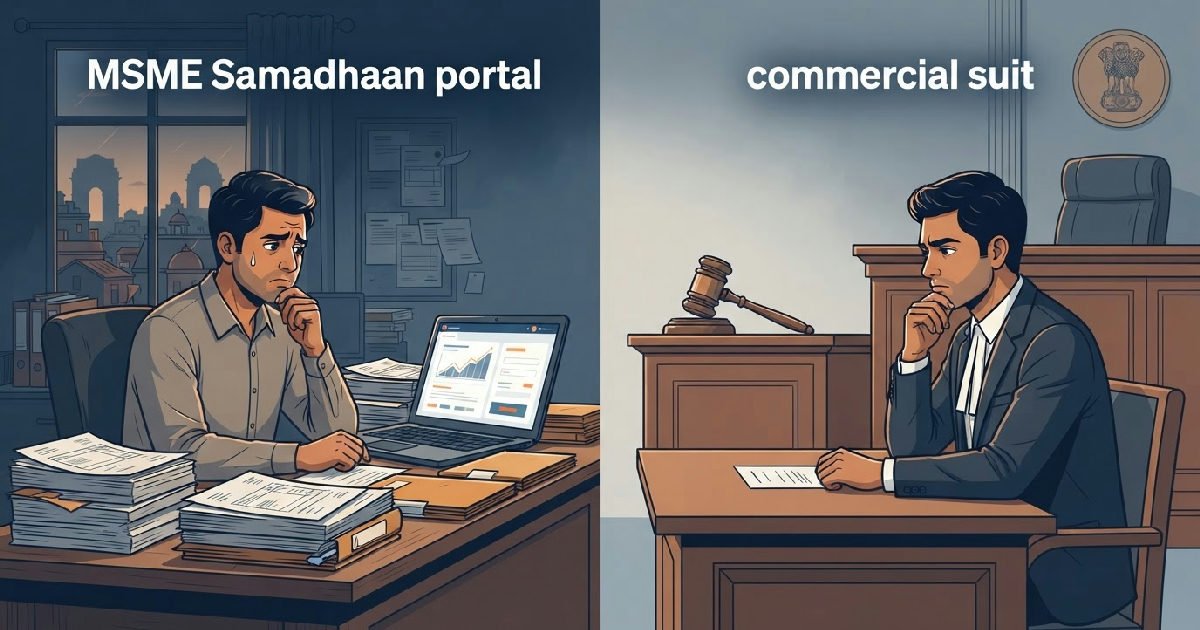
Suppliers in Delhi grappling with outstanding dues face a critical decision: whether to pursue their claims through the Micro, Small and Medium Enterprises (MSME) Samadhaan portal or by initiating a commercial suit. This choice isn’t merely procedural; it dictates the legal framework, potential for interest recovery, and overall timeline for resolution, and Delhi businesses weigh these options carefully.
Making the right selection depends heavily on the supplier’s registration status, the specific nature of the dispute, and their desired outcome.
MSME delayed payment for Delhi suppliers
The distinction between these two primary legal avenues is significant, influencing strategy and success rates. Companies must understand the nuances of each path to ensure effective and timely recovery of their hard-earned money. Blindly pursuing both or delaying action can lead to wasted resources and even forfeiture of rights.
For countless micro and small enterprises in Delhi, delayed payments pose an existential threat. The capital’s bustling commercial landscape often sees transactions extend beyond agreed terms, forcing suppliers to seek legal recourse. Both the MSME Samadhaan mechanism and the traditional commercial suit offer remedies, but they operate under vastly different principles and procedural requirements.
Choosing incorrectly can prolong the recovery process or diminish the chances of success. It’s paramount for suppliers to assess their unique situation, particularly their MSME registration status at the time the supply was made, before committing to a legal strategy. This initial assessment forms the bedrock of an effective payment recovery plan.
The Dual Pathways: MSME Samadhaan versus Commercial Suit
The MSME Samadhaan portal represents a statutory route specifically designed for micro and small enterprises. It offers a structured, time-bound process for dispute resolution, often leading to arbitration. Conversely, a commercial suit involves litigation within Delhi’s commercial courts, following the provisions of the Commercial Courts Act.
While MSME Samadhaan offers the distinct advantage of statutory interest on delayed payments, commercial suits provide a broader scope for complex disputes and scenarios where MSME registration criteria aren’t met. Each path has its own set of merits and demerits, making an informed decision crucial for aggrieved suppliers. Businesses must carefully weigh these options to avoid potential setbacks.
Crucial Considerations Before Initiating Action
Before any legal action commences, several factors demand close scrutiny. Suppliers must verify if they were registered as an MSME when the goods were supplied or services rendered. This registration date is vital for leveraging the benefits of the MSME Development Act, 2006. If not, the MSME Samadhaan portal might not be an available or effective recourse.
Furthermore, understanding the nature of the buyer’s resistance and their willingness to engage in alternative dispute resolution is important. Some buyers might prefer to settle disputes within the structured environment of a commercial court, especially if the matter involves complex contractual interpretations. Ignorance of pre-institution mediation requirements can also lead to significant delays.
The MSME Samadhaan Advantage: Statutory Backing
The MSME Samadhaan portal, established under the MSME Development Act, 2006, provides a specialized mechanism for micro and small enterprises to address delayed payment issues. This statutory route offers a streamlined process and significant advantages, particularly concerning interest on outstanding amounts. It’s a powerful tool, but its applicability hinges on specific criteria.
For registered MSMEs, this platform facilitates conciliation and arbitration through the Micro and Small Enterprise Facilitation Councils (MSEFCs). The process aims for swift resolution, ensuring that small businesses can recover their dues without being entangled in lengthy and expensive litigation.
Eligibility and Registration Impact
Crucially, only enterprises registered as Micro or Small under the MSME Development Act, 2006, can avail themselves of the MSME Samadhaan portal. Moreover, this registration must have been valid at the time the supply was made or service rendered. Post-facto registration does not retroactively confer the benefits for older transactions.
The definition of Micro and Small Enterprises is based on investment in plant and machinery or equipment, and turnover, as periodically revised by the government. Ensuring proper registration and keeping it updated is vital for any business intending to rely on this protective legislation for future payment recovery.
Expedited Resolution and Interest Provisions
One of the most compelling features of MSME Samadhaan is the provision for statutory interest on delayed payments. The Act mandates that if a buyer fails to pay an MSME supplier within the agreed credit period, or within 45 days if no period is specified, they are liable to pay compound interest at three times the bank rate notified by the Reserve Bank of India.
This substantial penalty acts as a strong deterrent against delayed payments and offers significant compensation to the aggrieved supplier. The MSEFCs are also mandated to dispose of complaints within 90 days, offering a potentially much faster resolution compared to traditional court proceedings.
Pursuing Recovery Through Commercial Suits in Delhi
When the MSME Samadhaan route is not viable, or if the dispute is complex, a commercial suit in the appropriate Delhi court becomes the primary recourse. This legal path, governed by the Commercial Courts Act, 2015, is designed to expedite high-value commercial disputes. It offers a robust framework for resolving payment issues, albeit with different procedural requirements and timelines.
A commercial suit provides a forum for intricate arguments, detailed evidence presentation, and a definitive judgment. While it might involve longer timelines than the ideal MSME Samadhaan process, it remains the standard legal approach for many businesses seeking recovery.
When the Commercial Court Becomes Necessary
A commercial suit is often the only option if the supplier is not a registered MSME or if the value of the dispute falls outside the specific thresholds for MSME Samadhaan.
Additionally, if the nature of the dispute involves complex contractual breaches beyond mere non-payment, or if there are counterclaims, a commercial court can provide a more comprehensive legal platform. Issues involving breach of supply agreement often necessitate this route.
Suppliers also opt for commercial suits when dealing with larger corporate entities that may have greater legal resources. In such cases, the formal court process ensures due diligence and a structured examination of all evidence, leading to a legally binding and enforceable judgment.
Mandatory Pre-Institution Mediation: Section 12A
Before filing a commercial suit in Delhi, parties are generally required to attempt pre-institution mediation, as stipulated under Section 12A of the Commercial Courts Act, 2015. This step aims to resolve disputes amicably outside of court, saving time and costs for all involved. It is a mandatory prerequisite, and non-compliance can lead to the rejection of the suit.
However, there are exceptions to Section 12A, particularly in cases seeking urgent interim relief. Legal counsel can advise on whether a particular case falls under such exceptions. Navigating this mandatory mediation is a critical initial hurdle in the commercial suit process.
Role of Legal Notices and Cheque Bounce Cases
Irrespective of whether a supplier opts for MSME Samadhaan or a commercial suit, issuing a well-drafted legal notice is almost always a prudent first step. A legal notice formally communicates the outstanding debt, the basis of the claim, and the intention to pursue legal action if payment is not made. It can often trigger pre-litigation settlement discussions.
In scenarios where a buyer’s cheque has bounced, Section 138 of the Negotiable Instruments Act, 1881, offers a potent legal remedy. This can be pursued concurrently or as a standalone action. While separate, a cheque bounce case can significantly bolster a supplier’s position in a broader commercial dispute. Drafting a legal notice correctly is paramount.
Strategic Pitfalls and Timelines to Avoid
Navigating the legal landscape for delayed payments requires strategic foresight. Suppliers often make critical errors by misunderstanding the interplay between the MSME Samadhaan portal and commercial suits, or by failing to adhere to strict legal timelines. These missteps can be costly, potentially rendering an otherwise strong claim unenforceable.
A common misconception is that one can simply “try” one route and then switch to another without consequences. This approach can lead to significant delays and procedural hurdles, undermining the overall recovery effort. Proper legal advice from the outset is essential to avoid such pitfalls.
The Peril of Blindly Filing Both Avenues
A crucial piece of advice for suppliers is not to blindly file claims through both the MSME Samadhaan portal and a commercial suit simultaneously or sequentially without a clear strategy. While the legal systems can overlap, pursuing both without understanding the implications can lead to jurisdictional conflicts, duplication of efforts, and potential dismissals.
For instance, if an MSME Samadhaan proceeding converts to arbitration, initiating a commercial suit on the same subject matter may be problematic due to the principle of res judicata or the doctrine of election. It’s advisable to pick one main recovery path based on a thorough assessment of the case.
Understanding Limitation Periods for Recovery
One of the most critical aspects of any legal recovery action is the limitation period. Under Indian law, a debt generally becomes time-barred after three years from the date it became due. Missing this deadline, often while waiting for a response on a portal or contemplating options, can extinguish the legal right to recover the money entirely.
Suppliers must be vigilant about these timelines. Even if pursuing MSME Samadhaan, they must monitor the progress and be prepared to initiate a commercial suit if the statutory period is nearing its end. Legal experts can provide crucial guidance on preserving the limitation period while exploring different recovery mechanisms.
| Feature | MSME Samadhaan Portal | Commercial Suit in Delhi |
|---|---|---|
| Eligibility | Registered Micro/Small Enterprises (at time of supply) | Any entity with commercial dispute |
| Jurisdiction | Micro & Small Enterprise Facilitation Councils (MSEFCs) | Commercial Courts of Delhi |
| Process | Conciliation, then Arbitration (if conciliation fails) | Pleadings, evidence, arguments, judgment (after mandatory mediation) |
| Interest Rate | Compound interest at 3x RBI Bank Rate (statutory) | As per contract or discretion of court (usually simple interest) |
| Pre-filing Step | Direct application to MSEFC | Mandatory Pre-Institution Mediation (Section 12A, with exceptions) |
| Approx. Timeline | 90 days (statutory target for MSEFC) | Significantly longer, dependent on court schedule and complexity |
Implications for Business and Legal Strategy
The choice between MSME Samadhaan and a commercial suit carries profound implications for a business’s financial health and strategic operations. It’s not merely about recovering funds; it’s about setting a precedent, managing resources, and maintaining commercial relationships where possible. A well-thought-out legal strategy is invaluable.
Small and micro-enterprises, often operating with thin margins, stand to benefit significantly from the expedited process and statutory interest offered by MSME Samadhaan. Larger suppliers, or those not registered as MSMEs, must be prepared for the rigours and procedural demands of commercial litigation.
Choosing the Right Forum for Optimal Outcome
The optimal forum depends entirely on the specific facts of each case. For a clearly defined delayed payment to a registered MSME, the Samadhaan portal is often the most efficient and beneficial route due to the higher interest rates and faster resolution mechanism. Its quasi-judicial nature can be less intimidating than a full-blown court case.
However, when the facts are contentious, involve multiple parties, or exceed the scope of simple non-payment, the commercial court provides the necessary judicial oversight and robust discovery processes. This ensures all facets of a complex dispute can be thoroughly examined before a judgment is rendered.
The Role of Expert Commercial Lawyers
Given the complexities involved, the expertise of commercial lawyers in Delhi becomes indispensable. They can meticulously assess the supplier’s registration status, the nature of the transaction, the contractual terms, and the buyer’s payment history. This assessment informs the recommendation for the most effective recovery path.
Legal counsel can also assist in drafting precise legal notices, navigating the intricacies of the MSME Samadhaan process, or skillfully representing the supplier in commercial court. Their guidance ensures compliance with procedural requirements, such as Section 12A mediation, and helps in protecting the supplier’s interests throughout the entire recovery journey.
What is the primary difference between MSME Samadhaan and a commercial suit?
MSME Samadhaan is a specific statutory mechanism for registered micro and small enterprises to recover delayed payments with high statutory interest, aiming for expedited arbitration. A commercial suit is a broader litigation process in commercial courts for any commercial dispute, not limited to MSMEs, and generally follows a longer, more formal judicial path.
Can I file both an MSME Samadhaan application and a commercial suit for the same delayed payment?
It is generally not advisable to file both for the same dispute simultaneously. While some initial steps may overlap, pursuing both without a clear strategy can lead to jurisdictional issues, procedural conflicts, and potential dismissal of one or both claims. Legal advice is essential to choose the most appropriate single path.
What happens if I miss the limitation period for recovering my payment?
If you miss the limitation period, typically three years from the date the payment became due, your legal right to recover the money through court action or statutory mechanisms will be extinguished. The debt becomes time-barred, meaning a court or council will likely dismiss any subsequent claim on that specific outstanding amount.
Unpaid MSME invoices in Delhi? Call or Whatsapp for free consultation.
Related Service: https://arpitmarwah.com/commercial-lawyers-in-delhi/