
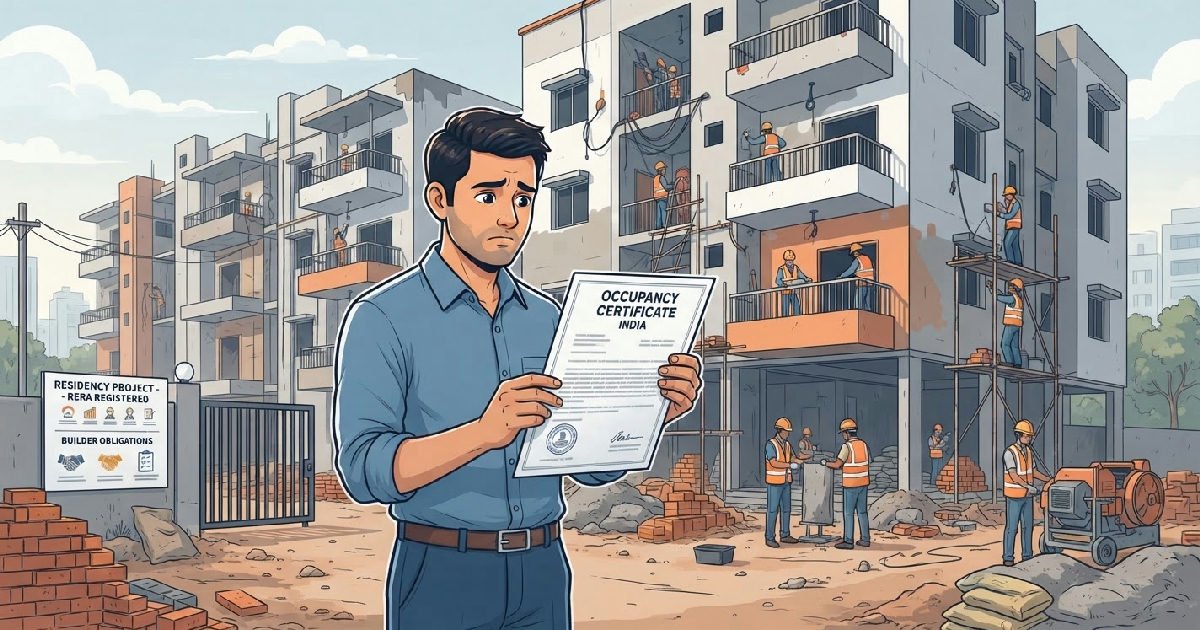
Homebuyers in India often face a tough decision when builders offer possession of new flats before obtaining the crucial Occupancy Certificate (OC). While the lure of moving in and ceasing dual rent and EMI payments is strong, accepting keys without this vital document carries significant legal, financial, and safety risks.
The Supreme Court of India underscored this in 2026, ruling that possession without an OC is legally invalid and cannot be enforced on buyers, irrespective of clauses in builder-buyer agreements.
Occupancy Certificate Not Required For…
An Occupancy Certificate is more than just a piece of paper; it’s a legal certification from the local municipal or development authority. It confirms that the building adheres to approved plans, complies with all building codes, meets safety standards—including fire safety and structural integrity—and is genuinely fit for habitation. Ignoring this crucial step can lead to unforeseen complications for property owners.
The legal framework surrounding property possession in India is clear, primarily driven by the Real Estate (Regulation and Development) Act, 2016 (RERA). This landmark legislation makes it unequivocally illegal for developers to hand over possession of a property without first securing an Occupancy Certificate. RERA mandates that possession can only be delivered once all necessary approvals are in place, ensuring properties meet stringent regulatory benchmarks.
Builders are also required to upload the OC onto the RERA project portal for transparency. This measure empowers prospective and current buyers to independently verify the status of this critical document. It significantly reduces reliance on verbal assurances from developers, bolstering consumer confidence in the process.
RERA’s Strict Provisions
Under RERA, developers have a statutory obligation to ensure a project is fully compliant before handing it over. This means securing not just the OC, but also all other necessary clearances. Failure to do so constitutes a “deficiency in service” under the Consumer Protection Act, offering buyers a powerful recourse against non-compliant builders.
Many homebuyers often wonder whether to push for possession or refund when faced with delays. But, accepting early possession can compromise future claims, making it imperative for buyers to understand their rights.
UP-RERA’s Recent Directive
Reinforcing national guidelines, the Uttar Pradesh Real Estate Regulatory Authority (UP-RERA) issued a significant directive on May 29, 2024. Order No. 7316/U.P. RERA/Admin./2024-25 explicitly mandates that builders must obtain an OC or Completion Certificate (CC) before issuing possession letters to homebuyers. This aims to prevent premature handovers and protect buyers from associated risks.
This directive from UP-RERA sets a clear precedent for other state authorities and underscores the regulatory push to enforce compliance. It means developers can no longer use procedural delays as an excuse to bypass the critical requirement of an OC, ensuring greater accountability in the residential sector.
Navigating the Peril: Key Risks for Homebuyers
Taking possession of a flat without a valid Occupancy Certificate in India can open a Pandora’s Box of problems for homebuyers. These range from immediate, tangible disruptions to essential services, to long-term financial and legal entanglements that can significantly diminish the value and security of a property investment.
The seemingly convenient option of moving in early can quickly unravel into a complex web of issues. Buyers often underestimate the ripple effects of bypassing this crucial legal document, exposing themselves to risks that could have been avoided by insisting on due process.
Legal Illegality and Enforcement Actions
Occupying a flat without a valid Occupancy Certificate is considered illegal, effectively rendering the occupant an unauthorized resident. Local authorities are well within their rights to impose substantial penalties, issue eviction notices, or, in extreme cases, declare the building unauthorized. This could even lead to demolition orders.
Such a situation jeopardizes legal ownership and property rights, creating an insecure living environment. For buyers dealing with a builder not giving possession as per RERA, pursuing the correct legal channels for the OC is paramount.
Disruptions to Essential Services
One of the most immediate and frustrating consequences for residents is the struggle to obtain permanent essential services. Connections for electricity, water, gas, and sanitation often prove challenging or impossible to secure without a valid OC. This forces residents to rely on temporary or even illegal connections, which authorities can disconnect without warning.
Beyond the inconvenience, some cities levy higher property taxes or water charges on buildings lacking an Occupancy Certificate. This unexpected financial burden further illustrates why an OC is not just a formality, but a practical necessity for comfortable and legal residency.
Financial Obstacles and Resale Headaches
The absence of an OC creates severe financial repercussions for homebuyers. Most banks and financial institutions typically refuse to disburse the full portion of a home loan without this certificate. This can leave buyers in an untenable financial position, especially after committing significant upfront funds.
Furthermore, selling a flat without an OC becomes a significantly problematic undertaking. Such properties attract fewer serious buyers, often leading to considerable pressure for price negotiation. Prospective buyers also struggle to secure home loans, and the entire resale process faces heightened legal scrutiny during due diligence, complicating transactions considerably.
Compromised Safety Standards
An Occupancy Certificate plays a vital role beyond mere administration; it serves as a critical safety assurance. It confirms that essential safety systems, such as fire safety installations, are fully functional and that the building adheres to structural integrity norms. Without an OC, there is no independent verification of the building’s safety compliance.
This places an undue burden of risk onto the buyers in the event of a fire, structural collapse, or electrical failure. The Supreme Court of India has emphatically stated that offering possession without fire clearance and an OC is both illegal and inherently dangerous, highlighting the profound safety implications.
Supreme Court’s Stance: Protecting Homebuyer Rights
The judiciary in India has consistently upheld the paramount importance of the Occupancy Certificate, particularly the Supreme Court. Their rulings have provided significant relief and clarity for homebuyers, reinforcing the idea that an OC is not a negotiable document but a fundamental right for property owners.
These judgments empower buyers to challenge builders who attempt to circumvent legal requirements, strengthening consumer protection. They also serve as a stark reminder to developers about their legal and ethical responsibilities.
Possession Deemed Invalid
In a landmark 2026 ruling, the Supreme Court of India declared that possession of a property without an Occupancy Certificate is legally invalid. This means builders cannot compel buyers to accept a flat if the OC has not been issued, irrespective of any clauses written into the builder-buyer agreement. This ruling offers significant protection against coercive tactics by developers.
The court’s position essentially nullifies any attempt by builders to pass on unfinished or non-compliant projects. It reinforces the principle that a property is only legally habitable once it has received the necessary certifications from the competent authorities.
Compensation for Delays
The Supreme Court has also affirmed homebuyers’ rights to compensation for delays, even if they move into a flat before the OC is obtained. Builders are liable to pay interest or a penalty, typically around 8% per annum simple interest, on the full purchase price from the agreed delivery date until the actual handover with the OC. Moving in does not waive these crucial rights.
This ruling ensures that builders cannot escape their obligations by pushing for early, non-compliant possession. For those facing delayed home possession, this provision provides a critical financial safeguard, making builders accountable for their timelines.
Understanding Partial Occupancy Certificates
In large-scale residential projects, developers sometimes obtain a Partial Occupancy Certificate (Part OC). This document certifies that specific towers or blocks within a larger development are complete and compliant, and thus fit for habitation. While a Part OC is legally valid, it applies only to the approved portion of the project.
Homebuyers in such projects must diligently verify that their specific unit falls under the approved Part OC. Crucially, they need to ensure that utilities and access for their block are independent and fully functional, not reliant on the completion of other, uncertified sections of the development. This avoids potential complications down the line.
A Part OC is not a blanket approval for the entire project. Buyers should confirm the scope of the certificate to avoid occupying a unit that, despite being part of a larger project with a Part OC, might still be in an uncertified or incomplete section. Due diligence remains paramount in these scenarios.
Strategic Advice for Indian Homebuyers
Navigating the complexities of property possession in India, especially concerning the Occupancy Certificate, requires informed decision-making. Homebuyers should approach the final stages of their property purchase with caution and a clear understanding of their rights and the builder’s obligations.
It’s not just about getting the keys; it’s about securing a legally compliant and safe home. Being proactive and well-documented can save immense hassle and financial loss in the future. Remember, an OC isn’t just a paper; it’s your assurance of a legitimate property.
Verifying the OC Status
Before making the final payment or taking physical possession, homebuyers must insist on receiving a certified copy of the Occupancy Certificate from the builder. Critically, this document should then be cross-referenced and verified on the local authority’s website or the relevant State RERA portal. This step ensures its authenticity and validity.
Do not rely solely on assurances or unverified copies. Digital verification offers an essential layer of security. This simple but vital check confirms the property meets all regulatory standards and is indeed legally ready for habitation, protecting your investment.
Documenting Refusal and Waivers
If a builder attempts to pressure a homebuyer into accepting possession without an OC, it is crucial to decline this offer in writing. Communicating this refusal via email creates an undeniable paper trail, which can be invaluable for future consumer complaints or legal action, such as filing a RERA complaint against a builder.
Furthermore, buyers should never sign a possession letter that waives rights to delay compensation or implies the unit is fully complete without an OC. Such clauses can significantly weaken a buyer’s legal leverage and their ability to claim rightful compensation for non-compliance by the builder.
| Aspect of Ownership | With Occupancy Certificate (OC) | Without Occupancy Certificate (OC) |
|---|---|---|
| Legal Status for Occupation | Fully legal and authorized; certified compliance with all building codes and plans. | Illegal occupation; occupant is unauthorized. Risk of penalties, eviction, or even demolition by authorities. |
| Access to Utility Services | Seamless access to permanent electricity, water, gas, and sanitation connections. | Significant difficulty in obtaining permanent connections; reliance on temporary or illegal services which can be disconnected. Potential for higher taxes. |
| Home Loan & Resale Viability | Banks readily disburse full loan amounts. Property is easily resold at fair market value with clear titles. | Banks often refuse full loan disbursement. Resale is problematic, attracting fewer buyers, requiring price negotiation, and complicating loan approvals for future buyers. |
| Safety and Structural Integrity | Independent verification confirms functional fire safety systems and adherence to structural norms. | No official verification of safety. Buyers assume significant risk from fire, structural collapse, or electrical faults. |
| Legal Leverage for Claims | Maintains strong legal standing for claiming delay compensation or refunds under RERA. | Accepting keys without an OC can significantly weaken legal leverage for claims, especially if a waiver is signed. |
What is an Occupancy Certificate (OC)?
An Occupancy Certificate (OC) is a legal document issued by local municipal or development authorities. It certifies that a building has been constructed in accordance with approved plans, complies with all relevant building codes and safety standards, and is deemed fit for human habitation. It is a mandatory document for legal possession of a property in India.
Why is taking possession without an OC risky?
Taking possession of a flat without an OC exposes homebuyers to several substantial risks. These include the property being deemed an illegal occupation, potential for penalties, eviction, or even demolition, significant difficulty in obtaining permanent utility connections (electricity, water, gas), challenges in securing home loans or reselling the property, and the lack of independent verification of safety and structural integrity concerns.
What should homebuyers do if a builder pressures them to take possession without an OC?
Homebuyers should unequivocally decline any pressure from builders to take possession without a valid Occupancy Certificate, and they should do so in writing to create a record. It is highly advisable to consult with a legal expert specializing in real estate law.
Under the Real Estate (Regulation and Development) Act, 2016 (RERA), builders are legally obligated to provide an OC before handing over possession, and buyers have strong rights to ensure this compliance.
Has the builder asked you to take possession without OC?
Do not sign a waiver in a hurry. WhatsApp or call for a free consultation. We assist homebuyers and NRIs in Delhi-NCR with possession, OC delay and RERA-related claims.
Related Service: Real Estate Law