
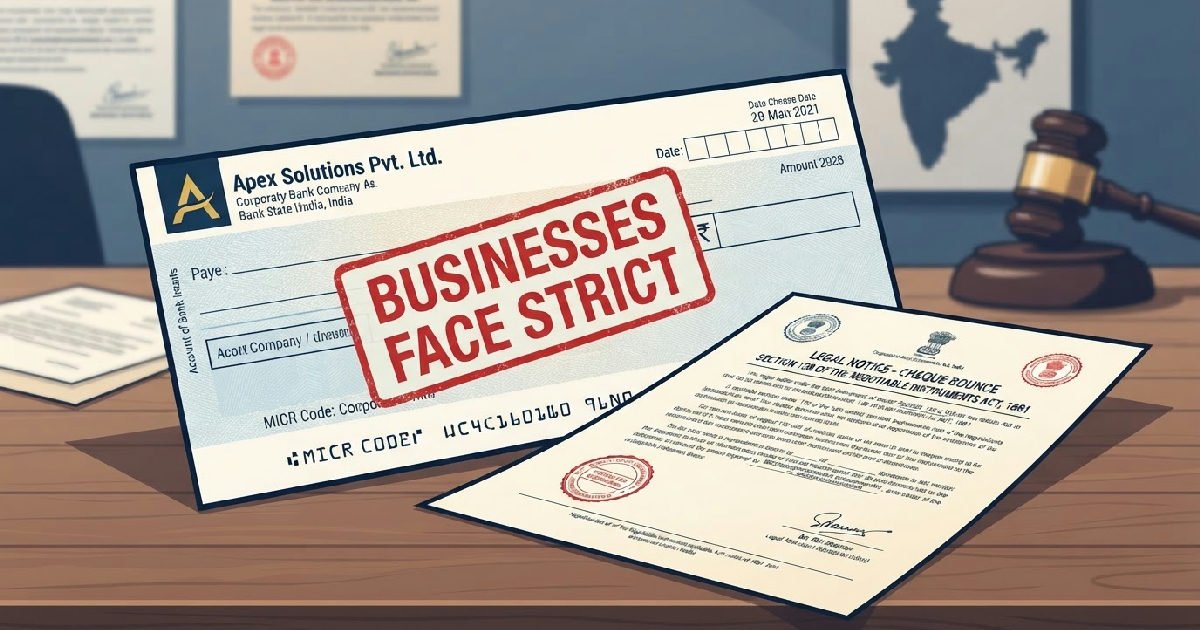
Businesses grappling with a dishonoured cheque from a corporate entity in India face a complex legal landscape. Initiating a cheque bounce case against a company demands meticulous adherence to the procedures outlined in Section 138 of the Negotiable Instruments Act, 1881 (NI Act). Businesses face strict conditions when pursuing these cases, particularly when dealing with a cheque bounce against a company.
Any procedural misstep can significantly weaken the entire prosecution, potentially delaying or even derailing the recovery of outstanding dues. Creditors often overlook critical statutory timelines and struggle with correctly identifying all necessary accused parties, which can prove costly in the long run.
Understanding the nuances of a cheque bounce against a company is crucial for effective legal action.
Cheque bounce against companies: Section 138 NI Act
Understanding the Implications of Cheque Bounce Against a Company
Section 138 of the NI Act governs cheque dishonour cases, classifying them as a criminal offense within India’s legal framework. However, not every bounced cheque automatically qualifies for action under this specific section. Several strict conditions must be met before a complaint can even be initiated in the courts.
Fundamentally, the cheque in question must have been issued to settle a legally enforceable debt or liability. This crucial requirement excludes instruments given as gifts, donations, or security deposits where the primary financial obligation has not yet been triggered, thereby underpinning the entire legal proceeding.
| Condition | Requirement under NI Act, Section 138 | Impact if Not Met |
|---|---|---|
| Cheque Purpose | Issued for a legally enforceable debt/liability. | Case invalid; cannot proceed under Section 138. |
| Presentation Period | Within 3 months of issue date. | Cheque becomes stale; claim under Section 138 invalid. |
| Bank Return Memo | Official memo citing specific dishonour reason (e.g., insufficient funds). | No proof of dishonour; legal steps impossible. |
| Demand Notice Dispatch | Within 30 days of receiving bank return memo. | Right to file complaint under Section 138 lost. |
| Payment Grace Period | Drawer has 15 days from notice receipt to pay. | Failure to adhere triggers right to file complaint. |
Furthermore, the payee must present the cheque to their bank within its stipulated validity period. This is typically three months from the original date of issue, and presenting it even a single day later can invalidate the claim under Section 138.
The bank must then return the cheque unpaid, explicitly citing reasons such as “insufficient funds,” “exceeds arrangement,” “account closed,” “signature mismatch,” “incorrect details,” or “stop payment instructions.” The official bank return memo serves as crucial evidence of this dishonour, without which further legal steps become impossible.
Finally, a legal demand notice becomes a mandatory procedural step. This notice must be dispatched to the cheque’s drawer within 30 days of receiving the bank’s return memo or dishonour intimation. The company then has a grace period of 15 days from receiving this notice to make the payment; failure to do so triggers the legal right to file a formal complaint.
Identifying correct accused parties in corporate cheque dishonour
One of the most frequent and critical pitfalls in pursuing a cheque bounce case against a company involves incorrectly naming the accused parties. Indian law is unequivocal on this point: the company itself must be named as an accused from the outset of the complaint.
Courts have consistently clarified that excluding the company from the complaint renders it fundamentally defective. This principle applies even if an individual director or officer signed the cheque, as the company’s distinct legal identity cannot be separated from the corporate debt.
Beyond the corporate entity, other individuals can and often should be included as accused parties to strengthen the case. This typically involves directors or other officers directly responsible for the company’s day-to-day affairs at the time the cheque was issued. Managing directors, whole-time directors, Chief Financial Officers (CFOs), and accounts officers frequently fall into this category.
Crucially, the person who physically signed the cheque is also a primary candidate for inclusion as an accused. Non-executive or independent directors, however, are usually only liable if direct evidence proves their participation in the company’s daily management or the specific transaction. Understanding these nuances is key to building a robust complaint, especially concerning director liability in cheque dishonour cases.
For partnership firms, the situation differs slightly, as individual partners can be prosecuted even if the firm isn’t named separately. Indian law considers a partnership firm a “compendious name” for its partners, meaning their individual liability is inherent.
Drafting an effective legal demand notice for payment
The legal demand notice isn’t just a formality; it is a cornerstone of a successful Section 138 prosecution and must be drafted with precision. Its proper content and timely dispatch are paramount, and it must be in writing, sent via registered post or courier with an acknowledgment for proof of delivery.
The content of this notice must be both precise and unambiguous to stand up in court. It needs to clearly specify the cheque number, its exact date, and the precise amount involved in the transaction. The notice should also explicitly state the bank return reason, exactly as indicated in the official return memo.
Furthermore, the notice must unequivocally state that the amount remains unpaid and issue a clear demand for payment of the full cheque amount. The company must be given precisely 15 days from the date of receiving the notice to clear the outstanding sum; demanding payment in a shorter timeframe will invalidate the entire notice, jeopardizing the case.
Finally, the notice must explicitly name both the company and any relevant individuals being put on notice, such as directors or signatories. It should also include a clear warning that legal action under Section 138 of the NI Act will be initiated if payment is not received within the stipulated period. Any vagueness or omission here can be exploited by the defence.
Properly navigating the intricacies of the legal notice is essential for bounced cheque restitution. A defectively drafted notice is one of the most common reasons for cases to falter.
Establishing proper jurisdiction for cheque dishonour complaints
Determining the correct court jurisdiction is another critical step that frequently causes complications for complainants. Filing a case in the wrong court can lead to significant delays, procedural rejections, and the wasteful expenditure of valuable resources.
While generally the complaint under Section 138 NI Act is filed where the payee’s bank is located, recent clarifications have refined this understanding.
The Supreme Court has specified that jurisdiction lies with the court having territorial authority over the payee’s home branch – the branch where the payee maintains their account – not merely the branch where the cheque was physically deposited for collection. This distinction is critical for proper filing.
Section 142(2)(a) of the NI Act further creates a statutory legal fiction, ensuring clarity on jurisdictional matters. This provision helps streamline the process by defining the specific territorial limits for initiating proceedings. Understanding these precise jurisdictional rules prevents common procedural errors.
Strategic steps after a cheque bounces
When a cheque issued by a company is dishonoured, immediate and decisive action is paramount to preserve legal rights. Businesses often make common mistakes that can jeopardize their ability to recover dues, such as missing statutory deadlines or targeting the wrong parties.
Companies should immediately collect all relevant documents, including the dishonoured cheque, the bank’s return memo, the original invoice, and any underlying contract. This documentation forms the bedrock of any future legal action. Calculating the 30-day notice deadline from the return memo receipt is the next crucial step.
Sending a properly drafted legal demand notice within this timeframe is non-negotiable. It must adhere strictly to the format and content requirements outlined under the NI Act. After dispatching the notice, the payee must then wait for the mandatory 15-day payment grace period to lapse before initiating court proceedings.
Deciding whether only a Section 138 complaint is sufficient, or if a civil/commercial recovery case is also needed, depends on the unpaid amount and the specific commercial relationship. The criminal nature of a Section 138 case often creates significant pressure for payment. However, for larger sums or complex commercial disputes, a dual approach can be more effective.
Filing within the statutory time limits, with the company correctly named as an accused, is fundamental to a successful prosecution. Once these statutory timelines are missed, the legal advantage shifts significantly to the other side, making recovery efforts far more challenging. Therefore, speed and precision are paramount.
These procedural steps are vital for resolving a bounced cheque case. Avoiding common pitfalls ensures a stronger legal position.
What makes a debt “legally enforceable” under the NI Act?
A debt is legally enforceable if it arises from a valid contract or agreement and is not time-barred. Cheques issued for illegal activities, gifts, or as security where no actual debt exists yet, generally don’t qualify under Section 138 of the NI Act.
Can I file a case if the cheque was presented after three months?
No, a case under Section 138 of the NI Act cannot be filed if the cheque was presented to the bank after its validity period, which is typically three months from its issue date. The cheque becomes stale, making a claim under this specific section invalid.
Why is it crucial to name the company as an accused party?
Indian courts have consistently held that the company, as the drawer of the cheque, must be made an accused party from the beginning of the complaint. Failing to include the company renders the complaint fundamentally defective, regardless of whether individual directors are also named.
Planning to file cheque bounce complaint against a company? WhatsApp or call for a free consultation.
Related Service: Cheque Dishonour Law