
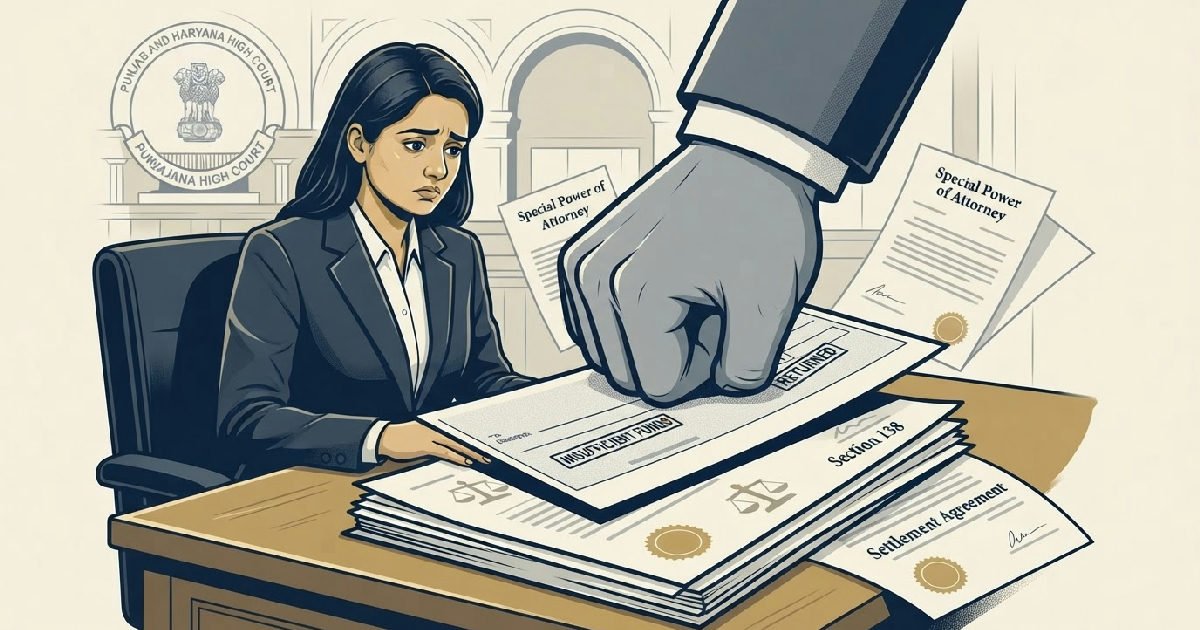
The Punjab and Haryana High Court upheld Tripti Srivastava’s cheque bounce liability on August 26, 2026, by dismissing her petition to quash Section 138 proceedings.
The court, presided over by Justice Alok Jain, determined that Srivastava could not circumvent her financial obligations, even though a settlement agreement had stipulated that her husband’s company, IQ Med Healthcare Private Limited, would discharge the outstanding amount.
High Court Upholds Cheque Bounce Liability Proceedings
This decision underscores the legal principle that a Special Power of Attorney, which authorized her husband, Durgesh Srivastava, to act on her behalf and ratified his actions as her own, could not be disregarded.
The court highlighted that a party cannot selectively benefit from a settlement while simultaneously disowning the very liabilities it was designed to resolve. The ruling stemmed from business dealings between Srivastava’s firm, her husband’s company, and the respondent, Yogesh Singla.
The core of the High Court’s decision rests on the inviolability of the Special Power of Attorney (SPA) that Tripti Srivastava had granted to her husband.
Justice Alok Jain pointedly remarked that Srivastava “on one hand wishes to take benefit of the said agreement, whereas, on the other hand does not wish to discharge her liability.” This observation cuts to the heart of the matter, illustrating the court’s view on her attempt to selectively apply the terms of the settlement.
The court explicitly rejected the argument that a subsequent settlement agreement could unilaterally nullify the legal responsibility arising from the SPA. Such an arrangement would undermine the foundational purpose of such legal instruments and introduce instability into contractual agreements. The verdict from the High Court decision ensures that accountability remains paramount in commercial transactions.
The Power of Attorney’s Critical Role
A Special Power of Attorney is a powerful legal tool, granting an agent specific authority to perform acts on behalf of the principal. In this instance, Tripti Srivastava’s SPA explicitly authorized Durgesh Srivastava to act on her behalf, with all his actions to be ratified as her own.
The court emphasized that this document legally bound her to the consequences of her husband’s actions in their business dealings.
Legal experts suggest this ruling serves as a vital reminder for individuals and businesses regarding the precise implications of granting powers of attorney. It clarifies that such instruments create direct legal links that cannot be easily severed by subsequent private arrangements, especially when criminal liability is at stake. The court carefully weighed the intricacies of the document against the settlement terms.
The ₹85 Lakh Settlement at the Heart of the Dispute
Central to the case was a one-time settlement agreement dated August 22, 2023, involving a significant sum of ₹85,00,000. Clause 1.1 of this agreement specified that this outstanding amount would be paid by IQ Med Healthcare Private Limited “on behalf of both the firms,” referring to Tripti Srivastava’s proprietorship and Durgesh Srivastava’s company. The dispute arose after the cheque issued under this arrangement was dishonored.
The dishonour of the cheque prompted the respondent, Yogesh Singla, to file a complaint under Section 138 of the Negotiable Instruments Act. This section is specifically designed to address situations where cheques are issued against insufficient funds or payment is stopped without valid reason, aiming to enforce financial discipline in commercial transactions.
The subsequent legal proceedings brought the matter before the Judicial Magistrate 1st Class, Karnal.
Unraveling the Business Dealings and Legal Arguments
The entanglement of the two petitioners, Tripti Srivastava and Durgesh Srivastava, stemmed from their respective business entities. Tripti Srivastava operated as the proprietor of her own firm, while Durgesh Srivastava was a Director of IQ Med Healthcare Private Limited. Both entities engaged in business dealings with the respondent, Yogesh Singla, incurring liabilities.
The complexity arose because the settlement agreement was designed to address liabilities from both distinct entities. This arrangement, initially intended to streamline the payment process, ultimately became a point of contention when the payment failed. The court had to ascertain whether the individual proprietor could be absolved of responsibility based on the corporate undertaking.
Understanding Dual Entity Dealings
The court meticulously examined how Tripti Srivastava and her husband, Durgesh Srivastava, structured their business affairs. They maintained two separate entities: her proprietorship and his private limited company. Both these entities had independently accrued liabilities with Yogesh Singla. The settlement was a consolidated effort to address these combined debts.
The ruling makes it clear that while such arrangements might appear efficient, they do not automatically merge individual and corporate liabilities, especially in the presence of specific legal instruments like a Special Power of Attorney.
The court emphasized that parties cannot create separate legal structures to benefit commercially, only to later dissolve accountability when financial obligations arise. This precedent could impact how intertwined business entities manage their liabilities going forward.
Overview of Section 138 NI Act
Section 138 of the Negotiable Instruments Act, 1881, is a crucial component of India’s commercial law, designed to instil confidence in cheque transactions. It criminalizes the dishonour of cheques under specific conditions, ensuring that drawers are held accountable for payments. For a Section 138 offense to be established, several conditions must be met.
These conditions include the cheque being issued for a legally enforceable debt, its presentation within the validity period, dishonour due to insufficient funds, a legal demand notice sent within 30 days of dishonour, and the drawer’s failure to pay within 15 days of receiving the notice.
The penalties can range from imprisonment up to two years to a fine up to twice the cheque amount, or both. This statutory framework aims to prevent frivolous issuance of cheques and uphold financial probity.
Petitioner’s Defense and Respondent’s Firm Rebuttals
Counsel for Tripti Srivastava presented several arguments to the Punjab and Haryana High Court seeking to quash the complaint and the summoning order issued by the Judicial Magistrate 1st Class, Karnal, under Section 528 of the Bharatiya Nagarik Suraksha Sanhita (BNSS).
Her primary contention was that the settlement agreement, in which her husband’s company undertook to discharge the liability, should absolve her of individual criminal proceedings. The argument referenced the complainant’s own statement acknowledging the husband’s responsibility for the outstanding amount against her firm, suggesting no legally enforceable debt remained against her.
Furthermore, the petitioner’s legal team cited another complaint where the complainant had opted to summon only the cheque-signatory, implying a precedent for isolating liability. This approach sought to distance Tripti Srivastava from direct responsibility for the dishonoured cheque, despite her initial role as a proprietor with outstanding liabilities. They aimed to demonstrate that the settlement had effectively transferred or nullified her personal obligation.
Respondent Challenges Petitioner’s Stance
In response, counsel for Yogesh Singla, the respondent, vehemently opposed the quashing petition. They argued that Tripti Srivastava had not approached the court with “clean hands,” having concealed the critical Special Power of Attorney she executed in favour of her husband.
This SPA explicitly stated her agreement to ratify all actions taken by him on her behalf, making his acts her own. The respondent maintained that this document was paramount to understanding her ongoing liability.
The respondent’s legal team also warned that discharging Tripti Srivastava would allow Durgesh Srivastava to later claim that the entity against whom the original liability was due had been absolved. This could potentially collapse the entire litigation and render the settlement meaningless, thereby allowing both parties to escape accountability.
They asserted that all statutory ingredients of Section 138 were met, and resolving disputed facts in a Section 528 BNSS proceeding would necessitate an impermissible “mini-trial.”
The Judicial Magistrate’s Role
The initial summoning of Tripti Srivastava and Durgesh Srivastava by the Judicial Magistrate 1st Class, Karnal, highlights the standard procedure in cheque dishonour cases. A magistrate can take cognizance of cases under Section 138 of the NI Act, initiating proceedings if there’s prima facie evidence.
While magistrates typically have financial limits on penalties, Section 143(1) of the NI Act allows them to impose fines up to twice the cheque amount in these specific cases.
This judicial step signifies that sufficient grounds were found to proceed with a trial, necessitating both petitioners to respond to the charges.
The current High Court ruling upholds the magistrate’s initial decision, preventing a premature quashing of the proceedings and allowing the trial to proceed based on the merits of the case and the evidence presented. An initial complaint is often the first step in such complex legal battles.
Legal Framework and Precedent in Cheque Cases
The Punjab and Haryana High Court’s judgment reinforces the intricate legal framework surrounding cheque dishonour and the use of Powers of Attorney. The court observed that Tripti Srivastava and her husband, having intentionally created and operated two distinct entities, could not selectively use the settlement agreement. They could not claim benefits from it while simultaneously disowning the underlying liabilities it sought to settle.
This stance is crucial for upholding the integrity of commercial transactions and legal agreements. It suggests that individuals cannot strategically compartmentalize their legal identities to evade financial responsibilities, especially when a formal legal instrument like an SPA links their actions. The ruling establishes a strong position against legal opportunism in such circumstances.
Distinguishing Liability in Prior Rulings
This case presents a critical distinction from previous rulings on Section 138 liability, particularly one from December 2023 by the Punjab and Haryana High Court, presided over by Justice NS Shekhawat.
That earlier ruling clarified that a wife would not be liable for a cheque drawn by her husband from a joint account if she was not a signatory. The focus there was on direct endorsement of the cheque.
However, the present case differs fundamentally due to the presence of the Special Power of Attorney. The SPA meant Tripti Srivastava had explicitly ratified her husband’s actions, making them her own, irrespective of whether she personally signed the dishonoured cheque. This distinction highlights how legal instruments can create specific liabilities that override general principles of non-liability for non-signatories. This emphasizes the nuanced application of law.
Impact of Bharatiya Nagarik Suraksha Sanhita (BNSS) Section 528
Tripti Srivastava’s petition to quash the proceedings was filed under Section 528 of the Bharatiya Nagarik Suraksha Sanhita (BNSS), 2023, which replaced Section 482 of the Code of Criminal Procedure, 1973. This section preserves the inherent powers of the High Court to prevent abuse of the court’s process or to secure the ends of justice.
However, these powers are typically exercised sparingly and cautiously, reserved for exceptional cases where criminal proceedings are frivolous or malicious.
The interim protection granted to the petitioner had, in fact, stalled the trial, further influencing the court’s decision not to interfere at this stage.
The high threshold for quashing proceedings under Section 528 BNSS remains, regardless of whether the underlying offense is non-bailable or, as in this case, a bailable one under Section 138 of the NI Act. Courts are generally reluctant to halt trials without compelling reasons.
The Court’s Rationale and What Comes Next
Justice Alok Jain articulated the court’s rationale for dismissing the petition, stating that granting relief at this stage “would amount to interfering with and prejudging the issues involved in the trial.”
This highlights the High Court’s reluctance to intervene prematurely in criminal proceedings, preferring that disputed questions of fact, including the effect of the settlement and the Special Power of Attorney, be fully resolved through a proper trial process. The court’s role is to ensure justice, not to preempt the judicial process.
The judgment also noted a critical detail: despite repeated calls to demonstrate her bona fides by making some effort towards discharging the liability, Tripti Srivastava’s counsel “categorically declined to do so.”
This lack of proactive effort to address the outstanding debt likely played a significant role in the court’s decision, reinforcing the perception that she sought to evade responsibility rather than genuinely resolve the dispute. It emphasizes the importance of good faith in legal negotiations.
Future Implications for Proprietors and Directors
This ruling carries substantial implications for individuals operating proprietorship firms who also have affiliations with private limited companies, particularly when business dealings become intertwined. It clarifies that a Special Power of Attorney creates a powerful and binding link, ensuring that principals remain accountable for actions undertaken on their behalf. The court will not allow such arrangements to be used as a shield against legitimate liabilities.
The decision reinforces the need for clear separation and meticulous documentation in business transactions involving multiple entities and delegated authority. It advises that merely assigning responsibility to a corporate entity in a settlement does not automatically absolve an individual if a Power of Attorney extends their personal liability.
This could lead to greater scrutiny of SPAs in commercial agreements, making individuals more cautious about the scope of authority they delegate.
Need for Bona Fides in Legal Disputes
The court’s observation regarding the petitioner’s refusal to demonstrate her bona fides by making an effort to discharge the liability is a powerful signal. In legal disputes, especially those involving financial obligations, a party’s willingness to show good faith can significantly influence judicial outcomes. A proactive approach to settlement or partial payment can often be viewed favorably by the courts.
This aspect of the judgment emphasizes that legal strategies should not solely focus on procedural technicalities. Instead, they should also demonstrate a genuine intent to resolve the underlying financial issues. The court expects parties to engage meaningfully, even when challenging the legal basis of a claim, particularly in cases involving commercial dishonour.
It suggests that a perceived lack of earnestness can undermine even technically sound legal arguments.
| Party/Entity | Role in Dispute | Key Action/Status |
|---|---|---|
| Tripti Srivastava | Petitioner / Proprietor | Granted Special Power of Attorney; sought to quash Section 138 proceedings |
| Durgesh Srivastava | Petitioner / Director, IQ Med Healthcare Pvt Ltd | Received Special Power of Attorney; company undertook liability in settlement |
| Yogesh Singla | Respondent / Creditor | Filed complaint under Section 138 NI Act |
| IQ Med Healthcare Private Limited | Company | Undertook to pay ₹85,00,000 on behalf of both firms in settlement |
| Punjab and Haryana High Court | Adjudicating Authority | Dismissed Tripti Srivastava’s petition, upholding trial proceedings |
What is Section 138 of the Negotiable Instruments Act?
Section 138 of the Negotiable Instruments Act, 1881, makes the dishonour of a cheque a criminal offense in India. It applies when a cheque is returned unpaid due to insufficient funds or other reasons, provided certain conditions like a legal demand notice are met. It aims to ensure accountability in cheque transactions.
How does a Special Power of Attorney affect liability in such cases?
A Special Power of Attorney (SPA) can significantly affect liability. If a principal grants an SPA to an agent to act on their behalf in financial matters, and explicitly ratifies the agent’s actions as their own, the principal can be held liable for those actions. This includes liability arising from dishonoured cheques, as demonstrated by the Punjab and Haryana High Court’s recent ruling.
Can a settlement agreement override an existing liability under Section 138 NI Act?
Not always. While a settlement agreement can resolve financial disputes, it doesn’t automatically quash criminal proceedings under Section 138 NI Act, especially if the conditions of the settlement are not fully met or if a prior legal instrument, like a Special Power of Attorney, establishes an undeniable link to the liability. The court may still require the trial to proceed to resolve disputed facts.