
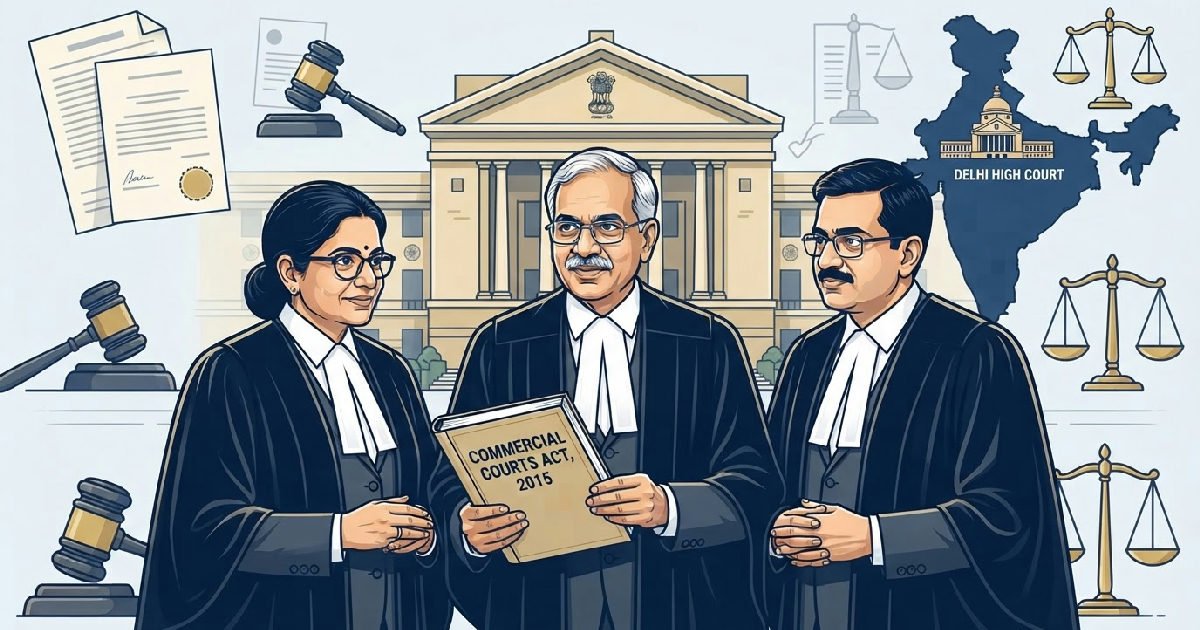
The Delhi High Court’s Full Bench delivered a landmark ruling on August 14, 2026, clarifying that the Commercial Courts Act, 2015, applies to commercial disputes initiated before its enactment on October 23, 2015. This crucial decision holds even if these suits were subsequently re-numbered or converted into commercial cases.
The court also affirmed that the Act restricts the right to appeal against orders not explicitly made appealable under its specific mechanism.
Commercial Courts Act applicability clarified
A three-judge Bench, comprising Justice V Kameswar Rao, Justice Chandrasekharan Sudha, and Justice Amit Mahajan, issued the ruling. Their decision addressed conflicting Division Bench interpretations that had created uncertainty within India’s commercial litigation landscape. The verdict has significant implications for how past and ongoing commercial disputes are adjudicated.
The majority opinion, authored by Justice V Kameswar Rao with Justice Chandrasekharan Sudha concurring, explicitly stated that the Commercial Courts Act applies to pending commercial suits from its effective date, October 23, 2015. This means the Act’s provisions took precedence regardless of when a suit was formally re-numbered.
They emphasized that the process of re-numbering a commercial suit by the Registry is merely an administrative or clerical step. It doesn’t dictate when the Act comes into force for a particular case. This distinction is vital for hundreds of cases that have been in legal limbo.
The ruling effectively streamlines the application of the Act, pushing past procedural delays that previously allowed older cases to circumvent its provisions. Businesses can expect greater uniformity in how commercial disputes are handled, irrespective of their filing date.
The crucial context of the Yes Bank vs. Modi Rubber case
This pivotal reference stemmed from an appeal filed by Yes Bank against a 2019 order. That order had allowed Modi Rubber’s application to amend its plaint under Order VI Rule 17 of the Code of Civil Procedure (CPC).
Modi Rubber originally filed the suit in 2014, seeking to recover ₹33.13 crore from Yes Bank. The dispute arose from credit facilities extended by the bank for a proposed joint venture involving Modi Rubber’s subsidiary and Continental AG.
Yes Bank initially provided a ₹100 crore credit facility in 2009, which grew to ₹130 crore by 2010. However, after Continental BV acquired the subsidiary in 2011, Yes Bank closed the facility and debited ₹7.16 crore in fees, leading to the legal challenge.
Yes Bank’s appeal and Modi Rubber’s contention
The suit remained an ordinary civil matter after the Commercial Courts Act became law in October 2015. Modi Rubber later sought to amend its original plaint, an application a Single Judge granted in March 2019.
Yes Bank challenged this order before a Division Bench, arguing that its right to appeal had accrued when the suit was filed in 2014. They contended this right couldn’t be nullified by a later law like the Commercial Courts Act.
Conversely, Modi Rubber argued that the Commercial Courts Act did apply to the dispute. They maintained that an order allowing a plaint amendment isn’t appealable under the Act’s restricted appeal mechanism, specifically citing Order XLIII of the CPC.
Conflicting interpretations and judicial consensus
The Full Bench was tasked with resolving disagreements between prior Division Bench decisions. Specifically, the cases of Brahmos Aerospace Pvt. Ltd. v. FIIT JEE Ltd. and Samsung Leasing Ltd. v. Samsung Electronics Co. Ltd. offered differing views on the Act’s retrospective application.
The majority judgment disapproved of the interpretation in Brahmos Aerospace, which had suggested that Section 13 of the Act wouldn’t apply until a suit was formally re-numbered. This precedent had allowed some cases to avoid the Act’s streamlined procedures.
Instead, the Full Bench affirmed the stance taken in Samsung Leasing. That earlier ruling correctly held that a Registry’s failure to formally re-number a commercial dispute does not negate the applicability of the Commercial Courts Act.
The judges made it clear: the legislative intent of the Commercial Courts Act was to restrict appeals in commercial matters. This applies solely to orders specifically listed under Order XLIII of the CPC, making many interim orders non-appealable.
Justice Mahajan’s nuanced perspective
While Justice Amit Mahajan concurred that the specific appeal in question was not maintainable, he presented a more nuanced view on the broader applicability of Section 13 of the Commercial Courts Act. His separate opinion added a critical distinction to the majority’s reasoning.
Justice Mahajan differentiated between a suit pending before a court already vested with commercial jurisdiction and one awaiting transfer from an ordinary civil court. He observed that if the court itself has jurisdiction over commercial disputes, the Act applies immediately.
However, he argued that an order issued by an ordinary Civil Judge before a commercial dispute is transferred and re-numbered shouldn’t automatically fall under Section 13’s restrictions. This distinction is particularly relevant for District Courts where ordinary civil and Commercial Courts often operate separately.
In the present case, this distinction didn’t alter the outcome because the Delhi High Court possesses jurisdiction over both original civil matters and its Commercial Division.
Nonetheless, Justice Mahajan’s opinion provides important guidance for cases in other jurisdictions, ensuring that parties retain their prior appeal remedies for orders made before formal transfer to a dedicated commercial court. This helps delineate the precise moment when the Act’s stricter appeal provisions kick in.
Broader implications for commercial litigation in India
The Delhi High Court’s definitive ruling is expected to significantly impact India’s commercial legal landscape. The Commercial Courts Act, 2015, was enacted to streamline dispute resolution and improve India’s “Ease of Doing Business” rankings.
This clarity on its retrospective application reinforces the Act’s original objectives. It aims to reduce case backlogs and accelerate the resolution of high-value commercial disputes. This ruling ensures that commercial cases, regardless of their initial filing date, are subjected to the Act’s faster mechanisms.
Businesses operating in India should now factor this interpretation into their litigation strategies. The limited scope for appeals means fewer delays and a more predictable judicial process for commercial matters, which is a major boost for business dispute resolution.
The role of the Commercial Courts Act
The Commercial Courts Act was introduced in 2015 and began operation on October 23, 2015, receiving Presidential assent on December 31, 2015. It was a direct response to international criticism regarding the Indian judiciary’s effectiveness in handling commercial cases.
Initially, disputes valued at ₹1 crore or more fell under its purview. However, amendments in 2018 lowered this “specified value” to ₹3 lakhs and above, vastly expanding the Act’s reach. This legislative evolution underscores a sustained effort to enhance judicial efficiency for commercial matters.
The Act’s Section 13 is central to its goal of expediency, specifically restricting appeals. Orders permitting an amendment of a plaint under Order VI Rule 17, for instance, are not included in the exhaustive list of appealable orders under Order XLIII of the CPC, as highlighted by this latest ruling.
This means litigants must understand that many procedural decisions will not be open to immediate challenge. This framework should accelerate the progress of commercial cases, moving them towards quicker finality. This strengthens the enforcement of commercial contracts, a key metric for investor confidence.
| Aspect | Pre-Commercial Courts Act (Before Oct 2015) | Post-Commercial Courts Act (After Oct 2015) |
|---|---|---|
| Applicability to Old Suits | Ordinary civil procedure applied by default | Act applies regardless of re-numbering date |
| Appeal Mechanism | Broader appeal rights under CPC | Restricted to orders under Order XLIII CPC |
| Primary Objective | General civil justice system | Expedited resolution of commercial disputes |
| Minimum Specified Value | No specific threshold for commercial courts | Initially ₹1 crore, later reduced to ₹3 lakhs |
The path ahead for commercial disputes
This Full Bench decision brings much-needed clarity, especially for cases that originated before 2015. The ruling firmly establishes the retrospective applicability of the Commercial Courts Act. It reinforces the legislative intent to expedite commercial dispute resolution by limiting appellate challenges.
The appeal involving Yes Bank is now scheduled to be listed before the appropriate bench on September 2, 2026, for further proceedings. The core question of the appeal’s maintainability has been settled, directing the path forward for this specific dispute.
For legal practitioners and businesses, this judgment means a more focused approach to commercial litigation. They must adapt to the Act’s stricter appellate framework and faster timelines. The era of protracted appeals on procedural matters is certainly drawing to a close in India’s commercial courts.
The consistency this decision provides is invaluable, reducing the scope for ambiguity in applying a critical piece of commercial legislation. It reinforces the principle that commercial courts designated to hear these cases are indeed the final authority on many interim matters.
Does the Commercial Courts Act apply to cases filed before 2015?
Yes, the Delhi High Court has clarified that the Commercial Courts Act, 2015, applies to commercial suits even if they were instituted before October 23, 2015. This is true even if the suits were only converted or re-numbered as commercial cases at a later date.
Can I appeal all orders made by a Commercial Court?
No, the Commercial Courts Act significantly restricts the right to appeal. You can only appeal against orders that are specifically listed as appealable under Order XLIII of the Code of Civil Procedure (CPC). Many interim or procedural orders are not appealable under this mechanism.
What was the main disagreement that led to this ruling?
The ruling addressed conflicting decisions from different Division Benches of the Delhi High Court regarding the applicability of the Commercial Courts Act. These conflicting precedents created uncertainty, particularly on whether the Act’s appeal restrictions applied to older cases that hadn’t been formally re-numbered as commercial suits.
Call or Whatsapp for free consultation.