
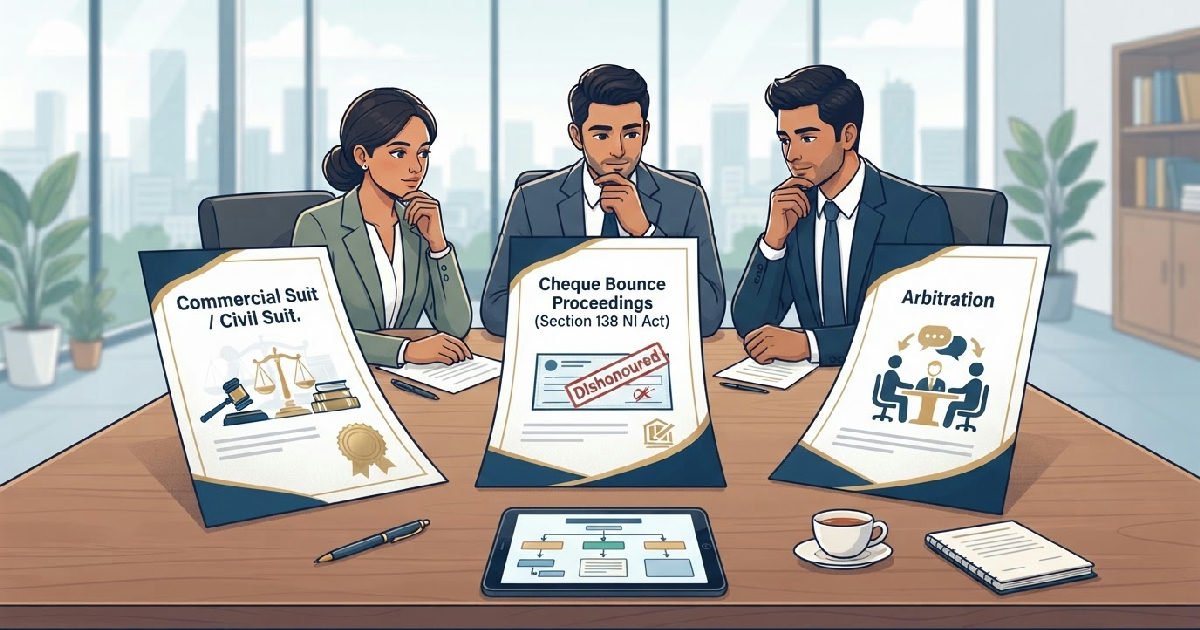
Indian companies grappling with unpaid dues from defaulting clients face a pivotal decision regarding legal recourse. The strategic choice between a civil suit, cheque bounce proceedings, or arbitration can significantly impact the speed, cost, and ultimate success of money recovery efforts in India. Indian companies weigh these options carefully.
Businesses must carefully weigh the distinct requirements and implications of each method to reclaim their outstanding payments. Opting for an unsuitable legal path often leads to unnecessary delays and escalating expenses, making an informed decision crucial for financial stability.
Navigating India’s Debt Recovery Landscape: Indian Companies Weigh Options
India’s legal framework offers three primary mechanisms for companies seeking to recover funds from clients who have defaulted. These avenues are designed to address various scenarios, from contract breaches to dishonored financial instruments.
Each option comes with its own set of procedural rules, governed by specific legislation, dictating how claims are initiated, progressed, and ultimately enforced. Companies typically choose based on the nature of the debt, available documentation, and the desired outcome for their commercial claims.
Legislative Frameworks for Commercial Claims
Civil suits for recovery operate under the overarching Code of Civil Procedure, 1908 (CPC), a foundational legal text. Cheque bounce cases, on the other hand, fall under Section 138 of the Negotiable Instruments Act, 1881, which introduces a criminal dimension to money recovery in India.
Arbitration, a private dispute resolution mechanism, is governed by the Arbitration and Conciliation Act, 1996. These distinct legal frameworks shape the strategy and expectations for businesses pursuing their claims against defaulting parties.
Civil Suits: The Foundation of Debt Recovery
The civil suit remains a universally available option for companies to recover outstanding dues, provided the claim falls within the prescribed limitation period. Generally, the Limitation Act, 1963, allows a three-year window from the date a payment becomes due.
This period can be extended if the debtor formally acknowledges the debt in writing or makes a partial payment before the deadline. Sending a legal notice before filing is also considered a prudent strategy that can precede formal litigation.
Specialized Commercial Courts Provide Efficiency
For disputes classified as “commercial,” businesses can file a commercial suit under the Commercial Courts Act, 2015. These specialized courts were established to ensure faster and more efficient resolution of business-related disputes.
Initially, the Act applied to disputes valued at one crore rupees or more. However, an Ordinance later reduced this threshold to just three lakh rupees, significantly expanding the jurisdiction of these courts and making them accessible for a wider range of claims.
Summary Suits Offer an Expedited Path
A “Summary Suit” under Order XXXVII of the CPC presents a quicker alternative for straightforward cases. This includes those based on clear written contracts or dishonored cheques, effectively limiting the defendant’s ability to prolong the legal process.
This option provides a more expedited path to judgment where the defense is less complex or appears without merit. It’s particularly effective when the documentation of the debt is irrefutable, such as with undisputed invoices.
Civil suits typically require the payment of court fees, which can be substantial depending on the claim amount. They also offer the crucial advantage of enabling interim relief, such as attaching assets before a judgment is even delivered.
The outcome is a legally binding decree that can be enforced directly against the defaulting party’s assets. However, these traditional civil suits can sometimes extend for years, particularly for complex matters requiring extensive evidence and hearings.
Meticulous documentation, including loan agreements, invoices, bank statements, and communications, is essential for success in civil litigation. Verbal agreements, however, are notoriously difficult to enforce within commercial courts, highlighting the need for written proof.
Cheque Bounce Proceedings: Criminal Pressure for Payment
When a defaulting client issues a cheque that subsequently bounces, Section 138 of the Negotiable Instruments Act, 1881, offers a potent recovery tool. This route initiates criminal proceedings, even though the primary goal for the complainant is financial recovery.
The criminal implications of a bounced cheque can exert significant pressure on the defaulting party. This often prompts a quicker settlement compared to purely civil actions, making it a powerful strategic choice in debt collection.
Adhering to Strict Procedural Timelines
To pursue a cheque bounce case, several strict procedural timelines must be met. The cheque must have been presented within its three-month validity period, and a legal notice demanding payment must be sent within 30 days of receiving the bank’s return memo.
If the debtor fails to make payment within 15 days of receiving this notice, a criminal complaint must be filed before a Magistrate within one month after that 15-day window closes. Missing any of these deadlines can lead to the dismissal of the case, emphasizing procedural rigor.
A conviction under Section 138 carries serious penalties, including imprisonment for up to two years, a fine up to twice the cheque amount, or both. Magistrates often prioritize imposing fines to compensate the aggrieved party rather than solely focusing on incarceration.
The Act also establishes a legal presumption, under Section 139, that the dishonored cheque was issued for a real, legally enforceable debt. This shifts the burden of proof to the drawer, who must then demonstrate otherwise, simplifying the complainant’s initial case.
While relatively faster than traditional civil suits in many cases, cheque bounce cases do not automatically guarantee full recovery with interest. Accused parties can employ various defenses to delay proceedings, such as claiming prior payment or disputing the validity of the notice.
These proceedings can run in parallel with a civil suit, adding significant consequences for non-compliance. The dual approach provides both criminal leverage and the means for full financial restitution.
Arbitration: The Confidential and Flexible Alternative
Arbitration provides a private dispute resolution method, available only if parties included a valid arbitration clause in their initial agreement. This process falls under the Arbitration and Conciliation Act, 1996, aligning with international standards set by the UNCITRAL Model Law.
The Act has seen several amendments in 2015, 2019, and 2021, all aimed at enhancing the speed, cost-effectiveness, and transparency of the arbitration process. This reflects a concerted effort to make arbitration a more attractive option for commercial disputes.
Key Features and Recent Amendments
The Arbitration and Conciliation Act is based on the UNCITRAL Model Law on International Commercial Arbitration and UNCITRAL Arbitration Rules. This foundational alignment ensures a globally recognized standard for dispute resolution.
The Act’s amendments enhance its trustworthiness and reduce judicial intervention. Arbitral awards are enforceable as a decree of the court, giving them the same legal weight as a court judgment.
Efficiency and Enforceability of Awards
Arbitration typically offers a faster resolution than traditional court litigation, with many proceedings concluding within 6-12 months. This efficiency, combined with the confidentiality of proceedings, makes it appealing for businesses wanting to keep disputes out of public view.
Parties also benefit from procedural flexibility, allowing them to agree on aspects like the language, location, and specific timelines of the arbitration. Arbitrators with specialized expertise can also be chosen, ensuring informed decisions for complex technical matters.
Arbitral awards are legally binding and enforceable as a decree of a court, giving them significant weight. While courts can be approached for interim measures, arbitral tribunals themselves can issue enforceable interim orders, further streamlining the process after the 2015 amendment.
Despite its advantages, arbitration can become expensive due to arbitrator fees and administrative costs, depending on the complexity and duration of the case. The effectiveness of arbitration heavily relies on a well-drafted arbitration clause, ensuring clarity on the process.
Challenges to arbitral awards are generally limited to specific grounds, which helps ensure finality. However, an uncooperative opposing party can still introduce delays, though often not to the extent seen in lengthy court battles, preserving some of its speed advantage.
Strategic Considerations for Businesses
Choosing the right legal path for money recovery is rarely a one-size-fits-all decision for Indian businesses. The optimal strategy depends on several factors, including the nature of the debt, the available evidence, and the debtor’s likely response to legal action.
Companies must assess the documentation meticulously, including loan agreements, invoices, and communication records. The strength and clarity of these documents can significantly influence the viability and potential success of any legal action, regardless of the chosen route.
Balancing Speed, Cost, and Enforcement Power
Each recovery method presents a different balance of speed, cost, and scope. Civil suits offer broad applicability and the potential for comprehensive damages but can be protracted and expensive due to court fees and procedural complexity.
Cheque bounce cases are generally faster and exert strong pressure due to criminal penalties, but they are only applicable when a cheque is involved and require strict adherence to timelines. Arbitration promises speed and confidentiality but hinges on a pre-existing contractual clause.
The behavior of the defaulting party is another critical consideration. If a client is known for delaying tactics, a method with strong leverage, like cheque bounce proceedings, might be more effective at compelling a swift resolution or settlement.
Conversely, for complex disputes involving multiple claims or a need for detailed examination of evidence, a commercial civil suit or arbitration with specialized arbitrators might be more appropriate. The amount of money involved also plays a role in justifying the potential legal costs.
Understanding commercial litigation options is vital for businesses to make informed decisions that align with their operational goals and financial health.
The Integrated Approach to Debt Recovery
In many instances, the most effective recovery strategy involves combining different legal approaches rather than relying on a single one. This multi-pronged attack can maximize pressure and increase the likelihood of a favorable outcome for businesses.
For example, a company might initiate cheque bounce proceedings while simultaneously preparing a civil recovery suit. This creates both immediate criminal pressure and establishes a parallel civil claim for the debt itself, covering all bases.
The Importance of Proactive Legal Notices
Before any formal legal filing, dispatching a robust legal notice is often the first crucial step. This formally notifies the defaulting party of the outstanding debt and the intent to pursue legal action, sometimes prompting a settlement without court intervention.
Such notices also serve as important documentary evidence should litigation become necessary. They clearly establish the demand for payment and the timelines provided, strengthening the creditor’s position in subsequent proceedings, whether civil or criminal.
The choice between these recovery avenues is a a nuanced commercial decision. It requires a thorough understanding of each method’s legal intricacies, potential advantages, and drawbacks in the context of the specific default incident.
Businesses are advised to seek expert legal counsel to navigate these complexities. A well-considered strategy tailored to the unique circumstances of each defaulting client can save significant time, resources, and ultimately, recover lost capital.
Comparison of Money Recovery Options in India
Navigating the various avenues for money recovery in India requires a clear understanding of each option’s framework, applicability, and potential outcomes. While civil suits offer broad legal recourse, cheque bounce proceedings provide specific leverage through criminal implications, and arbitration presents a private, often faster, alternative for resolution.
The choice hinges critically on the specifics of the debt, the contractual agreements in place, and the desired balance between speed, cost, and enforcement.
A detailed comparison reveals significant differences across governing laws, typical timelines, and cost structures. Businesses must assess whether they prioritize the extensive discovery and enforcement power of a civil suit, the swift criminal pressure of a cheque bounce case, or the confidential and potentially quicker resolution offered by arbitration, provided a valid clause exists.
Each method demands distinct documentation and adherence to specific procedural rules, making a tailored strategy essential.
Ultimately, the effectiveness of any recovery strategy is often determined by its alignment with the unique circumstances of the default. Understanding these nuances, from interim relief possibilities to the nature of enforcement, allows companies to make an informed decision that maximizes their chances of recovering outstanding dues efficiently, while also considering the resources they are willing to commit.
| Feature | Civil/Commercial Suit | Cheque Bounce Proceedings | Arbitration |
|---|---|---|---|
| Governing Law | Code of Civil Procedure, 1908 | Negotiable Instruments Act, 1881 (Sec. 138) | Arbitration and Conciliation Act, 1996 |
| Availability | Broad, general applicability | Cheque issued and dishonored | Valid arbitration clause required |
| Primary Objective | Debt recovery, damages, interest | Debt recovery (via criminal pressure) | Debt recovery (private, faster) |
| Typical Timeline | Can take years | Relatively faster than regular civil suits in many cases | Often 6-12 months |
| Cost Implications | Substantial court fees for high value | Court fees, legal fees | Arbitrator fees, administrative costs |
| Nature of Proceedings | Civil litigation | Quasi-criminal | Private dispute resolution |
| Enforcement | Decree enforceable against assets | Fine (up to 2x cheque amount), imprisonment | Award enforceable as court decree |
| Interim Relief | Possible (e.g., attachment before judgment) | Limited to settlement pressure | Possible (court or tribunal) |
| Documentation Required | Extensive, written proof essential | Cheque, bank memo, legal notice proof | Arbitration agreement, contract, evidence |
Frequently Asked Questions
Understanding the intricacies of money recovery mechanisms in India can be complex, often leading to common queries from businesses seeking to reclaim their dues. This section aims to address some of the most pressing questions, providing clarity on the distinctions and applicability of civil suits, cheque bounce proceedings, and arbitration in commercial disputes.
Navigating the legal landscape requires careful consideration of each option’s implications, from timelines and costs to the specific conditions under which they can be pursued. These FAQs are designed to offer quick insights into typical scenarios and strategic considerations, helping companies make more informed decisions about their debt recovery strategies.
While these answers provide general guidance, it is always recommended to consult with legal professionals for advice tailored to your specific situation. The nuances of contractual agreements, available evidence, and the debtor’s circumstances can significantly influence the most effective path forward for successful money recovery.
What is the primary difference between a Civil Suit and a Commercial Suit in India?
A Civil Suit is the general legal process for various disputes, while a Commercial Suit is specifically for “commercial disputes” under the Commercial Courts Act, 2015. Commercial Suits benefit from specialized courts designed for faster, time-bound resolution, often for higher-value claims.
Can I pursue both a Cheque Bounce case and a Civil Suit for the same debt?
Yes, you can. A Cheque Bounce case is a quasi-criminal proceeding that puts pressure on the debtor, while a Civil Suit (or Commercial Suit) is a civil remedy to recover the actual debt, including interest and damages. These two paths can run concurrently, offering dual leverage.
When is arbitration the most suitable option for money recovery?
Arbitration is most suitable when your contract with the defaulting client explicitly includes a valid arbitration clause. It’s often preferred for its potential speed, confidentiality, and flexibility, making it ideal for businesses that value privacy and a tailored dispute resolution process.