
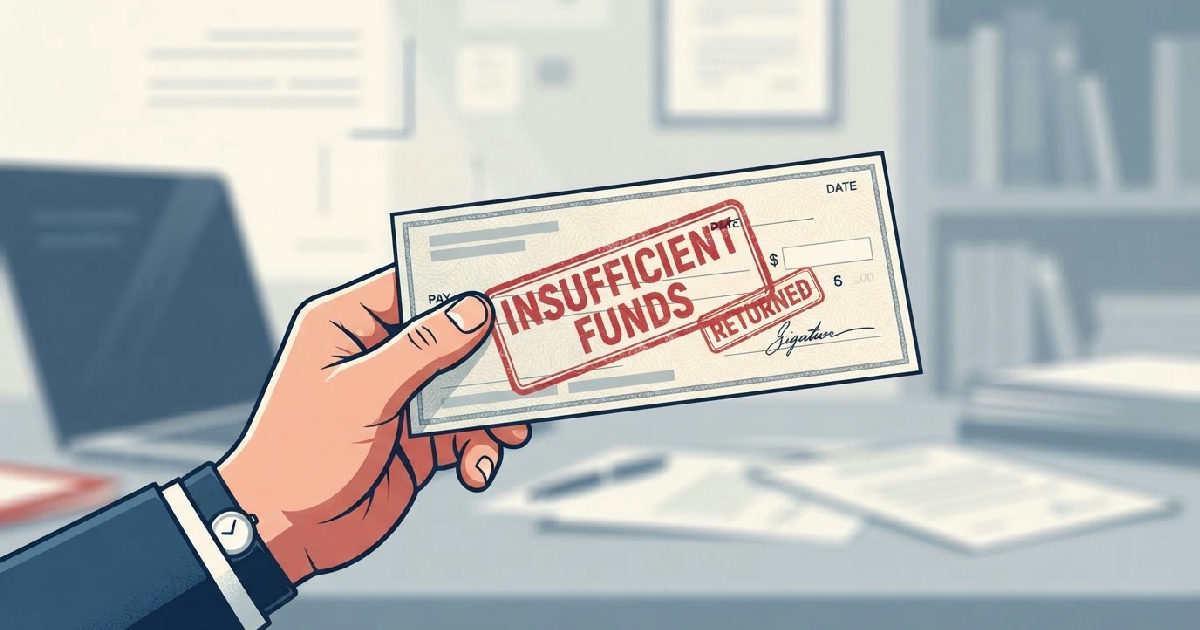
To fight a bounced cheque, understand the cheque bounce case punishment and your legal options to avoid potential financial and legal headaches. Knowing how to fight a bounced cheque charge is crucial for anyone caught in this situation.
A bounced check, also known as a bad check or a worthless check, occurs when a bank declines to process a payment because the account lacks sufficient funds or has other issues. While often resulting in fees, such incidents can escalate to civil lawsuits or even criminal charges, depending on state laws and intent.
Defining a Bounced Check and Its Triggers
A bounced check is essentially a payment instrument that a bank refuses to honor. This refusal typically stems from insufficient funds (NSF) in the drawer’s account.
But a lack of money isn’t the only reason a check might bounce. Other issues include a non-existent account, a stop payment order, errors in how the check was filled out, or a freeze on the account.
Insufficient funds: the primary culprit
Insufficient Funds (NSF) is the most common reason for a check to bounce. This simply means the account doesn’t hold enough money to cover the amount written on the check.
The drawer, or payor, is the individual or entity who writes the check. They are responsible for ensuring adequate funds are available to cover the transaction.
Other complications leading to a declined check
Beyond NSF, a check can bounce due to various administrative or deliberate actions. A stop payment order issued by the drawer prevents the check from being cashed.
Incorrectly filled-out checks, like missing signatures or incorrect amounts, can also lead to rejection. Moreover, a closed or frozen bank account will certainly cause a check to bounce.
Legal and Financial Consequences of Bounced Checks
The ramifications of a bounced check extend far beyond simple embarrassment. Both civil and criminal penalties can come into play, depending on the circumstances.
Understanding these consequences helps in grasping the seriousness of a bounced check and why it’s important to address it promptly.
Civil repercussions and escalating costs
The immediate financial impact often involves multiple fees. The drawer’s bank typically charges an NSF fee, which averages around $17, though many large banks have eliminated this particular fee.
The payee’s bank might also levy a returned check fee on the recipient. Beyond bank charges, the payee or merchant can impose their own returned check fee, often ranging from $25 to $40.
The original debt from the bounced check doesn’t disappear. If it remains unpaid, it can be sent to collections, potentially damaging the drawer’s credit score. Bounced checks carry significant legal and financial ramifications, affecting both individuals and businesses.
A payee can also initiate a civil lawsuit to recover the check amount plus any accrued fees. Some states even permit additional damages, like treble damages—three times the check’s amount—up to a maximum, such as $1,500 in California, if specific conditions are met.
When a bounced check turns criminal
Criminal charges are a far more severe outcome, generally reserved for cases involving “intent to defraud.” This means the drawer knowingly wrote the check with the deliberate purpose of deceiving the recipient.
The intent is to obtain goods, services, or money without ever planning to pay for them. Proving this intent is a crucial legal element for criminal prosecution.
Key Legal Defenses When You Fight a Bounced Check
If you’re facing a bounced check charge, several legal defenses might be applicable. These defenses primarily focus on disproving intent to defraud or highlighting procedural errors.
Knowing these defenses is an important part of understanding how to fight a bounced check effectively.
Absence of intent to defraud
The cornerstone of a criminal bounced check charge is “intent to defraud.” If you can demonstrate that you did not knowingly write a bad check with deceptive intent, criminal charges are unlikely to hold.
Perhaps you genuinely believed funds were available, or there was an unforeseen financial emergency. Evidence of prior good faith payments can also support this defense.
Technical errors or bank mistakes
Sometimes, a check bounces due to a mistake that wasn’t yours. This could involve an error by your bank in processing a deposit or a miscommunication regarding account balances.
Demonstrating a clerical error on the part of the bank or a problem with the check itself, such as an illegible routing number, can serve as a strong defense.
Timely payment or resolution efforts
If you rectify the situation quickly by making the payment, this can significantly mitigate the legal fallout. Promptly covering the bounced check amount demonstrates good faith and an absence of fraudulent intent.
Many jurisdictions will drop or reduce charges if the drawer makes restitution within a specified timeframe. This proactive approach shows you’re not trying to evade responsibility.
Strategies for Resolving a Bounced Check
Beyond legal defenses, several practical strategies can help navigate a bounced check situation. Proactive communication and understanding the legal landscape are key.
Consulting with legal professionals can provide clarity and guide you through the best course of action.
Communicate directly with the payee
Often, the simplest and most effective first step is to contact the payee directly. Explain the situation and offer to make good on the payment immediately, including any associated fees.
Many payees are more interested in recovering their money than pursuing legal action. A prompt and sincere offer to resolve the issue can prevent escalation.
Seeking legal counsel from an expert
If the situation appears complex or involves substantial amounts, it’s wise to consult a legal professional. An attorney specializing in financial law can offer tailored advice and representation.
A bounced cheque lawyer can navigate the legal and financial consequences, helping to protect your interests. They understand state-specific laws and can help negotiate with the payee or represent you in court.
Understanding state-specific laws
Laws regarding bounced checks vary considerably from state to state. Some states have specific provisions for demand letters and timeframes for restitution, while others have more stringent criminal statutes.
Familiarize yourself with the laws in your jurisdiction. This knowledge will empower you to understand your rights and obligations, informing your strategy to address the issue.
Financial Overview: Bounced Check Fees and Potential Damages
The financial penalties associated with bounced checks can quickly accumulate. It’s important to be aware of the different types of fees and potential civil damages.
These figures highlight the importance of careful financial management and swift action if a check bounces.
| Fee Type | Typical Range | Notes |
|---|---|---|
| Drawer’s Bank NSF Fee | Around $17 (average) | Many large banks have eliminated this fee |
| Payee’s Bank Returned Check Fee | Varies | Charged to the recipient of the bad check |
| Merchant/Payee Returned Check Fee | $25 to $40 | Imposed by the business or individual the check was written to |
| Civil Lawsuit Treble Damages | Up to $1,500 (e.g., California) | In some states, if specific conditions are met |
Preventing Future Bounced Checks
The best way to fight a bounced check charge is to prevent it from happening in the first place. Several practices can help maintain healthy account balances and avoid potential issues.
Regularly monitoring your bank account and understanding your spending habits are fundamental steps.
Regularly monitor account balances
Keep a close eye on your checking account balance, especially before writing significant checks. Digital banking tools and mobile apps make this easier than ever.
Setting up low-balance alerts can provide timely warnings, allowing you to transfer funds before a check is presented for payment.
Utilize overdraft protection
Overdraft protection can serve as a safety net, automatically transferring funds from a linked savings account or credit line to cover transactions. While it may involve fees or interest, it prevents a bounced check charge.
It’s a useful feature for occasional shortfalls, but relying on it too frequently can lead to accumulating debt or fees. Understanding common check issues, including overdrafts, is crucial for financial health.
Reconcile statements diligently
Regularly reconciling your bank statements with your own records helps catch discrepancies and prevents unexpected balance issues. This ensures that all transactions are accurately recorded and understood.
This practice can also help identify any fraudulent activity or errors that might lead to an unintended bounced check.
What is the most common reason for a check to bounce?
The most common reason for a check to bounce is insufficient funds (NSF). This means the account on which the check is drawn does not have enough money to cover the amount specified.
Can I face criminal charges for a bounced check?
Yes, criminal charges are possible for a bounced check, especially if there is an “intent to defraud.” This implies you knowingly wrote the check without intending to pay, often to deceive someone for goods or services.
What are the typical fees associated with a bounced check?
Typical fees include an NSF fee from the drawer’s bank (average around $17), a returned check fee from the payee’s bank, and a merchant/payee fee which often ranges from $25 to $40.