
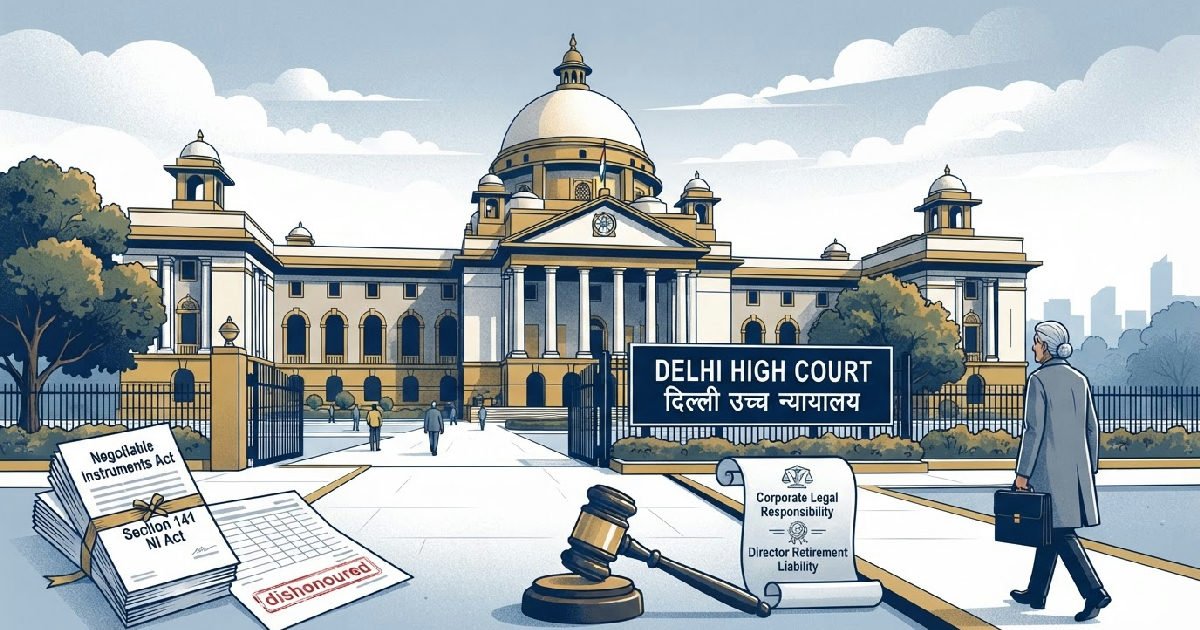
On September 23, 2020, the Delhi High Court ruled that retired company directors are not accountable for post-retirement firm operations, including dishonoured cheques. This decision, handed down by Justice V.
Kameswar Rao, clarifies the scope of liability under Section 141 of the Negotiable Instruments Act, 1881, offering crucial protections for former board members.
Defining Director Accountability Under Indian Law
The court’s stance emphasizes that criminal liability for such offenses hinges on an individual being actively “in-charge of and responsible for the conduct of the day-to-day affairs of the Company” at the precise moment the infraction takes place. This principle has since been consistently reaffirmed by the Supreme Court of India, shaping the corporate legal landscape.
India’s legal framework for corporate governance outlines clear responsibilities for directors. The Companies Act, 2013, for example, assigns various duties, powers, and liabilities to these fiduciaries. They’re tasked with acting in good faith, exercising due care, and diligently managing company affairs.
The Negotiable Instruments Act, 1881 (NI Act), plays a pivotal role in commercial transactions. Enacted to ensure the credibility of financial instruments like cheques, it makes the dishonour of a cheque a criminal offense under Section 138. This aims to prevent financial fraud and uphold accountability.
The pivotal role of Section 141 NI Act
Section 141 of the NI Act extends vicarious liability to officers of a company when an offense under Section 138 occurs. It stipulates that any person responsible for the company’s business at the time of the offense can be deemed guilty, alongside the company itself.
However, it provides a defense if the person can prove they lacked knowledge of the offense or exercised due diligence to prevent it.
This section is frequently invoked in cases of cheque dishonour, but its application has seen significant judicial interpretation. Courts have increasingly focused on the actual involvement and responsibility of individual directors.
Delhi High Court’s landmark ruling in Alibaba Nabibshah
The Delhi High Court’s ruling on September 23, 2020, specifically addressed a plea from an ex-Director. In the case of *Alibaba Nabibshah v. Small Farmers Agri-Busineaa Consortium & Ors.*, the petitioner was a Non-Executive Director who had retired eight years before the cheques in question were issued. Five complaints were filed against the petitioner concerning dishonoured cheques totalling Rs. 45 Lakhs.
Justice V. Kameswar Rao found that a director who has retired cannot be deemed responsible for the company’s day-to-day operations or for cheques issued and subsequently dishonoured after their retirement. This led to the quashing of proceedings against the petitioner, marking a clear boundary for post-retirement liability.
Supreme Court cements protections for former directors
The Supreme Court of India has further solidified this legal position with several recent judgments. On February 14, 2024, in *Rajesh Viren Shah v. Redington (India) Limited*, the apex court explicitly stated that a director who has resigned cannot be held liable for the non-realization of cheques issued by the company after their departure. Their responsibility for conducting business ceases upon resignation.
This ruling emphasized that the legitimacy of the resignation was not disputed, with Form-32 filings confirming the cessation of directorship. It underscored that liability under Section 138 requires a director to be actively involved at the time the dishonoured cheque was issued, not merely present when the debt was incurred.
Further clarifications from the apex court
Other Supreme Court decisions have reinforced this interpretation. In *Adhiraj Singh v. Yograj Singh & Ors.* on December 2, 2024, the court reiterated that a resigned director bears no liability under Section 138 of the NI Act for cheques issued post-resignation. Similarly, *KAMALKISHOR SHRIGOPAL TAPARIA v.
INDIA ENER-GEN PRIVATE LIMITED* on February 18, 2025, saw the court quash proceedings against an independent non-executive director, Mr. Kamalkishor Shrigopal Taparia.
The Supreme Court found no direct involvement in the company’s financial affairs or cheque issuance. These rulings collectively highlight a judicial trend towards a stricter interpretation of director liability for cheque dishonour under the NI Act, requiring concrete proof of active responsibility.
Shifting accountability in corporate governance
These judicial pronouncements have significant implications for corporate governance in India. They provide clearer demarcation of responsibility, especially for non-executive and independent directors who are not involved in the day-to-day financial management of a company. It recognizes their oversight role rather than direct operational control.
The emphasis on being “in-charge of and responsible for the conduct of the business” at the time of the offense is crucial. This means that merely holding a directorship is no longer sufficient to attract liability. Complainants must now provide specific evidence of a director’s active participation in the events leading to the cheque’s dishonour.
The distinction between director roles
There are different types of directors, each with varying levels of involvement. Executive directors are deeply embedded in daily operations, while non-executive directors primarily participate in board decisions and strategic oversight. Independent directors, as introduced by the Companies Act, 2013, aim to provide objectivity without direct financial interests or operational roles.
The courts are increasingly recognizing these distinctions. They’re less likely to hold non-executive or independent directors liable unless there are specific allegations of their direct involvement in the impugned transactions. This protects individuals who provide strategic guidance without day-to-day operational control.
Practical implications for companies and directors
For companies, this legal clarity underscores the importance of meticulously documenting director appointments, resignations, and the scope of their responsibilities. Accurate and timely filing of forms like Form 32 with the Registrar of Companies (RoC) or Ministry of Company Affairs (MCA) is paramount. This ensures a clear record of when a director’s association with a company ceases.
Directors, particularly those contemplating retirement or resignation, must ensure their departure is formally recorded and communicated. This protects them from potential future legal entanglements related to the company’s subsequent financial actions. It’s about creating a verifiable paper trail.
Minimizing future legal exposure
The rulings highlight the need for robust internal controls and clear delegation of financial authority within companies. Specific individuals should be identifiable as being responsible for issuing and managing cheques. This minimizes ambiguity and helps to properly assign liability if issues arise.
It also places a greater burden on complainants to conduct thorough due diligence before initiating proceedings. They must specifically aver how and in what manner a director was responsible for the company’s business at the time of the offense. General allegations are unlikely to succeed.
Evolving landscape of vicarious liability in India
The interpretation of Section 141 of the NI Act has undergone significant evolution over the years. Courts have consistently emphasized that provisions establishing vicarious criminal liability must be interpreted strictly. This is a departure from earlier, broader interpretations that sometimes saw blanket liability applied to all directors.
The judicial philosophy now centers on preventing the misuse of corporate structures to evade genuine accountability, without unfairly penalizing individuals not directly involved in the offense. This balance is critical for fostering a predictable and fair legal environment for businesses.
Global parallels in director protection
This strict interpretation aligns with international principles where criminal liability for directors is generally seen as an exception. Many jurisdictions seek to protect non-executive and independent directors to encourage effective corporate governance. Indian Supreme Court jurisprudence is increasingly mirroring these global best practices.
The trend promotes a more nuanced understanding of corporate roles and responsibilities. It prevents a situation where mere designation could lead to criminal charges, instead demanding proof of active involvement or negligence. This fosters a healthier environment for attracting qualified individuals to board positions.
Future outlook for corporate legal challenges
These judgments are set to streamline litigation under the NI Act, focusing court resources on cases where genuine liability can be established. They will likely reduce the number of frivolous complaints filed against former or peripherally involved directors. This provides welcome relief for many individuals.
It will also compel parties to carefully consider the specifics of a director’s role and the timing of their involvement before initiating legal action. The legal community widely expects this to improve the clarity and efficiency of cheque dishonour cases. Supreme Court limits director liability for specific acts.
Here’s a breakdown of some key rulings impacting director liability under the NI Act:
| Case Name | Court | Date of Ruling | Key Principle / Outcome |
|---|---|---|---|
| Alibaba Nabibshah v. Small Farmers Agri-Busineaa Consortium & Ors. | Delhi High Court | September 23, 2020 | Retired Director not responsible for post-retirement cheque dishonour. |
| Rajesh Viren Shah v. Redington (India) Limited | Supreme Court of India | February 14, 2024 | Resigned Director not liable for non-realization of cheques issued post-resignation. |
| KAMALKISHOR SHRIGOPAL TAPARIA v. INDIA ENER-GEN PRIVATE LIMITED | Supreme Court of India | February 18, 2025 | Quashed proceedings against independent non-executive director without direct involvement. |
| Saroj Pandey v. Govt. of NCT of Delhi | Supreme Court of India | April 7, 2026 | Mere directorship insufficient; specific averments of being “in charge of” required for liability. |
These rulings collectively reinforce a more stringent application of vicarious liability for cheque dishonour, demanding clear evidence of active responsibility.
Can a director be held liable for all company actions?
No, a director’s liability is not absolute. Under Indian law, particularly concerning cheque dishonour cases, a director is generally only liable if they were “in charge of and responsible for the conduct of the day-to-day affairs of the Company” at the time the offense was committed. Mere designation as a director is not enough to prove liability.
What happens if a cheque is dishonoured after a director resigns?
If a director has properly resigned and their resignation has been duly recorded (e.g., by filing Form 32 with the Registrar of Companies), they typically cannot be held liable for cheques issued and subsequently dishonoured by the company after their departure. Courts have consistently ruled that responsibility ceases upon formal resignation.
How can directors protect themselves from unwarranted liability?
Directors can protect themselves by ensuring their roles and responsibilities are clearly defined and documented. Crucially, upon resignation, they must ensure their departure is formally acknowledged and recorded with regulatory bodies like the Ministry of Corporate Affairs. This creates a clear legal trail demonstrating cessation of responsibility.