
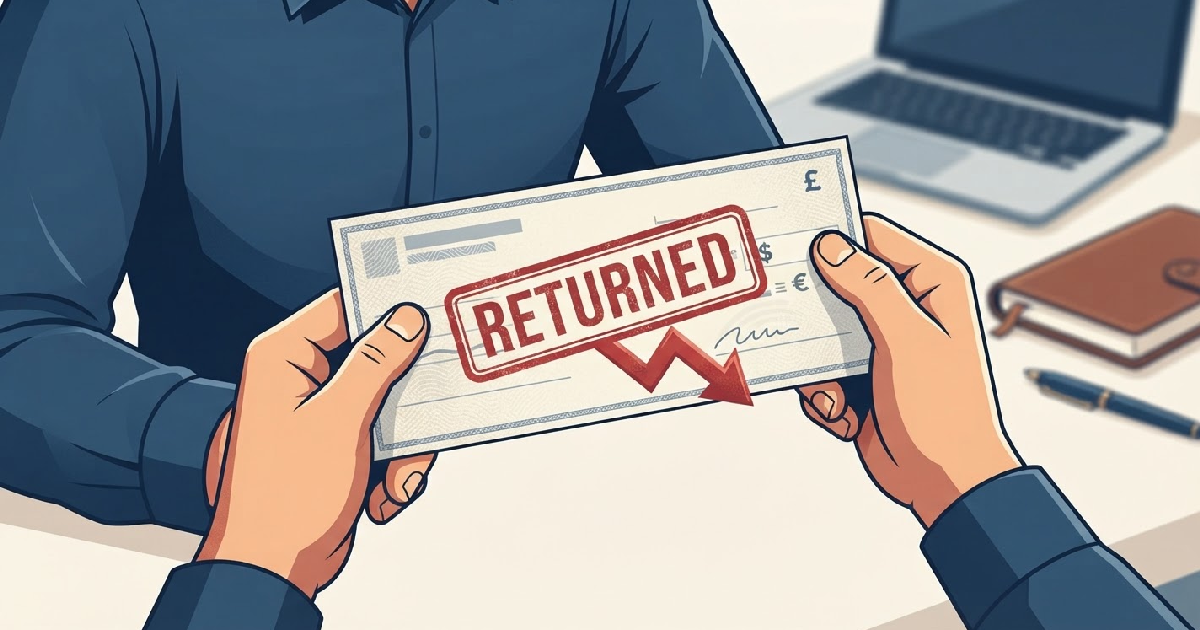
When a bank refuses to process a cheque for payment, commonly known as a bounced cheque, it triggers a cascade of financial and potentially legal issues. This most often happens because the cheque writer, or drawer, lacks sufficient funds in their account to cover the amount.
However, a mismatched signature, an incorrect date, a stop payment order, or even a closed account can also cause the refusal.
The Mechanics of a Cheque Dishonour
Understanding the precise mechanics and consequences of a dishonoured cheque is crucial for anyone involved in financial transactions in 2026. This guide outlines the process, clarifies the fees involved, and explains the legal implications for both the drawer and the intended recipient, known as the payee.
A bounced cheque, also referred to as a dishonoured or returned cheque, means the drawee bank cannot fulfill the payment instruction. Insufficient funds (NSF) in the drawer’s account is the primary reason this occurs. Still, other issues like a signature mismatch can also lead to rejection.
The process starts when the drawer writes a cheque to the payee. The payee then deposits this cheque into their own bank, often called the collecting bank. This bank then sends the cheque, or an electronic image, to the drawee bank for payment verification.
How Cheques Move Through the System
The drawee bank undertakes a verification process. It checks the cheque’s details against the drawer’s account information, confirming the signature, date, and most importantly, the availability of sufficient funds. This step is a formal demand for payment, known as presentment.
If the drawee bank identifies an issue, it will “dishonour” or “bounce” the cheque, refusing to transfer funds. The bank then notifies the collecting bank, providing a specific reason code. The clearing process typically takes one to five business days.
When a Transaction Fails
After the cheque bounces, the collecting bank informs the payee and reverses any provisional credit given for the deposited cheque. The physical cheque or its image is then returned. If funds were made provisionally available and the cheque subsequently bounces, the bank reclaims those funds from the payee’s account.
Both the drawer and the payee may incur fees from their respective banks in these situations. This can make a seemingly simple transaction unexpectedly costly. Knowing the cheque clearance time can help manage expectations.
Financial Fallout for Drawers and Payees
A dishonoured cheque carries immediate financial repercussions for everyone involved. Banks typically levy non-sufficient funds (NSF) fees on the drawer. Beyond these direct charges, there are broader consequences impacting financial standing and relationships.
“Bouncing a check can lead to financial penalties, damaged relationships with payees, and credit and legal issues,” according to PNC Insights. These impacts extend beyond the immediate transaction, affecting future banking services and credit access.
Bank Fees and Merchant Charges
In the United States, NSF fees for the drawer can range from approximately $15 to $30. Some US banks have eliminated these fees entirely. Merchants may also charge additional fees, often between $25 and $40, for returned cheques.
Canadian federal regulations, effective March 12, 2026, cap NSF fees on personal accounts at $10 per occurrence. Banks in Canada are allowed only one NSF fee per account over two business days. Furthermore, they’re prohibited from charging an NSF fee if the overdraft amount is under $10.
Broader Financial Consequences
For the drawer, repeated instances of bounced cheques can severely damage their banking relationship and credit standing. Banks might close accounts or refuse future services. Payees also face inconveniences and potential fees from their own banks when deposited items are returned.
This situation underscores the importance of diligent account management. Overdraft protection or coverage services can act as a crucial buffer. These services prevent a cheque from bouncing by covering transactions, usually for an associated fee.
Navigating the Legal Landscape of Bounced Cheques
The legal implications of a bounced cheque extend beyond just fees and damaged credit. In many jurisdictions, writing a cheque with insufficient funds can lead to significant legal action. This includes civil lawsuits to recover the amount owed, along with damages and additional charges.
Some legal systems even treat repeat or intentional instances of cheque bouncing as criminal offenses. This is especially true if there’s an element of fraud involved. Understanding these bad cheque laws is essential for all parties.
Legislative Frameworks and Definitions
Legislative frameworks, such as the Uniform Commercial Code (UCC) in the US or the Negotiable Instruments Act, 1881, in India, govern the rights and responsibilities associated with cheques. These codes provide the legal structure for commercial transactions involving negotiable instruments.
For example, the UCC defines “presentment” as “a demand made by or on behalf of a person entitled to enforce an instrument… to pay the instrument.” Such legal definitions are fundamental to how courts handle disputes arising from dishonoured instruments. It’s also important to be aware of the statute of limitations for these cases.
| Type of Fee | Typical US Range | Canadian Federal Cap (as of Mar 12, 2026) |
|---|---|---|
| Drawer’s NSF Fee (Bank) | $15 – $30 | $10 per occurrence |
| Merchant’s Returned Cheque Fee | $25 – $40 | Not specified by federal regulation |
| Payee’s Returned Cheque Fee (Bank) | Can also be charged (no specific range) | Not specified by federal regulation |
Protecting Yourself from Dishonoured Cheques
For those writing cheques, utilising services like overdraft protection or overdraft coverage can prevent a cheque from bouncing. Overdraft protection automatically transfers funds from a linked account. Overdraft coverage allows the bank to cover transactions that exceed the balance, typically for a fee, even without a linked account.
Regularly monitoring account balances and reconciling statements also helps avoid unexpected shortfalls. For payees, it’s wise to verify the drawer’s identity and trustworthiness before accepting a cheque, particularly for large sums. Always confirm funds have fully cleared before acting on the payment, as provisional credit can be reversed.
What does it mean if a cheque bounces?
If a cheque bounces, it means the bank has refused to process it for payment. This usually happens because the account lacks sufficient funds, but other reasons include a mismatched signature, an incorrect date, a stop payment order, or a closed account.
What are the immediate consequences for the cheque writer?
The cheque writer will typically incur a non-sufficient funds (NSF) fee from their bank. In the US, this ranges from $15 to $30, while in Canada, federal regulations cap it at $10 per occurrence. Merchants may also charge additional fees, often between $25 and $40 in the US.
Can I face legal action if my cheque bounces?
Yes, depending on the jurisdiction and circumstances. While initial instances might only lead to fees, intentionally writing bad cheques or repeated offenses can result in civil lawsuits to recover the debt and associated costs. In some cases, particularly with intent to defraud, it could lead to criminal charges.