
You can cash a cheque without a bank account at various locations, including many grocery stores and check-cashing services. 2% of U.S. households, representing about 5.9 million people, that are currently unbanked, knowing how to cash a cheque without a bank account is a vital financial skill. While a traditional bank account offers the most convenient and cost-effective way to handle funds, alternative services exist for those operating outside the conventional banking system.
These options, though often involving specific fees and identification requirements, provide crucial access to funds for millions. Understanding each method’s mechanics and associated costs helps in making informed financial decisions.
Understanding financial instruments for funds access
Before exploring the various cheque-cashing methods, it’s essential to define the fundamental financial instruments involved. Both cheques and bank accounts are central to managing money.
What is a cheque?
A cheque is a written, dated, and signed instruction to a bank or financial institution. It directs the bank to pay a specified sum of money from the drawer’s account to a named person or entity, or to the bearer.
This negotiable instrument allows for the transfer of funds without the need for physical cash. It serves as a critical tool in many financial transactions.
What is a bank account?
A bank account is a formal financial arrangement made with a bank or other financial institution. It enables an individual or entity to store money securely and manage various financial transactions.
These transactions include depositing and withdrawing funds, making payments, and transferring money. It forms the backbone of personal and commercial finance for most people.
Navigating cheque cashing options without a bank account
Several pathways exist for individuals who need to cash a cheque but do not have a traditional bank account. Each method has its own set of procedures, fees, and identification requirements.
Cashing at the issuing bank
Cashing a cheque directly at the bank it was drawn on is frequently the most economical choice. The issuing bank will often cash “on-us” cheques, those written by their own customers, even for non-account holders.
You’ll need to visit a branch in person, presenting a valid government-issued photo ID such as a driver’s license, state ID card, passport, or military ID. The bank verifies funds and your identity.
Fees for this method typically range from $5 to $8 for cheques over $50. Bank of America and Chase, for example, charge $8, while Wells Fargo charges $7.50.
PNC Bank may not charge fees for cheques $25 or less, but it charges 2% for amounts greater than $25. Regions Bank charges 1.50% of the cheque amount (with a $5 minimum) for printed payroll and government cheques, and 4% (with a $5 minimum) for other cheque types.
Hanna Horvath, CFP and Managing Editor at Bankrate, recommends starting with the issuing bank. She states, “They have the most incentive to help you since it’s their customer’s check, and their fees are usually more reasonable than check-cashing stores.”
Retailer cheque cashing services
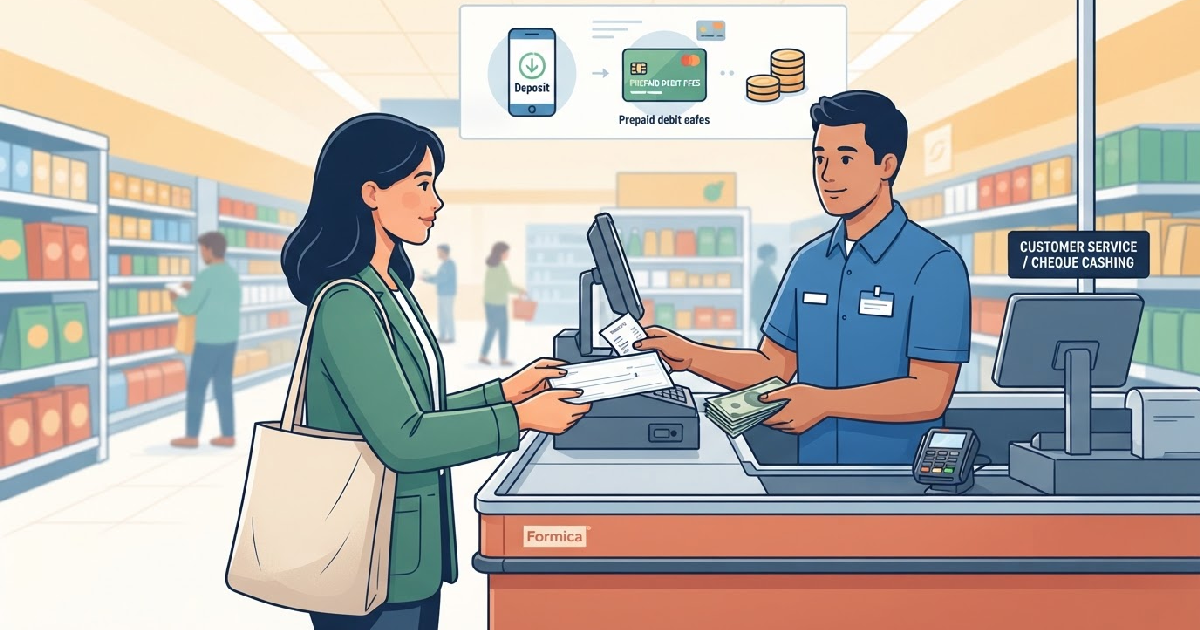
Many major national retailers and grocery store chains also provide cheque-cashing services, often at their customer service desks or money centers. Walmart and Kroger are prominent examples.
You’ll need the physical cheque and a government-issued photo ID. Some locations might also request a Social Security number, a thumbprint, or proof of address for verification.
Walmart charges $4 for cheques up to $1,000 and $8 for cheques over $1,000. Its maximum cash limit per transaction is $7,500, a limit that applies between January and April.
Retailers typically limit personal cheques to $200-$500, while government cheques often have higher limits. Many Walmart locations offer extended operating hours, providing convenient access outside standard banking hours.
Specialized cheque-cashing stores
Businesses like ACE Cash Express, Check Into Cash, and Amscot specialize in cashing cheques for individuals without bank accounts. These establishments are widespread, but generally come with higher costs.
You’ll need your cheque and identification. Some services may only require the cheque itself, particularly if you lack a government-issued ID or are under 18, though ID is usually required. This method is often the most expensive option.
Fees can range from 1% to as much as 10% of the cheque’s value. A $500 cheque, for instance, could incur a $50 fee, significantly reducing the amount received. Fees can vary by state regulations and cheque type.
Leveraging prepaid debit cards
Prepaid debit cards offer another avenue for accessing cheque funds without a traditional bank account. You can load funds from a cheque directly onto these cards.
Some cards allow direct deposit, while others enable deposits via ATM or mobile app by taking a picture of the cheque. Be aware of potential monthly maintenance fees and reload charges associated with these cards.
Mobile cheque load services may offer free standard clearance. However, instant clearance typically carries a fee, such as 0.5% to 1.75% for Cash App, or 2% with a minimum of $5 for expedited cheques with Netspend. Understanding these varying fee structures is essential.
Using mobile cheque-cashing apps
Several mobile applications, including PayPal, Cash App, Venmo, and Ingo Money, facilitate remote cheque deposits. Users typically take a photo of the cheque, and the funds are then loaded onto an app balance or linked prepaid card. Navigating mobile cheque deposit has become increasingly popular for its convenience.
Instant access to funds through these apps usually incurs a fee, often ranging from 1% to 5% of the cheque amount. Standard processing, which can take several business days, is frequently offered for free.
Cash App provides free standard clearance but charges 0.5% to 1.75% for instant clearance. It sets mobile deposit limits at $3,500 per cheque and $7,500 per month.
PayPal and Venmo charge a 1% fee for government cheques and 5% for all other cheques. PayPal has a limit of $5,000 per cheque and a monthly limit of $15,000 for mobile cheque deposit.
For payroll and government cheques under $250, the Ingo Money App charges a $5 fee; over $250, it charges 2% of the transaction. For other cheques, it charges $5 for values under $100, or 5% of the transaction for cheques over $100.
Account setup typically requires endorsing the cheque, providing personal information, and submitting a government ID. For detailed guidance on proper endorsement, review cheque endorsement safety tips.
Signing over a cheque to a trusted individual
As a last resort, you can endorse a cheque by writing “Pay to the order of [their name]” on the back, signing it, and then having a trusted friend or family member cash it. They would use their own bank account and identification.
It’s important to note that not all banks accept third-party cheques. Some financial institutions may also require both you and the individual to be present with valid identification. This method relies heavily on trust and isn’t universally accepted.
Comparative costs and requirements for unbanked cheque cashing
The choice of where to cash a cheque without a bank account significantly impacts the fees incurred. Understanding these costs and requirements is crucial for making an informed decision, particularly for those managing finances carefully.
| Method | Typical Fees | Key Requirements | Max Cheque Limit (General) |
|---|---|---|---|
| Issuing Bank | $5-$8 (cheques > $50) or 1.5-4% | Valid government-issued photo ID, in-person visit | Varies by bank’s policy |
| Major Retailers (e.g., Walmart) | $4 (up to $1,000); $8 (over $1,000) | Physical cheque, government-issued photo ID | Up to $7,500 (Walmart, Jan-Apr) |
| Cheque-Cashing Stores | 1-10% of cheque value | Cheque, ID (sometimes waived) | Varies widely by store/state |
| Prepaid Debit Cards | Fees vary by card/service, some free standard clearance | Physical cheque or photo of cheque, account setup | Varies by card provider |
| Mobile Cheque-Cashing Apps | 0.5-5% for instant clearance; standard often free | Endorsed cheque, app account, government ID for setup | $3,500-$5,000 per cheque (app specific) |
General requirements and important considerations for cheque cashing
Regardless of the chosen method, several universal requirements and considerations apply when cashing a cheque without a bank account. Adhering to these guidelines can help prevent delays or outright rejections.
Identification is essential
Most locations rigorously demand a valid, government-issued photo identification. This typically includes a driver’s license, state ID card, passport, or military ID. Some services may also ask for a Social Security number or proof of address for additional verification, securing safely depositing and cashing a cheque.
Cheque validity and endorsement
The cheque must be made payable directly to you and must be properly signed by the payer. Crucially, it must not be expired; most personal cheques remain valid for 180 days. Proper endorsement is necessary for all methods.
Understanding fee structures transparently
Fees for cashing a cheque without a bank account vary widely across different services. These charges can range from free, for some mobile app standard clearances, to as much as 10% of the cheque’s total value. Always confirm the exact fee before proceeding to avoid unexpected costs.
Financial inclusion and its implications
The persistence of financial exclusion for the unbanked segment of the population underscores the necessity of these alternative financial services. While they offer convenience, the higher fees often associated with these methods can disproportionately affect those who can least afford them, potentially exacerbating financial strain.
Efforts aimed at promoting financial literacy and expanding access to affordable, traditional banking services remain critical. Such initiatives can help bridge the gap for millions who currently rely on these costlier alternatives, fostering a more inclusive financial landscape for all.
What is the cheapest way to cash a cheque without a bank account?
Cashing a cheque at the issuing bank is generally the cheapest option available. Fees typically range from $5 to $8 for cheques over $50, with some banks like PNC charging 2% for amounts greater than $25, and Regions Bank charging 1.50% (with a $5 minimum) for payroll/government cheques or 4% (with a $5 minimum) for other types.
Can I cash a personal cheque at Walmart without a bank account?
Yes, Walmart does offer cheque-cashing services for personal cheques without requiring a bank account. They charge $4 for cheques up to $1,000 and $8 for cheques over $1,000. Retailers typically limit personal cheques to $200-$500.
What identification do I need to cash a cheque without a bank account?
Most locations require a valid government-issued photo ID, such as a driver’s license, state ID card, passport, or military ID. Some services may also ask for a Social Security number, thumbprint, or proof of address for additional verification.